Freigang Banned 16 Months, Misses World Cup
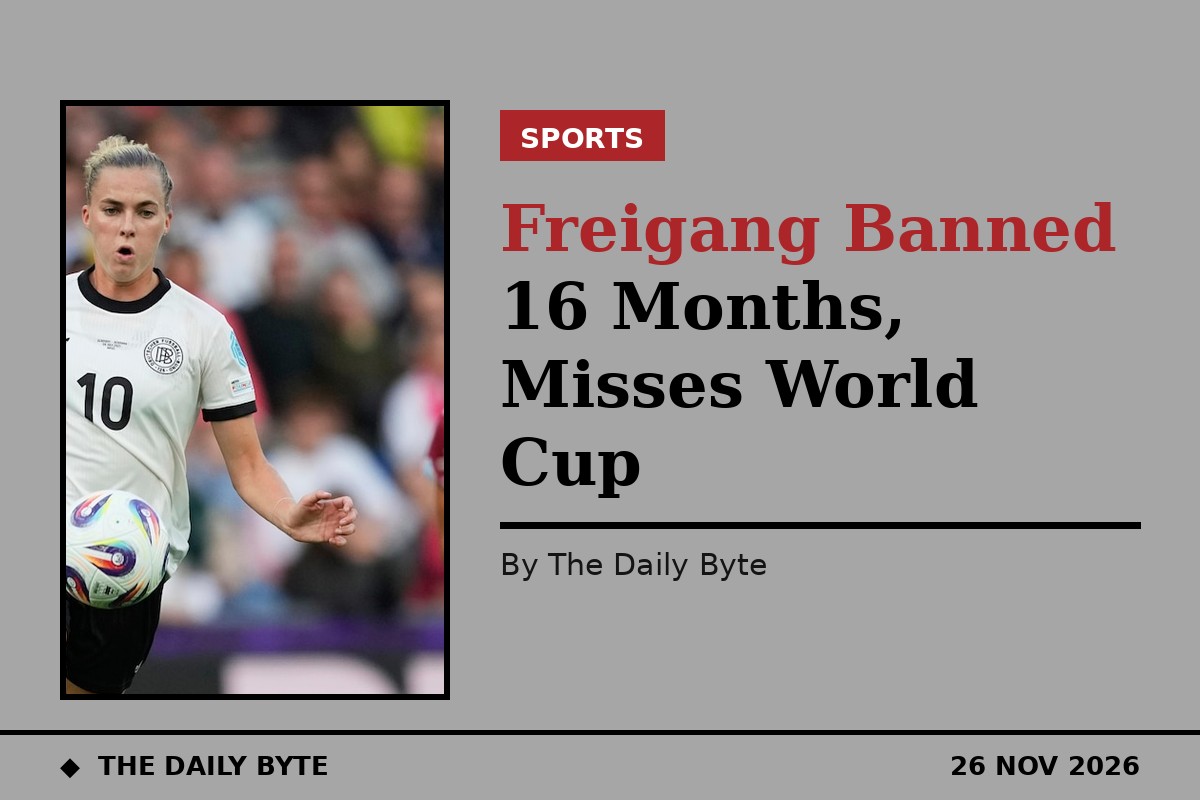
Germany forward Laura Freigang has been suspended for 16 months after committing three anti-doping whereabouts failures, ruling her out of next year's Women's World Cup in Brazil.
The German Football Association (DFB) announced the suspension on Thursday 26 November. Freigang, 28, accepted a case resolution agreement reached between the World Anti-Doping Agency (WADA), Germany's National Anti-Doping Agency (NADA), the DFB and herself.
The ban is backdated to 8 June 2026, the date she was notified of the case, and runs until 7 October 2027. She will be allowed to train with a team again from 8 August 2027 and to return to competitive play from 8 October 2027, more than two months after the World Cup ends.
What Freigang did wrong
The case centres on whereabouts failures, not a failed drugs test. Under the World Anti-Doping Code, athletes in the testing pool must keep their location details up to date so testers can find them for no-notice, out-of-competition testing. Three failures in a 12-month period amount to an anti-doping rule violation under Article 2.4 of the code.
Freigang committed three failures to comply with reporting or testing requirements between 11 March 2025 and 23 February 2026. She has said the missed tests came down to inconsistencies and misunderstandings around the daily updating of her whereabouts information.
A ban of up to two years was possible. The 16-month suspension was agreed as a settlement, avoiding a full disciplinary hearing. All of her individual competitive results since 23 February 2026 are disqualified, with medals, honours, points and prizes forfeited. Her teams' results in the relevant matches are unaffected.
Freigang stressed that she was never accused of taking a banned substance. "It's important to me to emphasise once again that I was never suspected of doping at any point," she wrote on Instagram after the announcement.
"I am aware of my responsibility regarding my reporting obligations and the importance of clean sports. At the same time, my case wasn't always as black and white as it might have appeared from the outside. My agreement to a settlement does not mean that I share all the assessments of my case."
A World Cup place lost
The timing of the ban is brutal for Freigang. The Women's World Cup in Brazil starts on 24 June 2027, and she will still be suspended when it is played. Germany won the tournament in 2003 and 2007, and Freigang, who has scored 17 goals in 45 appearances for her country, would have expected to be part of the squad.
She played at the previous World Cup, the European Championship and the Olympics, and captains Eintracht Frankfurt, who are third in the Frauen-Bundesliga. Her contract with the club runs until June next year, leaving her club future uncertain while she serves the suspension.
Whereabouts cases are rare at the top of women's football, and the length of the ban underlines how seriously the authorities treat the system. The testing regime only works if athletes can be found without warning, and repeated failures to be where the paperwork says they will be are treated as a serious breach even when no banned substance is involved.
For Germany, the loss is a sporting one as well as a reputational one. Freigang is an established international forward, and head coach Christian Wuck must now plan for a World Cup without a player who has been a regular in the squad. For Freigang herself, the next competitive football she plays will come in October 2027, almost 20 months after her last whereabouts failure.