Le Pen vows tougher penalties for journalists
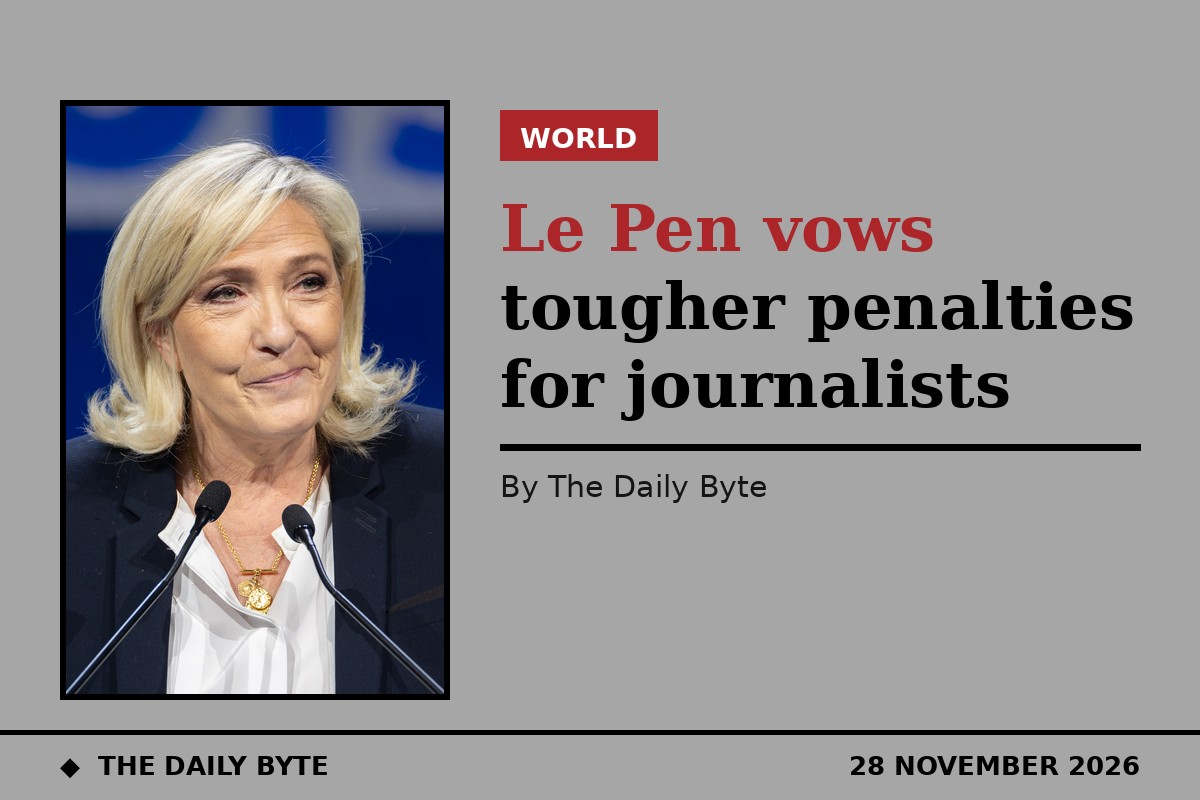
Marine Le Pen has pledged to increase penalties for journalists who publish material obtained through breaches of the secrecy of criminal investigations, if she is elected president of France in 2027, in a move that has put press freedom at the centre of the French election campaign.
Speaking at a press conference on Friday 27 November to present her manifesto for France's overseas territories, Le Pen said the media would no longer be able to publish confidential material from investigations and judicial inquiries with what she called total impunity. She promised to increase the existing penalties for journalists convicted of receiving such information.
A pledge made under pressure
The remarks came as her party, the National Rally, faces several judicial investigations, including inquiries into its campaign financing. In recent days, Le Monde and Mediapart have published new material about antisemitic messages attributed to Jordan Bardella, the party's president, who denies writing them. At the same press conference, Le Pen reaffirmed her confidence in Bardella, answering simply yes when asked whether he still had her trust.
Le Pen described the methods of the media investigating her party as scandalous in the middle of a presidential campaign. She said that when she is president, it will be about respect for the secrecy of investigations and judicial inquiries, and that newspapers are full of material obtained through breaches of that secrecy.
What the law already says
French law already carries heavy penalties in this area, a point Le Monde made in its analysis of her pledge. Journalists are not themselves bound by the duty of confidentiality that applies to judges, court clerks, police officers, gendarmes and court-appointed experts. But receiving information obtained through a breach of investigative secrecy can be punished with up to five years in prison and a fine of 375,000 euros. If the offence is committed repeatedly or as part of an organised group, the penalty rises to ten years in prison and a fine of 750,000 euros. Breaching the secrecy itself carries up to three years in prison and a fine of 45,000 euros.
Given the severity of those sanctions, Le Monde noted, it is difficult to see how the existing penalties could be increased further. To prosecute a journalist, it must also be proven that the published material actually came from a criminal offence, specifically a breach of investigative secrecy. The scope of that secrecy is limited to investigative acts and the duration of the investigation, and it does not prevent journalists from reporting on criminal proceedings or describing the stages of an investigation.
The European Court of Human Rights, whose case law is binding on France, has traditionally protected press freedom strongly, and any change would have to be tested against France's constitutional protections for the press and the confidentiality of sources.
Le Pen's remarks come at a sensitive moment for her own political future. Following an appeal trial in 2026, her guilt in a separate case was upheld, but the sentences were suspended or reduced, allowing her to stand in the 2027 election. She is the National Rally's candidate for the presidency, and the party is leading in early polling for the 2027 race.
The pledge also follows the dismissal this week of a senior civil servant over suspected leaks to the National Rally. Hugues Moutouh, the former secretary general of the Interior Ministry, was dismissed as prefect of the Centre-Val de Loire region on 25 November after suspicions emerged that confidential information had been leaked to the party. He has not been indicted and remains presumed innocent.
Whether Le Pen's promise becomes a central plank of her campaign or remains a response to a difficult week for her party, it has set up a direct argument about the balance between the secrecy of judicial investigations and the freedom of the press, an argument that is likely to run through the French presidential campaign.


