Lebanon seeks UNIFIL role beyond mandate end
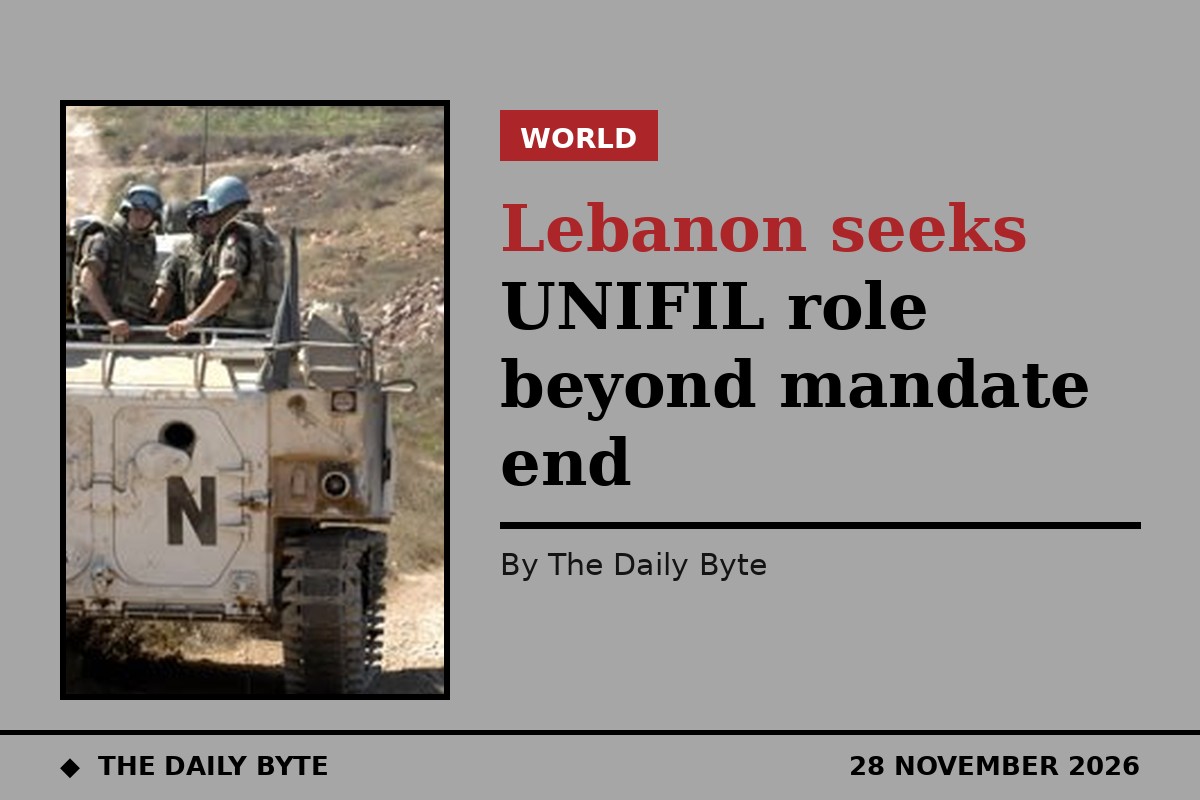
Lebanon's prime minister says a new proposal is in the works that could allow the United Nations peacekeeping force in southern Lebanon to keep carrying out some of its duties after its mandate expires at the end of the year.
Prime Minister Nawaf Salam told The Associated Press in an exclusive interview in Beirut on Friday that France is preparing to introduce a resolution at the UN Security Council that would let the force, known as UNIFIL, continue functions such as clearing mines, escorting humanitarian convoys and monitoring violations during a drawdown period, while the Council debates what should replace it.
Salam said US officials had indicated that Washington could be "open to considering" such an arrangement.
"This would not resolve the problem of so-called post-UNIFIL, but it will give us some extra time to agree on a new architecture in southern Lebanon," Salam said at the government palace in Beirut.
No plan in place for what comes next
The UN Security Council voted last year to terminate UNIFIL's mandate at the end of 2026, bowing to demands from the United States and its close ally Israel, which argued that the force had failed to stop Hezbollah's military build-up in southern Lebanon.
UNIFIL officials say they were never charged with disarming Hezbollah and that the force helped to preserve calm in the border region for 17 years before Hamas's 2023 attack on southern Israel ignited a regional war.
The 7,500 peacekeepers currently stationed in southern Lebanon are expected to gradually withdraw over about six months after the mandate expires.
A Western diplomat said one option under discussion is to slow down the withdrawal and "maintain certain UNIFIL missions" to avoid a power vacuum. France has not publicly commented on the proposal.
Stalled withdrawal and disarmament
Much of southern Lebanon remains occupied by Israeli forces after a war broke out in March between Israel and the Lebanese militant group Hezbollah, which is backed by Iran. Hezbollah has refused to give up its weapons, and Israel says it will not withdraw before the group is disarmed.
Lebanon and Israel reached an agreement in June under which Israeli forces were supposed to gradually withdraw and hand over control to the Lebanese army, while Hezbollah was to be disarmed. Implementation has stalled, as have talks between the two countries.
Salam denied that the talks had collapsed but said the "formal negotiations were put on hold" because of the Israeli elections and uncertainty about the next government.
Salam said that "any force to be deployed will have to be endorsed by the Security Council".
A region 'in flux'
Salam said that with the wider Middle East and especially his region "in flux", it is hard to make definitive plans. Efforts are still under way to form a new government in Israel following last month's elections, and it remains unclear whether the US-Iran war is heading towards a new escalation or a negotiated solution. Iran is Hezbollah's main backer.
While the Lebanese government has insisted that its negotiations with Israel are separate from any US-Iran deal, Salam acknowledged that "the relation between the US and Iran directly affects the situation in Lebanon".
"Lebanon is not an isolated island in the Mediterranean," he said. "We are very much influenced by developments in the region. The whole region is in turmoil."
On Hezbollah, Salam said his government has open lines of communication with the group and with Iran but will not "allow the future of the country to be contingent on Iran's wishes".
Hezbollah, which has suffered a series of major blows in two recent wars with Israel, seems to be "more and more dependent on Iran" and continues to receive some military and financial assistance from Tehran, Salam said.
Since the ouster of Syria's Iran-allied former president Bashar Assad two years ago, the flow of arms from Iran to Lebanon via Syria has slowed but not stopped, Salam said.
Hezbollah has threatened to fight any attempt to forcibly disarm it, and the Lebanese army has so far moved cautiously. "Definitely we are not seeking confrontation with Hezbollah," Salam said. "But we will not succumb to the intimidation of Hezbollah."


