Lee Approves Special Counsel Law on Own Cases
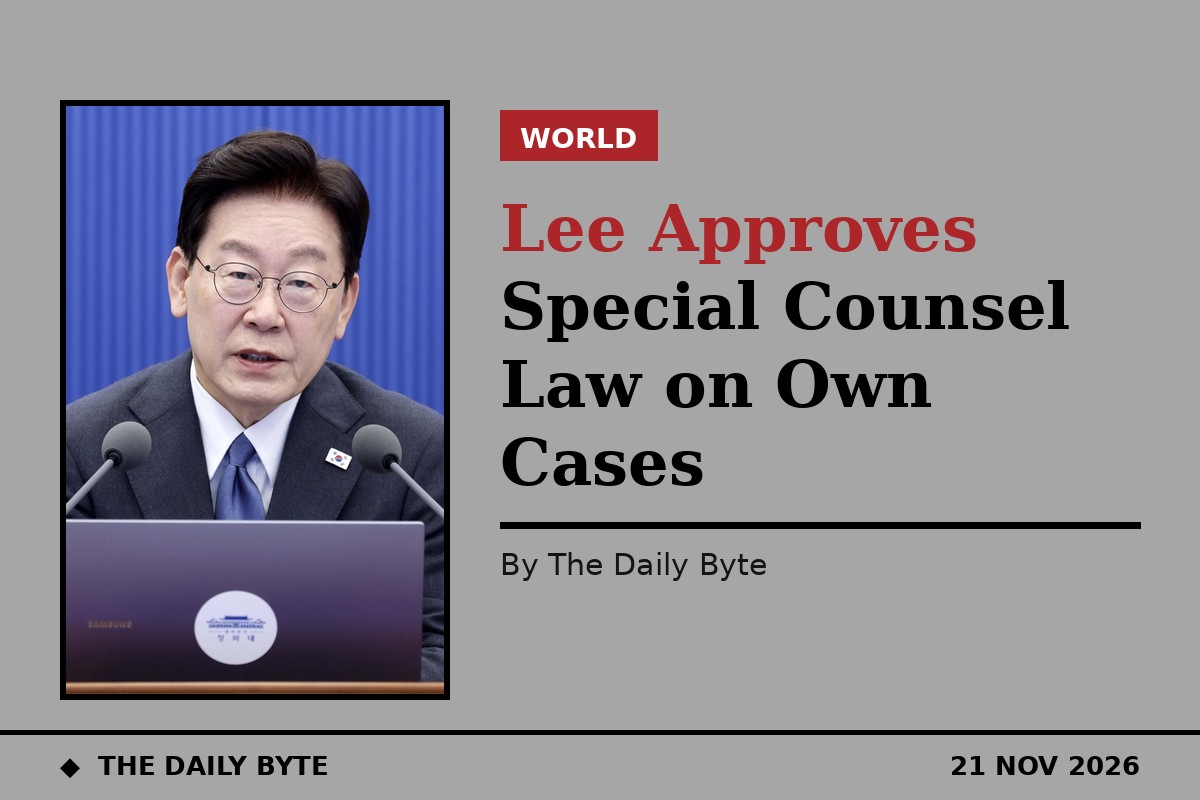
South Korean President Lee Jae Myung has approved a special counsel law covering cases tied to himself, bringing into force legislation that will examine how prosecutors handled investigations into him — and drawing accusations of a conflict of interest.
The National Assembly passed the bill on 6 November under the leadership of the ruling Democratic Party. The Cabinet approved it for promulgation on 17 November at a meeting chaired by Prime Minister Han Sung-sook while Lee was abroad. Lee then authorised its promulgation electronically from overseas, and the law took effect on 19 November, ahead of a Saturday deadline.
What the special counsel will examine
The law sets up a special counsel investigation into allegedly fabricated indictments. Of the 12 matters subject to investigation, six involve cases connected to Lee himself. The inquiry will look into whether there was evidence tampering, inducement of testimony, or abuse of investigative and prosecutorial powers in the handling of cases involving Lee.
Those cases include the Daejang-dong, Wirye and Baekhyeon-dong development projects, sponsorship of the Seongnam FC football club, and the Ssangbangwool cash transfer to North Korea. Lee pushed the Daejang-dong project as mayor of Seongnam, and faces a breach of trust indictment over it.
Who picks the counsel
Under the law, the Democratic Party, the People Power Party and the Rebuilding Korea Party each recommend one candidate, from whom Lee will appoint one as special counsel. The main opposition People Power Party has said it will not recommend a candidate, and has criticised the law as a “Lee Jae-myung jailbreak law”. That leaves nominations solely to the Democratic Party and the Rebuilding Korea Party, both aligned with the administration.
The arrangement has drawn sharp criticism in the press. An editorial in the Korea JoongAng Daily said that for Lee, who is personally involved in the cases, to appoint a special counsel recommended by parties aligned with his administration “constitutes a clear conflict of interest”, adding that it “violates a fundamental principle of the rule of law: no one should serve as a judge in their own case”. The editorial argued that the controversy raises questions about whether the investigation can command public confidence.
Lee's defence
Lee defended himself the day after the law took effect. Speaking at a senior secretaries' meeting on 20 November, and posting on X, he said the Daejang-dong development project had returned 550 billion won — about 376 million dollars — in development gains to the public, and questioned how his indictment on breach of trust charges could stand.
“If granting a development permit and clawing back 550 billion won for the public is a breach of trust, then what about ordinary development permits where private developers take 100 percent of the gains with nothing returned to the public?” he wrote. He posted the comment alongside a clip of attorney Jung Min-yong, who worked on the Daejang-dong project, describing a prosecutor as having said the project “went well” but that prosecutors had “our own job to do”.
A crowded week at home
Lee returned home on 19 November from a four-day trip to the Philippines and China, where he attended the ASEAN and APEC summits, held his fourth summit with Japanese Prime Minister Sanae Takaichi, and met Russian President Vladimir Putin for the first time since taking office. Back home he also faced fears of AI-assisted cheating on the College Scholastic Ability Test, the national university entrance exam held on 19 November, and ordered a full overhaul of the national examination system. The special counsel law lands in the middle of that crowded agenda — and its credibility will now depend on a process in which the president appoints the investigator of his own cases.


