Lee Jae Myung Vows to Fix Korea's Undervalued Stocks
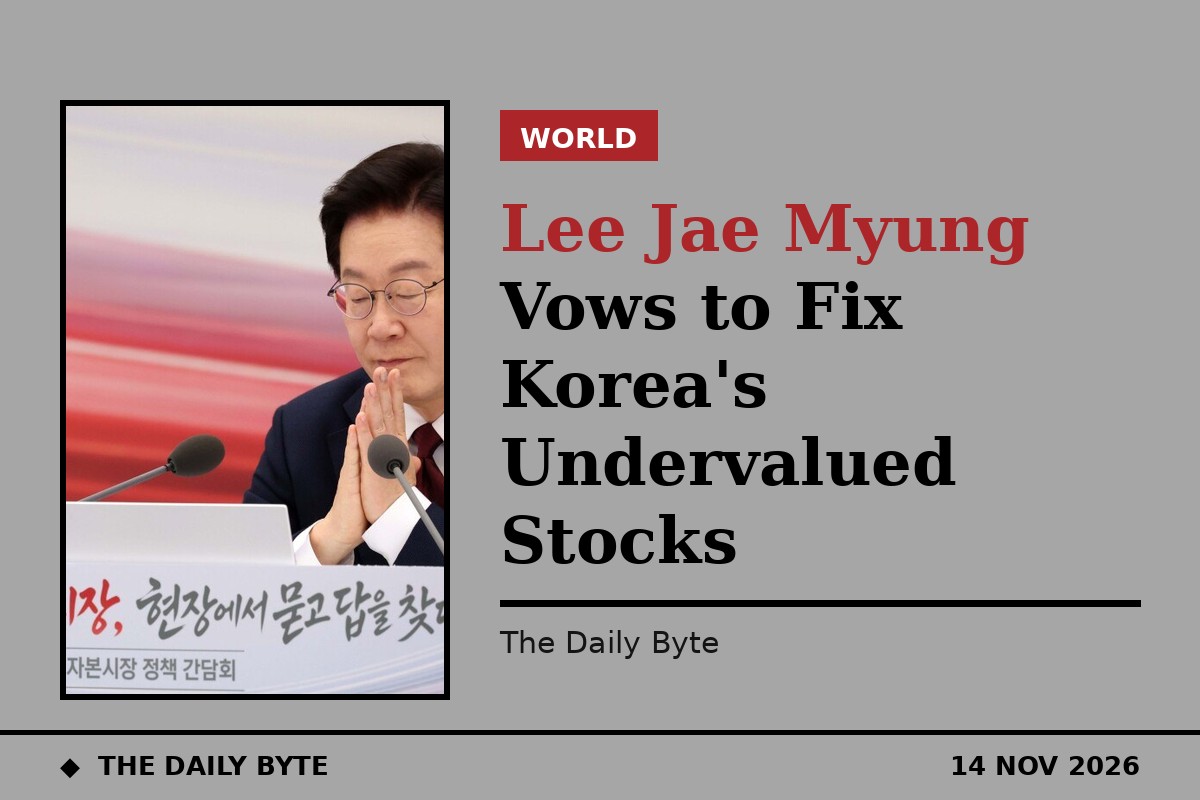
South Korean President Lee Jae Myung has vowed to end the persistent undervaluation of the country's stocks, ordering a review of barriers to hostile takeovers and the creation of a high-level reform body as the market reels from a sharp slide. "Normalizing the capital market is our government's unwavering policy direction and commitment," Lee said at a policy meeting at the Korea Exchange in Seoul on Friday.
Lee chaired the meeting in Yeouido, western Seoul, with experts, corporate representatives and government officials, in his second visit to the exchange as president. The benchmark KOSPI index reached an all-time closing high of 9,114.55 points in late June, but has since fallen back into the mid-5,000-point range. On 6 November the index plunged 6.02 per cent to close at 5,059.69, barely holding the 5,000 line, while the Kosdaq fell 5.03 per cent to 644.27.
Hostile takeovers as the key tool
Lee called hostile takeovers the most powerful tool for normalising a market he says undervalues Korean companies, a gap often called the Korea discount. "The biggest mechanism for normalizing the market is hostile takeovers, but Korea harbors hostile feelings toward hostile takeovers, right?" he said. "Conduct a full survey of whether any mechanisms are blocking hostile takeovers, and find ways to encourage them."
He also backed a mandatory tender offer rule that would let minority shareholders share in the control premium in a takeover. The ruling Democratic Party and the government are discussing a revision capping the mandatory purchase at 50 per cent plus one share of a company's total issued shares, with shares bought from the largest shareholder and minority shareholders on a pro rata basis. At Lee's suggestion, participants voted by an impromptu show of hands, and most backed the 50 per cent plus one share option. "Even if I take criticism for it, I lean toward growing the pie, toward the view that every shareholder benefits only when M&A is boosted and the market as a whole is normalized," Lee said.
Delistings and a crackdown on manipulation
Lee also took aim at companies whose shares are concentrated in the hands of the largest shareholder. "Where the largest shareholder holds more than half the shares, a contest for management control is impossible, and such companies are effectively run like private companies," he said, ordering officials to review ways to remove them from the market or screen them out. He said firms with a free float below 10 per cent should be delisted, and that insolvent and underperforming companies on the Kosdaq "should be swiftly delisted".
He further ordered the creation of a high-level government body dedicated to capital market reform, with participation from the public and private sectors, reporting directly to him. "I think I made a mistake last year. Things seemed to be going so well, so easily, that I let my guard down," he said. "I will personally see to it that legislation and administrative measures alike are completed as quickly as possible."
Lee also turned to stock manipulation and other unfair trading, saying he had instructed the Serious Crime Investigation Agency, launched on 2 October, to be especially strict in its crackdown. He described the undervaluation of South Korean stocks as an "unreasonable abnormality" and said investor confidence was the most important value in a sound capital market. "The most important value in the capital market is trust. Removing worries, giving people faith, creating a reasonably predictable market: in the end, restoring that trust is the key." Lee wore a red tie to the meeting, the colour that signals rising stock prices in Korea.
Sources: K-VIBE (Yonhap) and Korea JoongAng Daily.


