LHC: Farmers can sue over fake fertiliser in court
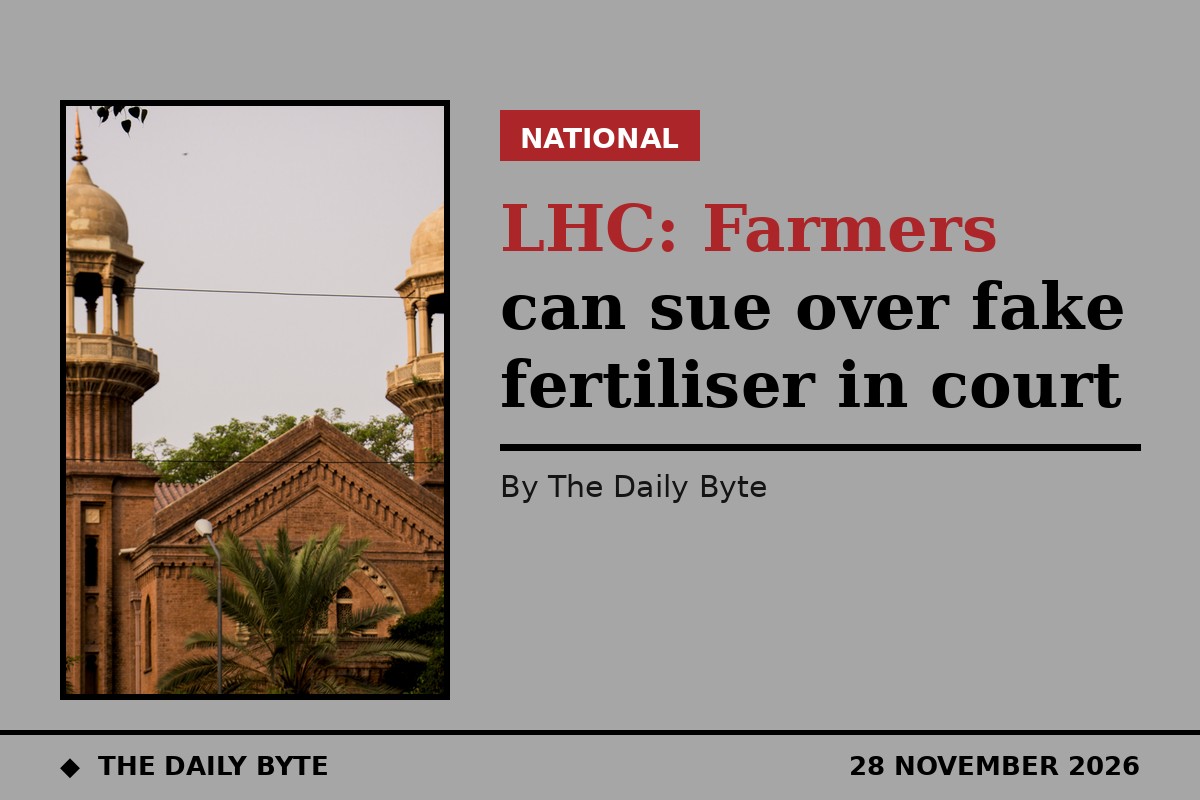
The Lahore High Court has ruled that a farmer in Punjab who buys fertiliser to grow his own crop for a living is a consumer, and can take a complaint about fake or defective fertiliser to a Consumer Court. The judgment, released on 27 November 2026, reopens a Gujranwala farmer's case that had been thrown out without a hearing.
The case, FAO No. 33128 of 2024, was decided by Justice Anwaar Hussain and approved for reporting as 2026 LHC 9197. It concerns a farmer who bought fertiliser from a commission agent in the Gujranwala grain market. The fertiliser was sold as the product of a well-known company. The farmer said that after he used it, his crop yield fell, and with it the income his family lived on.
He complained to the Consumer Court in Gujranwala. On 23 April 2024 that court dismissed the complaint at the very first stage, without hearing evidence. It held that he had bought the fertiliser for a commercial purpose, so he was not a consumer under the Punjab Consumer Protection Act, 2005. The farmer appealed to the High Court under section 33 of the Act.
The High Court allowed the appeal and sent the complaint back for a fresh hearing. Its reasoning turned on the words of the Act itself. Section 2(c) leaves out anyone who buys a product for any commercial purpose, but its Explanation says that commercial purpose does not include products bought and used only to earn a living as a self-employed person. The judge held that this Explanation must be applied to a farmer who cultivates his own land.
The court made four points that will matter to other farmers. First, fertiliser is a product under section 2(j) of the Act. Second, selling the crop is not resale of the fertiliser, because the wheat or rice grown is a different thing from the fertiliser bought. Third, earning money from a harvest does not make the buyer a business: for a self-employed cultivator, a lower yield is itself a loss of income. Fourth, there is no acreage test in the law. The Act sets no limit on the size of the land or the number of bags bought. The Consumer Court must look at the facts of each case, including how much land is involved, whether the farmer works it himself, and how the farming is run.
The court also dealt with the other side of the argument. A large agricultural company that buys fertiliser for its operations may still be buying for a commercial purpose. But that question is one for evidence, the judge said, not a reason to dismiss a complaint on the first day.
The fertiliser company had argued that if the product was counterfeit, the farmer's remedy lay under counterfeiting law and not in the Consumer Court. The High Court rejected that argument. Section 3 of the Act makes its remedies additional to those under other laws, so a farmer can report fake fertiliser to the Agriculture Department for testing and a criminal case, and can also claim damages in the Consumer Court.
The Consumer Court in Gujranwala will now decide whether the fertiliser in this case was counterfeit or genuine but defective, and which party is liable. If fake goods were sold as genuine, the seller's liability comes first, along with any link proved between the company and that stock. If the product was genuine but faulty, the rules on defective products apply. The High Court has not decided who must pay the farmer. That question is still to be heard.
Farmers who want to use the same route must first send the seller a written legal notice and give it 15 days to respond. The complaint must then be filed within 30 days, and no court fee is charged. The Punjab Consumer Protection Council's guidance says a claim should be filed in the Consumer Court of the farmer's own district, with the dealer's receipt, the batch number on the bag and a sample of the fertiliser kept as evidence.
Fake and substandard fertiliser is a recurring problem in Punjab, and the provincial Agriculture Department has been raiding factories and dealers. In one recent raid in Muridke, officials seized 100 bags of Tara Super SSP and 80 bags of BOP fertiliser from a factory said to be making counterfeit stock. The Lahore High Court's ruling gives farmers a second forum, alongside the Agriculture Department, in which to pursue the sellers.