Li Qiang Hails 'Extraordinary' China-ASEAN Ties in Manila
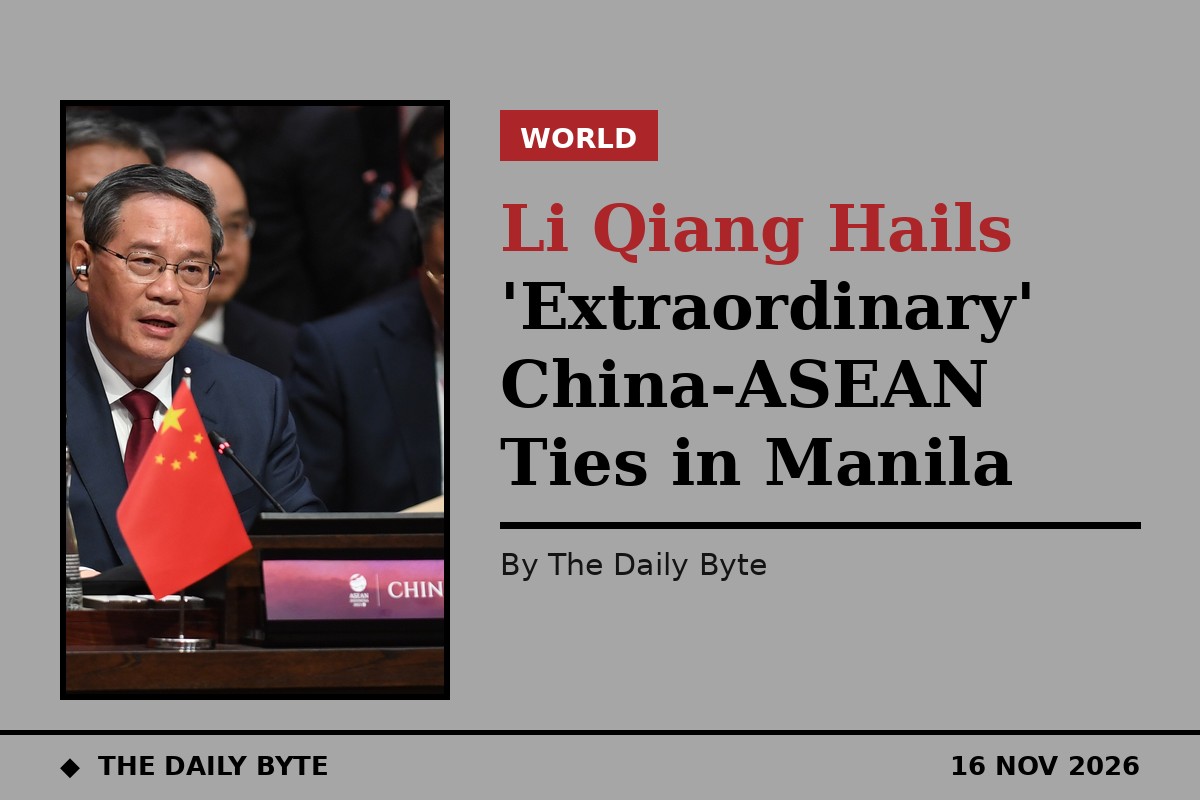
Chinese Premier Li Qiang has hailed what he called the “truly extraordinary” achievements of China and Southeast Asia, telling leaders at the ASEAN summit in Manila that Beijing remains committed to free trade even as global trade restrictions tighten.
Speaking in opening remarks to regional leaders on Monday, Mr Li said that at a time of growing unilateralism and protectionism and recurring geopolitical conflict, economic relations between China and the 11-member Association of Southeast Asian Nations had only strengthened.
“The past five years have been truly extraordinary, and the achievements we scored have not come easily,” he said, pointing to annual trade with the bloc of more than $1 trillion last year and cumulative two-way investment of more than $500 billion.
“We remain firmly committed to safeguarding multilateralism and promoting free trade and endeavor to make the pie bigger,” he added.
According to a readout by the state news agency Xinhua of his remarks in the closed-door meeting, Mr Li said that in today’s turbulent world “it is all the more important for China and ASEAN to stand united, ward off interference, and work together”.
China is ASEAN’s biggest trading partner
China is ASEAN’s biggest trading partner and a key source of investment for the bloc, whose combined economy is worth more than $3.9 trillion. But the bloc’s biggest economies are also keen to expand ties with the United States amid trade and diplomatic uncertainty under the Trump administration.
That balancing act was on full display in Manila on Monday, as the bloc held talks with the leaders of Australia, South Korea, Japan and the United Nations, while preparing for the arrival of US President Donald Trump on Tuesday.
Mr Trump is due to arrive at the tail end of the summit before travelling to the Asia-Pacific Economic Cooperation forum in Shenzhen, where a trilateral meeting with Chinese President Xi Jinping and Russian President Vladimir Putin is scheduled.
In Manila, Mr Trump will meet ASEAN leaders and attend his first meeting of the Quad group of Indo-Pacific powers — the United States, Japan, Australia and India — the first such gathering in two years. His predecessor, Joe Biden, attended six meetings of the group, which is widely considered a counterweight to China’s growing influence in the region, although its members have said it is not directed against any one country.
Protests expected as Trump arrives
Anti-Trump protests are expected when the president arrives in Manila, after four days of demonstrations by leftist groups, students and workers demanding an end to the war in the Middle East and the scrapping of the US-led Pax Silica initiative.
Japanese Prime Minister Sanae Takaichi said in a post on X that the international community was facing historic changes, and that in Manila she would promote Japan’s efforts to strengthen a free and open Indo-Pacific, in which ASEAN plays a central part.
South China Sea code still unfinished
The ASEAN leaders’ summit ended on Sunday without completing a protracted code of conduct with Beijing to try to manage simmering disputes over the South China Sea, which the Philippines, as this year’s chair, had hoped could be wrapped up this year.
Philippine Foreign Secretary Ma. Theresa Lazaro said negotiators had reached provisional agreement on about 80 per cent of the draft text, up from roughly 50 per cent when the Philippines took the chair, but that several key issues remain unresolved, including whether the code would be legally binding. She said another five to six months of talks could complete the text, with negotiations continuing under Singapore’s chairmanship in 2027.
The leaders also resolved to continue ASEAN’s policy of excluding the leaders of war-torn Myanmar from its summits, but left the door open for a return if “sustained and concrete progress” on a peace plan agreed after the coup five years ago can be demonstrated.
The meeting also saw an apology from Indonesian President Prabowo Subianto to neighbouring Singapore and Malaysia over the impact of sustained transboundary haze from forest and peatland fires that have raged for months.
Source: Reuters, via BusinessWorld.


