Libya and Boeing Sign Expanded Aviation Deal
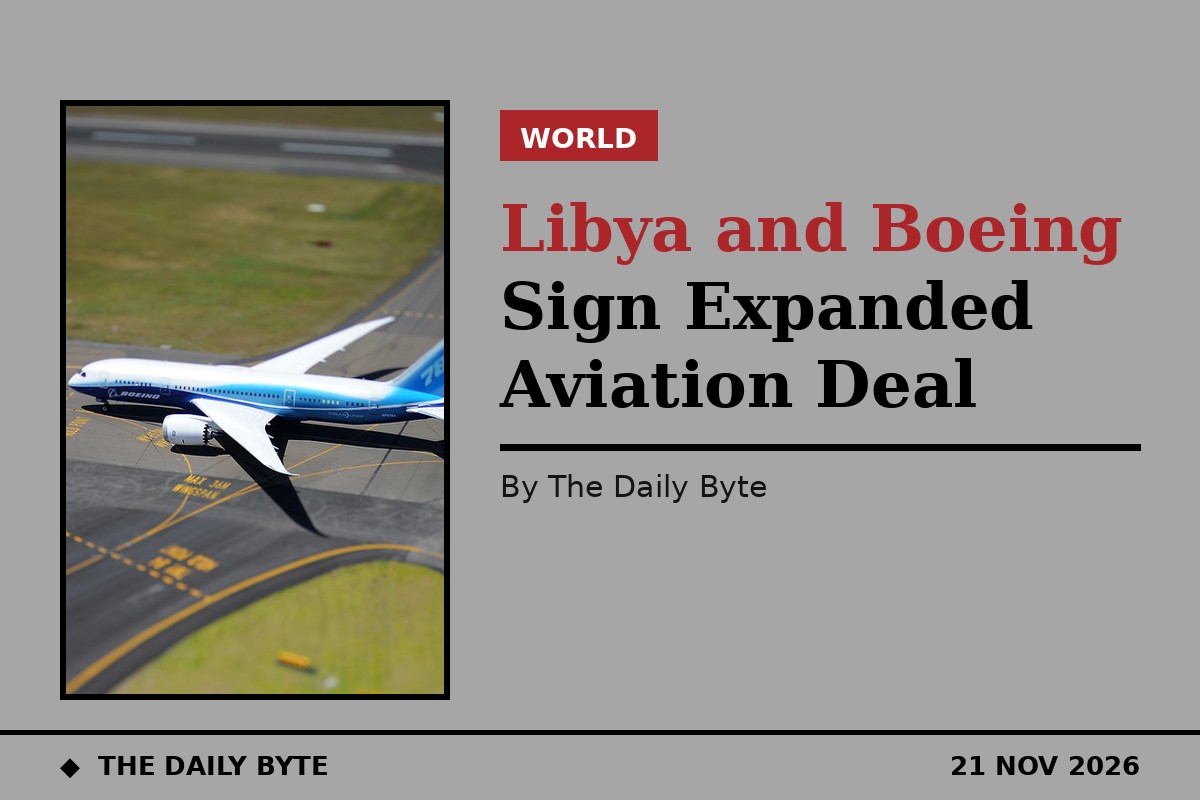
Libya and Boeing have signed an expanded memorandum of cooperation to develop Libya’s civil aviation sector, in a deal announced in Washington on Friday, 20 November. The agreement was unveiled by Massad Boulos, the United States Senior Adviser for Arab and African Affairs, after he attended the signing ceremony.
Boulos described the memorandum as an important step towards modernising Libya’s aviation industry and expanding opportunities for American businesses. He said the administration of President Donald Trump was working to open new opportunities for United States companies, encourage investment and create jobs in both countries.
A modern, well-connected aviation network could bring Libyans closer together, strengthen national institutions and support economic growth, Boulos said. He expressed hope that the memorandum would lead to a binding commercial agreement in the future. No aircraft purchase contract, investment value or implementation timetable was announced alongside the memorandum.
New airline plans behind the deal
The agreement follows months of discussions between Boeing and Libya’s Tripoli-based Government of National Unity over plans to establish a new national airline. In October, Mustafa Al-Manea, head of the government’s Executive Team for Prime Ministerial Initiatives and Strategic Projects, met Boeing representatives to review progress on the proposed carrier, covering aircraft fleet requirements, technical support, operational arrangements, training, financing and the project’s feasibility study.
A virtual meeting on 12 November had already covered the launch plan for a maintenance, repair and overhaul centre for the planned airline, including technical and operational capabilities, training programmes for engineers and technicians, and the development of local maintenance capacity to manufacturer-approved standards. The centre is also intended to target customers outside Libya. Domestic network planning was discussed at the same meeting, including target cities and airports, passenger traffic, projected demand, seat capacity and frequencies.
The government has not named the planned airline, its fleet size or aircraft type, or a launch date. It has also corrected earlier reporting that linked the government project to Libyan United Airlines, a privately owned carrier that says it is not affiliated with the government initiative.
Building on the May agreement
The expanded memorandum builds on a strategic cooperation agreement signed in May 2026, when Transport Minister Mohamed Al-Shahoubi signed the earlier deal during an official visit to Washington, at a ceremony held at the office of United States Secretary of State Marco Rubio. That agreement covered support for programmes to acquire modern aircraft, enhanced technical and technological cooperation, and the development of aviation infrastructure in line with international standards.
The partnership has been developed through a series of meetings over the past year. The two sides first met face to face in Washington in October 2025, on the sidelines of the annual meetings of the International Monetary Fund and the World Bank, and Boeing’s White Paper for the partnership was approved in December 2025. A virtual meeting followed on 11 March 2026 as part of the Libyan-American Partnership initiative.
Wider trade talks in Washington
The aviation agreement coincided with talks in Washington between Libyan officials and the Office of the United States Trade Representative on implementing the bilateral Trade and Investment Framework Agreement. Those discussions focused on regulatory and customs barriers and on facilitating the entry of American companies into the Libyan market. Both sides also explored investment opportunities in energy, mining, infrastructure and services.
Boulos also met Libyan Economy and Trade Minister Souhel Abu Shiha during the week, with energy cooperation and the integration of economic relations on the agenda. The chairman of Libya’s National Oil Corporation, Masoud Suleman, was also present.
Libya’s existing state carriers, Libyan Airlines and Afriqiyah Airways, face severe operational difficulties, and the government has presented the Boeing partnership as part of a wider effort to rebuild air transport, improve connectivity between Libyan cities and international markets, and diversify the economy beyond oil.


