Libya and EU Discuss Lifting Flight Ban on Airlines
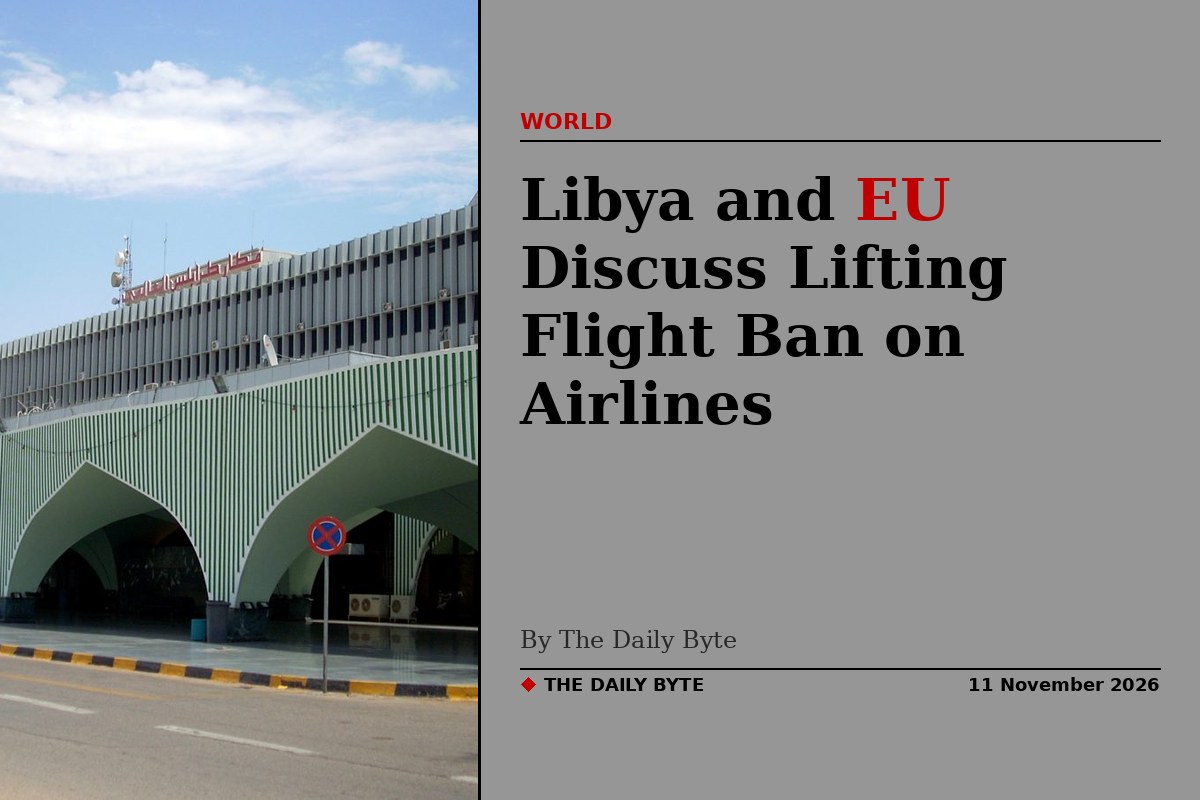
Libya and the European Union have discussed lifting the ban on Libyan civil aviation operating in European airspace, in talks held in Tripoli on Monday 10 November. Taher El-Baour, Libya's Acting Minister of Foreign Affairs and International Cooperation, received Alexios Konstantopoulos, the Ambassador of the European Union to Libya, at the ministry's headquarters in the Libyan capital.
The meeting was attended by Abubaker Al-Taweel, Director of the European Affairs Department, and Musab Hamza, Head of the European Union Section at the department. According to the ministry, the two sides discussed cooperation and partnership relations between Libya and the European Union, as well as ways to strengthen and develop them across various fields.
What was on the agenda
Foremost among the issues discussed was the lifting of the ban on Libyan civil aviation operating in European airspace. The two sides also discussed irregular migration and the latest developments in Libya's political process. The meeting touched on the proceedings of the Ministerial Conference of the Community of Sahel-Saharan States (CEN-SAD), which was recently hosted in Tripoli. The ambassador highlighted the significance of Libya hosting the conference and commended its convening in the capital and its importance in strengthening cooperation and coordination among the community's member states.
No timetable for lifting the ban was announced, and the meeting produced no decision to restore flights. The discussion itself, however, is the latest step in a long-running Libyan effort to return its airlines to European skies after more than a decade of restrictions.
A ban in place since 2014
All airlines certified by Libya's aviation authority remain on the EU Air Safety List, which prevents Libyan-certified carriers from operating to, from or over European Union territory because of concerns about national safety oversight. The ban dates back to 2014, when security and regulatory concerns that followed Libya's political upheaval in 2011 led the European Commission to bar Libyan carriers from EU airspace.
The European Commission concluded in June 2026 that there were not yet sufficient grounds to change Libya's position on the list, so the ban remains in force. That assessment is separate from the question of whether individual foreign operators may fly into Libya, which is governed by their own national authorities, insurance and risk assessments.
A recent opening — but not a reopening
The talks in Tripoli come shortly after a significant, if partial, change in Libya's aviation position. The International Civil Aviation Organization (ICAO) formally lifted airspace restrictions and warnings introduced during Libya's civil conflict on 23 October 2026, ending measures that had been in place since 2015. The decision was announced by ICAO Secretary-General Juan Carlos Salazar at a meeting of Middle Eastern civil aviation officials in Doha, and Libya's Ministry of Transport said it would be circulated to all 193 ICAO member states for implementation.
But the ICAO decision does not by itself reopen European routes for Libyan airlines. The European Union Aviation Safety Agency continues to list the Tripoli Flight Information Region as an active conflict zone, and its current bulletin remains valid until 31 January 2027 unless reviewed earlier. The bulletin assesses Libyan airspace below Flight Level 320 as presenting a high level of risk. The United States is more restrictive still: the Federal Aviation Administration's Special Federal Aviation Regulation No. 112 prohibits specified US carriers and US-registered civil aircraft from operating in Libyan territory and airspace, a rule extended until 20 March 2028.
Migration and politics also on the agenda
The Tripoli meeting also covered irregular migration, a long-standing issue between Libya and the EU, and the latest developments in Libya's political process. Libya remains divided between rival administrations, and the EU has continued its engagement with Libyan institutions on the path towards stability and unified state institutions.
The CEN-SAD conference discussed at the meeting underlines Tripoli's recent diplomatic activity. Libya hosted the 22nd ordinary session of the Executive Council of the Community of Sahel-Saharan States on 7 November, opened by Prime Minister Abdulhamid Dbeibah, with foreign ministers from Egypt, Tunisia, Chad, Djibouti, the Central African Republic, Sierra Leone, Somalia and Guinea-Bissau among those taking part. CEN-SAD was established in Tripoli in February 1998 and has 28 member states across Africa's Sahara and Sahel regions.
Konstantopoulos, a Greek diplomat, only recently took up his post. He presented his credentials to Mohamed Al-Mnifi, head of Libya's Presidential Council, in October, succeeding Italian ambassador Nicola Orlando, who left the post in September. For Libya, the immediate question is whether the diplomatic engagement in Tripoli, combined with the ICAO decision, can persuade European regulators to begin easing a ban that has kept its airlines out of European airspace for twelve years. Libya Herald reported the meeting, and JetBay reported the current status of the EU ban, the EASA bulletin and the ICAO decision.


