Lithuania Holds Russian Grain at Klaipėda Port
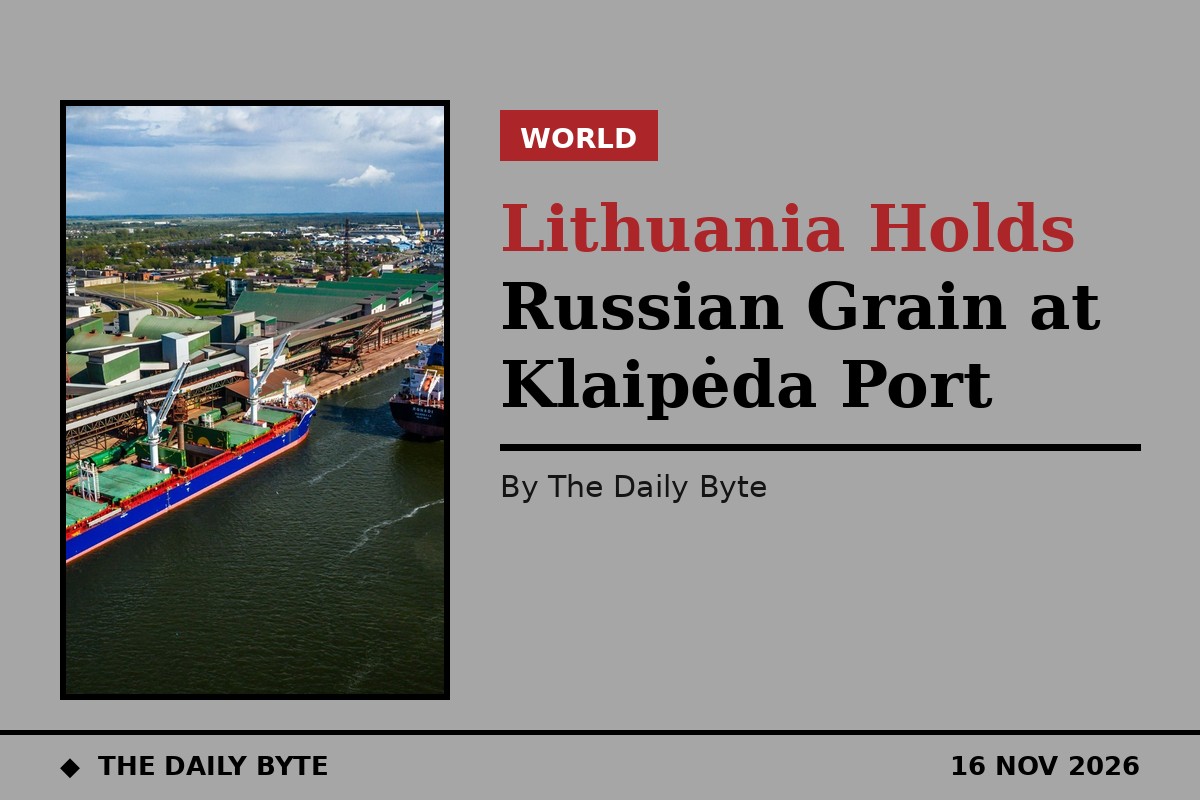
Lithuania has begun holding Russian and Belarusian grain shipments at its Baltic Sea port of Klaipėda until laboratory tests can confirm where the grain was grown, under stricter controls that took effect on Monday 16 November 2026.
The new rules mean shipments cannot clear customs or leave the port for global markets until the results are available, a process that can take two months or more. The measures cover wheat, barley, maize and sunflower seeds exported through Klaipėda from Russia or Belarus.
Every shipment will face document checks, physical inspection and sampling by Lithuania's State Food and Veterinary Service, with samples sent to laboratories abroad because Lithuania has no laboratory capable of carrying out the tests itself.
Shipments held until tests come back
Under the rules, announced by Lithuania's Agriculture Ministry on 10 November, grain cargoes must remain held at the port while the origin checks are carried out. Importers must pay for the checks, and the exporter bears the costs of storage, testing and any return or destruction of the cargo.
Lithuania began extending origin inspections to grain from Russia and Belarus in September, but until now shipments could move on while checks were under way. From Monday, customs clearance is withheld until the laboratory results arrive.
What happens if the origin is false
If the tests establish that a shipment's declared origin is false, it will have to be returned or destroyed, a Lithuanian Agriculture Ministry official told Reuters.
That is the sharp end of the policy. Vilnius suspects that some of the grain Russia exports may have been harvested in Ukrainian territory under Russian occupation, and then shipped out under Russian documentation. The checks are intended to stop grain taken from occupied land from reaching world markets through a Lithuanian port.
Why Lithuania is acting
Lithuanian Agriculture Minister Kęstutis Mažeika instructed the State Food and Veterinary Service in early September to check the origin of all food and feed grain transported from Russia and Belarus.
The concern is not new, but the volumes have grown. After disruptions to exports through Black Sea ports, more Russian grain has been redirected to Baltic ports, including terminals in Latvia and Lithuania, even though those ports can handle only a fraction of the volume that usually moves through southern routes.
EU sanctions already prohibit imports of Russian grain into the bloc, but transit through EU territory to buyers elsewhere is still allowed. That gap is what the Baltic states are trying to close.
Baltic neighbours move in step
Lithuania is not acting alone. Estonia introduced a complete ban on the transit of Russian and Belarusian grain through its territory on 1 October, as a national sanction.
Latvia has prepared draft legislation for a similar ban, with its foreign ministry submitting the proposal to the government for approval. Latvian customs data shows Russian grain transit through Latvia nearly doubled in September 2026 compared with the same period last year.
All three Baltic states called on the European Union in early October to ban the transit of Russian grain through the bloc as a whole, a proposal that has not yet been adopted at EU level.
For now, the controls are national measures, applied port by port. But with Lithuania's rules in force from today, the Baltic route for Russian grain has narrowed sharply, and exporters face months of delay and the risk of losing a cargo altogether if its paperwork does not match its origin.


