London air pollution hits very high as fog lingers
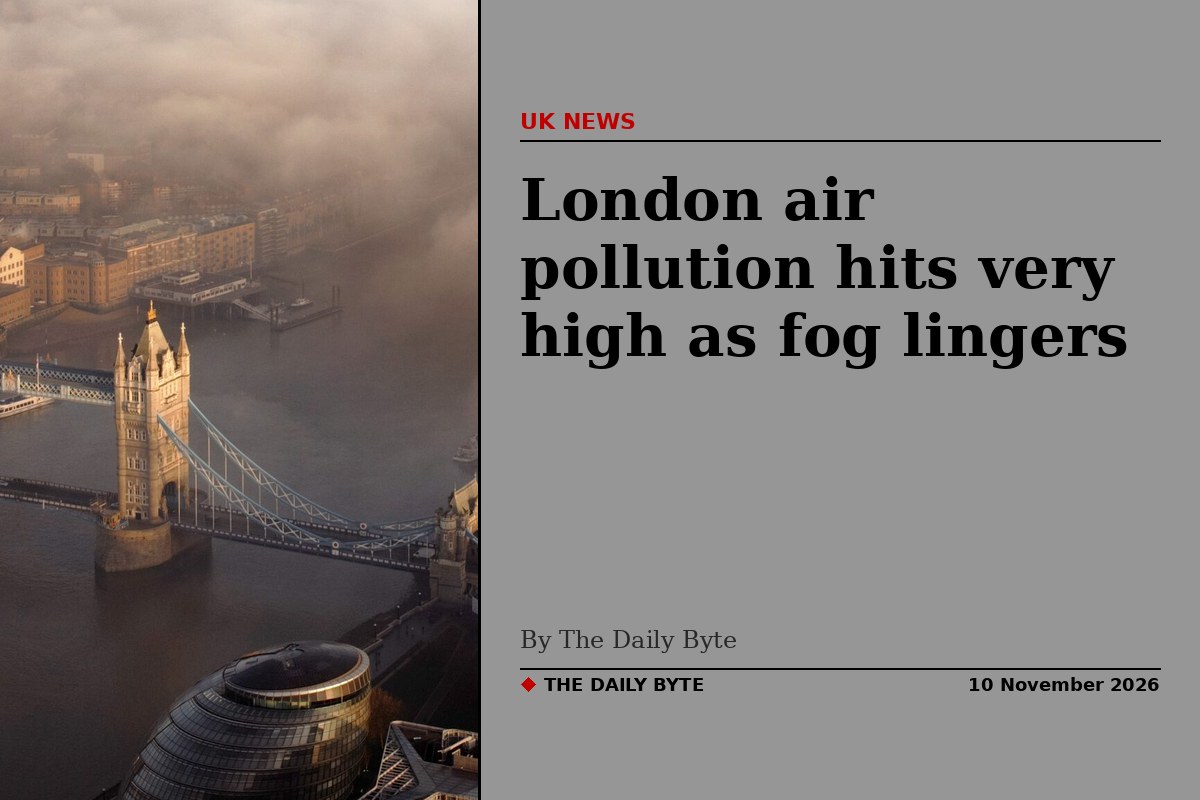
London has been placed under a high air pollution alert for Tuesday, 10 November, after dense fog and almost still air trapped pollution over the capital and government monitors recorded the highest pollution levels in the country.
Government monitoring recorded Greater London at “very high” pollution, the top band of the national air quality scale, while the South East and the East Midlands were recorded as “high”. The Mayor of London, Sadiq Khan, issued the alert for Tuesday on the advice of forecasters at Imperial College London. It is the fourth high air pollution alert issued in the capital this year, with the last one coming in June during a heatwave.
The mayor’s office said dense fog and very light winds had allowed pollution to build up over the weekend and linger into Monday morning. Bonfire Night fireworks and bonfires added to the problem, with smoke held close to the ground by the still, foggy conditions.
What the monitors recorded
Air pollution climbed to the highest level on the government’s scale across urban areas of England on Monday. Official monitoring showed 11 sites, mostly in London and Greater Manchester, reaching the top band of the ten-point index for particulate matter in the 24 hours to 10am.
The worst reading came from Hillingdon in west London, where fine particles known as PM2.5 averaged 129 micrograms per cubic metre over 24 hours, more than eight times the daily level recommended by the World Health Organization. Jane Burston, chief executive of the Clean Air Fund, said monitoring networks could not pin down exactly where the pollution had come from, but that the autumn celebrations were almost certainly a major factor.
City Hall said the alert covers the whole of London. People most vulnerable to poor air are being asked to look after themselves, and everyone is being asked to burn and drive less while the alert is in force. The thresholds for the alerts are set by the Department for Environment, Food and Rural Affairs’ national Daily Air Quality Index, and City Hall says both the “high” and “very high” bands are substantially above the World Health Organization’s guideline values.
Fog warning and travel disruption
The Met Office has also issued a yellow warning for fog across parts of England and Wales, in force until 10am on Tuesday. The affected area stretches from Luton to Manchester, covering parts of central and northern England and Wales, with visibility reduced to less than 100 metres in some places overnight.
The forecaster said slower journey times were possible, with delays to public transport and a chance of delays or cancellations to flights. Met Office chief meteorologist Jason Kelly said persistent high pressure had brought light winds and clear skies, allowing fog to form, while weak November sunshine meant it was fairly slow to clear.
The fog is expected to thin and clear during Tuesday morning, but forecasters say it will give way to cooler and frosty weather later in the week. Rain arriving later on Tuesday should also help to clear the air over the capital.
How the alert system works
London’s air quality alert system was set up by the mayor in 2016. Forecasts from Imperial College London are checked against other public forecasts, including airTEXT, the Met Office and London Air, before an alert is issued. The system sends notifications to schools, councils and registered individuals whenever moderate, high or very high pollution is forecast.
National health guidance on air quality recommends that people with existing heart or lung conditions monitor official air pollution indices and reduce strenuous outdoor activity when levels are high. Anyone who notices symptoms such as a tight chest or difficulty breathing should seek medical advice.