Los Angeles Hit by 4.2 Earthquake Near Commerce
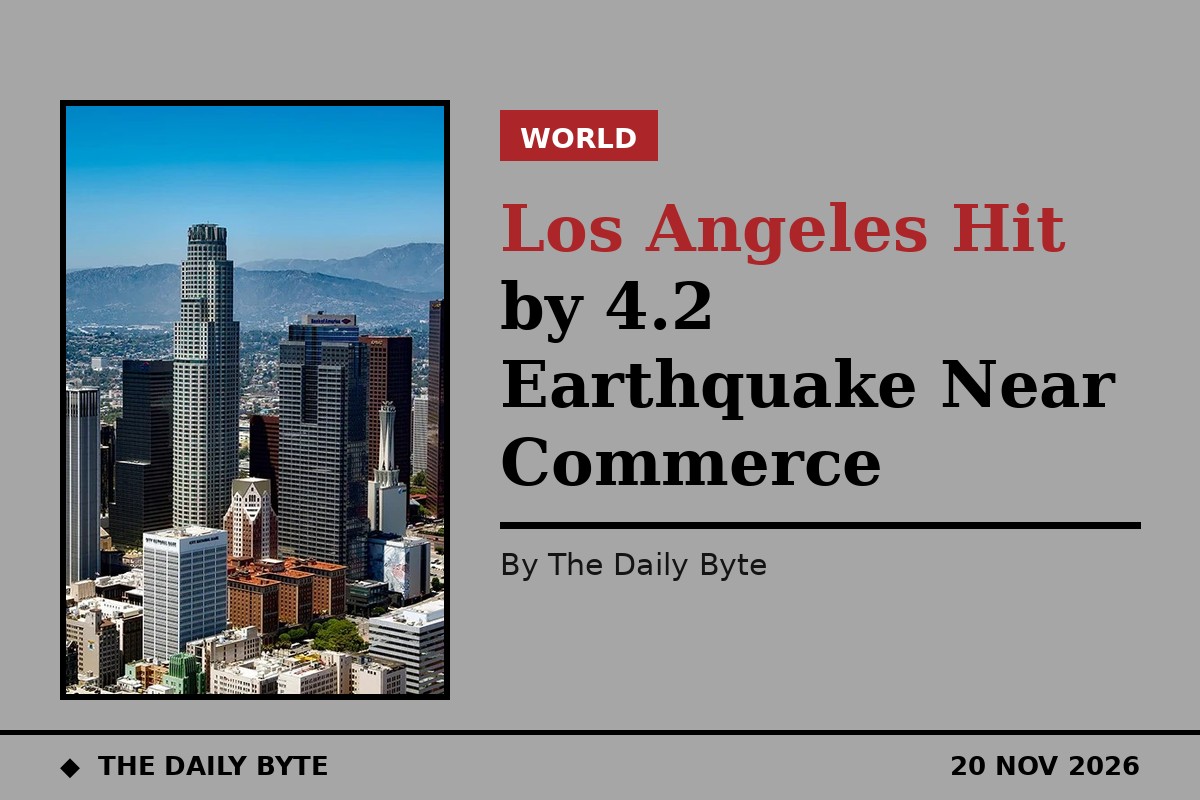
A magnitude 4.2 earthquake shook the Los Angeles area early on Friday, waking residents across Southern California after a tremor struck near the city of Commerce.
The earthquake hit at 3:25 a.m. Pacific time, with its epicentre about one mile north-west of Commerce, according to the United States Geological Survey (USGS). The quake struck at a depth of about 10.6 miles, and was first reported as a magnitude 4.4 before the survey revised it down to 4.2.
Commerce sits about five miles south-east of downtown Los Angeles, and the quake's central location meant shaking was felt widely across the region.
Shaking felt across the Los Angeles basin
People reported feeling the tremor across the Los Angeles metropolitan area, including in Pasadena, North Hollywood, Gardena and Riverside. More than 7,500 people submitted reports to the USGS describing the shaking within the first hour, through its Did You Feel It? system, which helps scientists map how far and how strongly a quake is felt.
Because the epicentre was close to the centre of the urban area, shaking was felt throughout the region even though the quake was moderate in size, the USGS said. No damage was expected from a quake of this magnitude, but the shaking was strong enough to wake many people in the early hours.
Fire crews survey the city
The Los Angeles Fire Department activated its earthquake response protocol, sending personnel from all 106 neighbourhood fire stations to survey the city's 470-square-mile area for damage to critical infrastructure and other areas of concern.
There were no initial reports of structural damage or injuries, the department said. The survey typically takes less than an hour, and residents were asked to prepare for possible aftershocks.
Anyone who felt the quake has been encouraged to report it to the USGS, so scientists can build a clearer picture of where the shaking was strongest.
Drop, cover and hold on
Officials reminded residents that if another earthquake strikes, they should drop to their hands and knees, cover their head and neck, and hold on under a sturdy table or desk until the shaking stops. People indoors should generally stay inside rather than rushing outside while the ground is moving.
Aftershocks are possible after an earthquake of this size, and the fire department urged residents to remain prepared.
Why California shakes so often
California sits along the boundary between the Pacific Plate and the North American Plate, which are constantly moving past one another and building stress in the Earth's crust. When that stress overcomes friction along a fault, the fault slips suddenly and releases energy as seismic waves.
The San Andreas Fault is the best-known fault system in the state, stretching roughly 800 miles, but it is far from the only one. California has hundreds of active faults, including the Hayward, Calaveras, San Jacinto and Elsinore systems. Scientists cannot predict earthquakes with enough precision to say when a major one will happen, where it will strike or how large it will be, according to the USGS, which instead monitors seismic activity and calculates the probabilities of future quakes.


