Louise Casey: Governments 'Asleep at Wheel' on Social Care
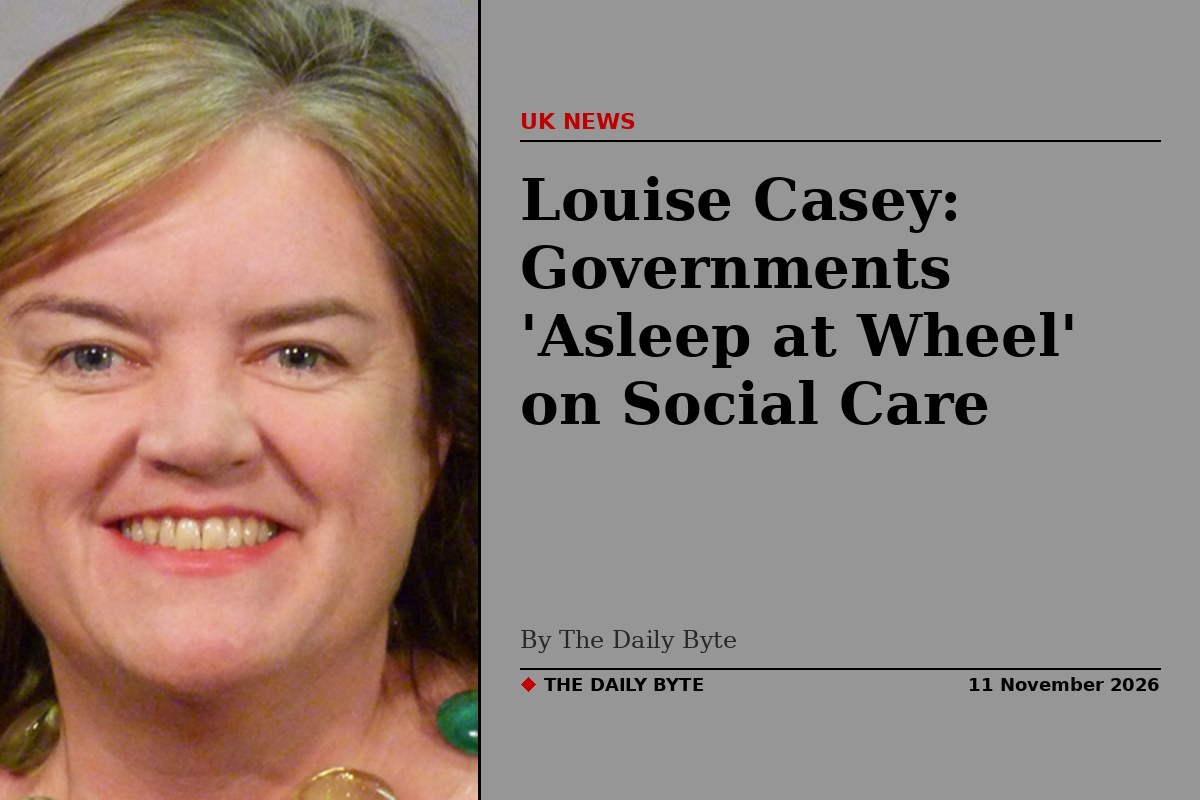
Baroness Louise Casey has accused successive governments of being “asleep at the wheel” on social care, warning that no one is in charge of England’s adult social care system. The head of the Independent Commission on Adult Social Care delivered the verdict in a speech to social care leaders in Liverpool on Wednesday, as new research published today described the system as fundamentally fragmented.
The research, carried out by the Nuffield Trust and the Institute for Government, found that England has no clear “system stewardship” for social care. Responsibilities are spread between central government departments, arm’s-length bodies, national and local government, and a large number of non-public providers, leaving the system to grow as a chaotic patchwork of local services with no clear vision.
A system with no one in charge
Baroness Casey said the result was that people’s experience of care varied widely depending on where they live, with different standards, assessment processes and waiting times. Private providers now dominate the sector in a pattern the research said had emerged in a “largely uncontrolled and unintended way”, while regulation of services has often been ineffectual.
More than 1.5 million people work in social care across around 19,000 employers, yet England is the only one of the UK’s four nations with no mandatory register of care workers. The report also warned of poor transparency around fees: people who pay for their own care are charged, on average, 40 per cent more for the same service than people whose care is arranged by their council. People with savings worth more than £23,250 receive no help with care costs from their local council, and high fees sometimes mean people are forced to sell their homes to pay for what they need.
Pandemic failures a ‘national shame’
In her speech to the National Children and Adult Services Conference, Baroness Casey also condemned the handling of social care during the pandemic, when Covid-19 “spread like wildfire” through care settings. She said many older people died without their loved ones by their sides, and many care workers left their jobs after what they had seen.
The UK Covid-19 Inquiry said last month that the care sector had been “something of an afterthought” during the pandemic, and rejected as unfounded the claim made in May 2020 that a “protective ring” had been thrown around care homes. More than 43,000 people died from Covid-19 in UK care homes between March 2020 and July 2022. Baroness Casey said: “It is a national shame that this was allowed to happen. It should never happen again.”
A new settlement for care
Baroness Casey called for a “new settlement” for care, “one based on values I still believe this country shares: decency, contribution and a duty to care for our neighbours, our loved ones and ourselves”. She said public understanding of how social care works was “so low”, with many people in denial about getting older and unaware that social care, unlike the NHS, is not free at the point of use.
“It’s not like we’re not already paying for social care, and in a way, we’re paying for failed social care,” she said in an interview with the Press Association. She said the time was right to put social care “on the map”, describing it as an issue that affects every family in the country.
Burnham’s National Care Service plan
The prime minister, Andy Burnham, has embraced the Casey review and accelerated its completion to next year, 12 months quicker than planned under the previous government, with the expectation that a national care service plan will feature in Labour’s next election manifesto. He has announced he will use savings from scrapping the state pension triple lock, starting in the next parliament, to fund a care service based on the Scottish approach of free personal care, with individuals paying for “bed and board” costs. The change is hoped to generate about £15 billion a year by the end of the 2030s, although the Institute for Fiscal Studies has suggested the savings would not be enough.
Baroness Casey welcomed the prime minister’s proposal as “a major win for social care”. Her commission is expected to report next summer with recommendations for reform. The research published today warned, however, that successful reform would require political will and bravery, and that no amount of reorganisation would be enough without the determination to dedicate resources, time and energy to social care.