Mackenzie Valley Highway Named National Interest Project
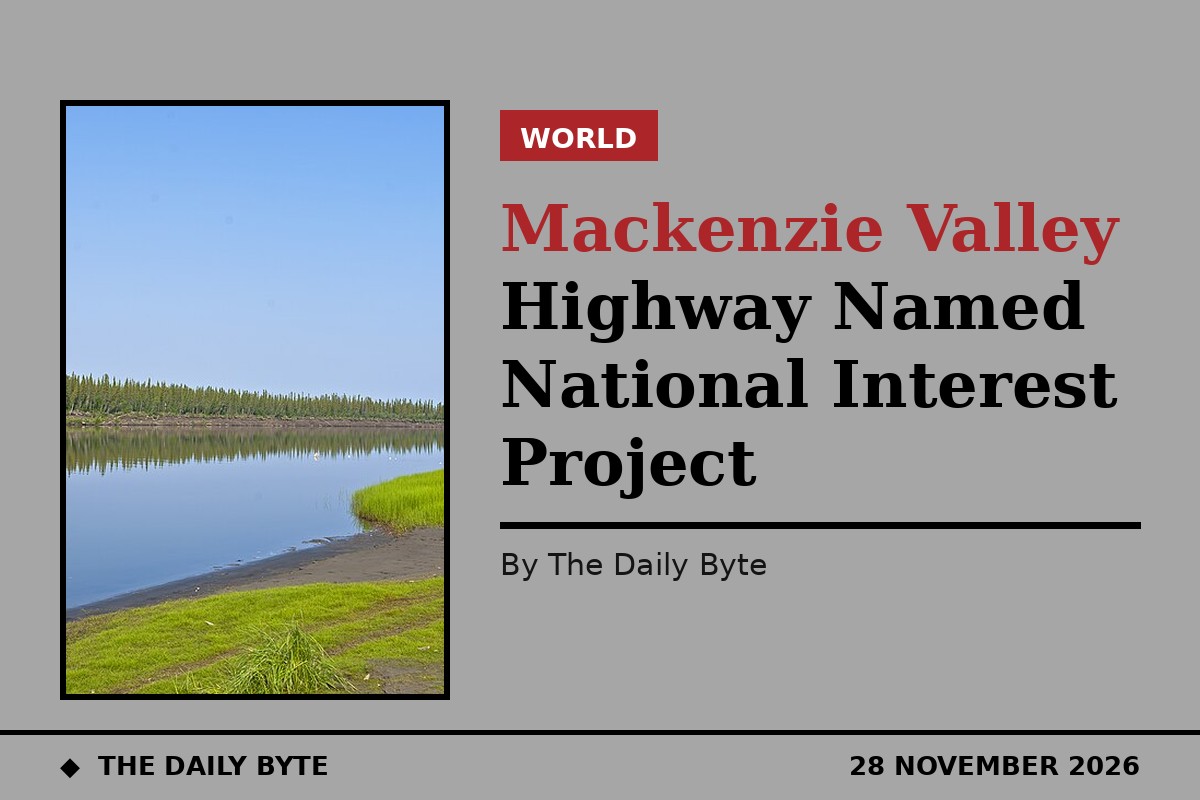
Canada's long-promised Mackenzie Valley Highway has taken its biggest step forward in decades, after Prime Minister Mark Carney listed the 800-kilometre all-season road as a project of national interest.
Carney made the announcement in Yellowknife on Friday, describing the highway as the first project in Canada's North to be listed under the Building Canada Act. The designation allows the federal Major Projects Office to coordinate regulatory requirements and move the project through its environmental assessment more quickly.
Year-round road access at last
The proposed highway will run the length of the Mackenzie Valley, linking Highway 1 at Wrigley to the Dempster Highway south of Inuvik. For the first time, the communities of Tulita, Norman Wells and Fort Good Hope will have year-round road access, ending their reliance on winter roads, barges and air travel for much of the year.
More than 10,000 people are expected to benefit, including about 1,900 people in the Sahtu region who will gain an all-season road connection for the first time. The government says the drive between Yellowknife and Inuvik will fall from about 38 hours to an estimated 23 hours, cutting roughly 1,300 kilometres from the journey.
Jobs, cost and timetable
The project will also create 3,000 jobs at peak construction and is expected to open up new opportunities for local businesses, trade and tourism, as well as supporting resource exploration. The federal government has committed to fully funding construction and certain maintenance costs, with 3.1 billion dollars earmarked in Budget 2026 and the total cost of the northern and southern sections estimated at 4.2 billion dollars.
A new Crown corporation will be created to manage the project, and current projections put completion in 2032. Work already under way includes 405 million dollars invested since the project was referred to the Major Projects Office in March, and the relocation of the Oscar Bridge and the Christina Creek realignment are due to start once the winter road is built in early 2027.
Security and the Arctic corridor
The highway also has a security dimension. The government says a more reliable transport corridor will improve connections between the North American Aerospace Defence Command forward operating locations in Yellowknife and Inuvik, and support the movement of Canadian Armed Forces personnel, equipment and supplies.
The announcement follows the signing, on 25 November, of a Leadership Governance Understanding between the Sahtu Secretariat Incorporated, the Gwich'in Tribal Council, the Pehdeh Kie First Nation, the Government of the Northwest Territories and the Government of Canada. The agreement sets out a shared framework for planning and delivering the highway, although the territorial government stressed that it does not replace environmental assessment processes or constitute Indigenous consent.
The project still has to complete an environmental assessment that began in 2013 and is being carried out by the Mackenzie Valley Environmental Impact Review Board. Officials expect that review to wrap up by the end of 2027.
Carney also announced more than 120 million dollars from the Arctic Infrastructure Fund to advance the Arctic Economic and Security Corridor, an Indigenous-led project that would build a road from Yellowknife towards the Nunavut border and ultimately to a deepwater port at Grays Bay on the Arctic Ocean. The aim is to have that project shovel-ready by 2029.
Reaction in the North
Northwest Territories Minister Caroline Wawzonek welcomed the announcements, calling the listing another important milestone in what she described as a remarkable year for the project. The highway is the third project to be listed as being in the national interest, after the Pacific Link pipeline and the Roberts Bank Terminal 2 expansion in British Columbia.
For Carney, the announcement was personal as well as political. Born in Fort Smith in the Northwest Territories, he noted that for the first year of his life the only way out of his home town was a winter road. The Mackenzie Valley Highway, he said, is being built for the people of the North, in partnership with the people of the North.


