Macron: Cutting Ukraine Aid Is 'Recipe for Another War'
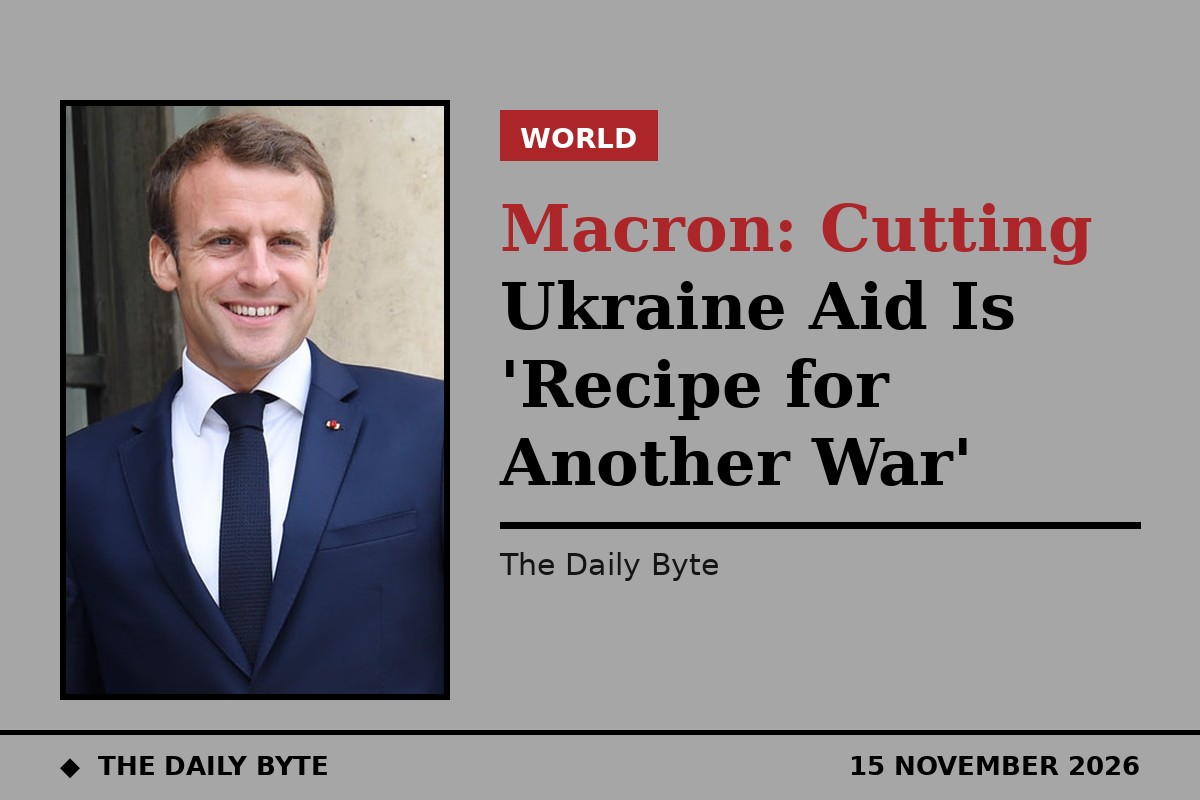
French President Emmanuel Macron has warned that countries seeking to limit aid to Ukraine want to impose an unjust peace on Kyiv, and that doing so would be a recipe for another war.
In a message posted on social media on Saturday, 14 November, Mr Macron said: “Those who want to ration aid to Ukraine wish underneath it all to force an unjust peace on it.” He added: “That is the spirit of defeat. That is a recipe for another war. That cannot be France’s position.”
The warning came after a week of intense diplomacy over the war in Ukraine. European leaders met in Dublin on 12 and 13 November for the ninth European Political Community summit and an informal European Council meeting, where Ukraine was at the centre of the discussions.
Two priorities from Dublin
Mr Macron set out what he called two priorities from the Dublin talks. The first is to help Ukraine get through the winter. The second is to work with Ukraine towards a just and lasting peace.
He said France’s responsibility is to keep up financial support and to help Ukraine protect its people, its power plants and its electricity grids. Russian strikes on Ukraine’s energy system have continued as winter approaches, and European leaders in Dublin identified helping Ukraine survive the cold months as one of their shared aims.
At the Dublin summit, 42 countries backed a declaration on European security principles proposed by France. The declaration set out that peace in Ukraine cannot be settled without Ukraine, and that matters affecting Europe’s security cannot be decided without Europeans.
Europe wins a seat at the talks
Mr Macron’s warning followed a week in which Europe fought its way into negotiations it had feared would be held over its head. United States envoys Steve Witkoff and Jared Kushner held two days of American-mediated talks between Russian and Ukrainian delegations in Abu Dhabi on 10 and 11 November. The talks agreed a large prisoner exchange in principle, but produced no breakthrough on a ceasefire or on territory.
On 12 November, the two envoys met President Vladimir Putin in Moscow and then flew to Dublin, where they briefed Ukrainian President Volodymyr Zelensky. On Friday, 13 November, European leaders chose five countries — France, Germany, Italy, the United Kingdom and Poland — alongside the European Union institutions, to represent Europe in future negotiations.
Mr Macron told leaders in Dublin that Europe must take full part in reaching a fair and lasting peace, and he warned there that without Europeans there is no support for Ukraine. The European Union has agreed a 90 billion euro loan to Ukraine for 2026 and 2027, underlining how much of the financial burden of supporting Kyiv now falls on Europe.
What happens next
The peace effort remains far from settled. Mr Zelensky said in comments released on Saturday that Washington has suggested Kyiv cede land to Moscow in exchange for Ukraine joining NATO. The United States has not confirmed such a proposal as its position, and no date has been set for the next round of talks.
Mr Macron did not name the countries or politicians he was responding to in his message. But his intervention made France’s position plain: cutting back support for Kyiv is not a shortcut to peace, in his view, but a path to a settlement imposed on Ukraine — and one that would not hold.
For now, the focus in European capitals is on the winter ahead: keeping Ukraine’s lights and heating on, keeping financial support flowing, and keeping Europe at the negotiating table when the next round of talks is held.
Source: France 24 / AFP via EuropeSays; ICWWM


