Magnitude 5.4 Quake Strikes Near Ambon, Indonesia
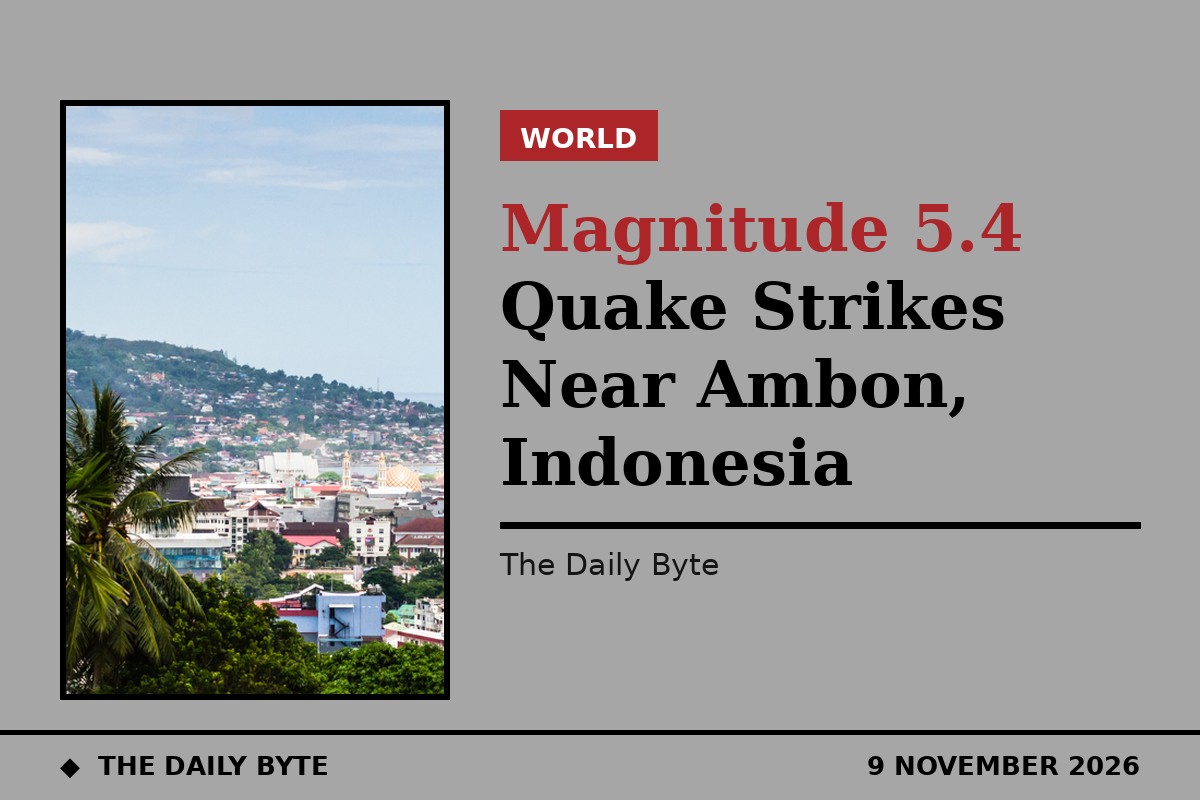
A magnitude 5.4 earthquake struck eastern Indonesia on Monday evening, shaking the Maluku islands region east of the provincial capital, Ambon, according to the United States Geological Survey (USGS).
The tremor was recorded at 6.48pm local time on Monday, 9 November (9.48am UTC), at a shallow depth of about 10 kilometres. The USGS placed the epicentre about 160 kilometres east of Masohi, on the island of Seram, roughly 255 kilometres east of Ambon.
Scientific estimates published by the USGS indicate that around 220,000 people were exposed to shaking from the quake. The agency classified the risk of high fatalities at its lowest level, green.
No tsunami warning issued
No tsunami warning was issued after the earthquake. The USGS recorded a tsunami threat level of zero for the event, and the tremor struck under land, about five kilometres from the sea, at a magnitude that is not usually strong enough to generate a tsunami.
There were no immediate reports of casualties or significant damage in the information published about the quake. With the epicentre located well offshore from the main population centres of Maluku, the shaking felt in Ambon and surrounding areas was expected to be light to moderate.
A region used to tremors
Indonesia sits on the Pacific Ring of Fire, a belt of seismic activity around the Pacific Ocean where several tectonic plates meet, and earthquakes are a regular occurrence across the archipelago. Maluku province, spread across hundreds of islands in the east of the country, is one of the most earthquake-prone parts of Indonesia.
Shallow earthquakes, like Monday's, are often felt more widely than deeper tremors of the same magnitude, because the energy is released closer to the surface. Even so, a magnitude 5.4 quake at this distance from major towns would normally be expected to cause limited damage, with the main risk coming from weakened buildings and landslides in hilly areas.
What happens next
Indonesia's meteorology, climatology and geophysics agency, BMKG, monitors seismic activity across the country and issues public updates after significant earthquakes. Residents in affected areas are advised to follow official guidance and to stay alert for aftershocks, which commonly follow a quake of this size in the hours and days afterwards.
Emergency services in Maluku routinely carry out checks after earthquakes, including inspecting buildings, roads and port facilities. Any damage reports are usually published by the local disaster management agency once field assessments are complete.
The quake came a day after a separate magnitude 5.7 earthquake struck central Japan, injuring more than 20 people in Shizuoka and Aichi prefectures, in a reminder of how active the seismic zone around the western Pacific has been in recent days.


