Magnitude 6.7 earthquake strikes deep off Kamchatka, Russia
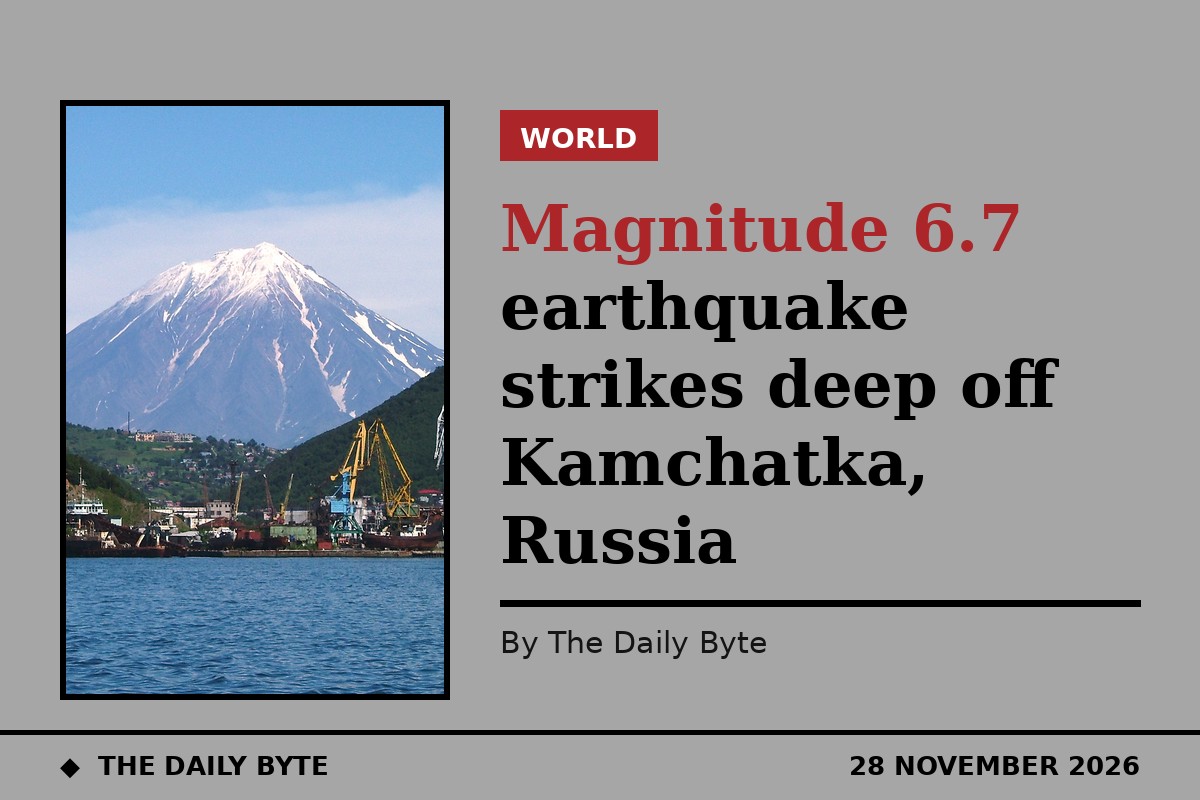
A strong magnitude 6.7 earthquake struck deep beneath Russia's Kamchatka Peninsula on Saturday, the strongest earthquake recorded anywhere in the world in the past 24 hours, according to the United States Geological Survey.
The earthquake hit at 13:15 UTC on Saturday, 28 November, which was 01:15 in the early hours of Sunday, 29 November, in Kamchatka. The USGS placed the epicentre 62 kilometres north-northwest of Yelizovo, a town near the regional capital Petropavlovsk-Kamchatsky, at a depth of 188.4 kilometres. Its coordinates were 53.719 degrees north and 158.079 degrees east.
The USGS has marked the event as reviewed, meaning an analyst has checked the magnitude, location and depth. No tsunami warning was issued, and the agency issued a Green alert, its lowest level, indicating little expected impact. No casualty or damage figures have been reported, and no felt reports from the public were listed in the USGS data at the time of publication.
Deep focus, limited shaking
The depth of this earthquake is the key to why a magnitude 6.7 event caused so little apparent disruption. At 188 kilometres down, the rupture happened far below the crust, inside the descending Pacific Plate in what seismologists call the Wadati-Benioff zone. Deep earthquakes of this kind spread their energy over a wide area, but the shaking that reaches the surface is gentler than from a shallow earthquake of the same size.
The USGS gave the event a maximum instrumental intensity value of about 4.5 on the Modified Mercalli scale, which corresponds to light shaking, and an estimated intensity of IV in the area closest to the epicentre. That is the level at which dishes and windows may rattle and parked cars may rock, but well below the level that damages sound buildings.
The nearest sizeable city, Petropavlovsk-Kamchatsky, lies about 80 kilometres south-east of the epicentre, on the shore of Avacha Bay beneath the Koryaksky and Avachinsky volcanoes. Yelizovo itself is smaller and closer, and it is also home to the peninsula's main airport. Neither city reported damage in the hours after the earthquake, and there were no reports of disruption to the submarine cables that run near the eastern coast of Kamchatka, with monitoring showing signal delays unchanged from before the event.
One of the most restless places on Earth
Kamchatka is among the most seismically active regions on the planet. The Pacific Plate is sliding beneath the Okhotsk Plate along the Kuril-Kamchatka Trench at roughly 80 millimetres a year, and the peninsula sits above a chain of active volcanoes as well as some of the world's largest earthquake faults.
The region has been especially restless in the past two years. A magnitude 8.8 earthquake struck off the Kamchatka coast in July 2025, one of the largest ever recorded in the region, and it was followed by a long series of aftershocks. Saturday's earthquake is the strongest in the area since then, but it is a very different kind of event: far deeper, far smaller, and far less dangerous.
Saturday's earthquake was also the strongest recorded anywhere in the world in the past 24 hours. The USGS listed 235 earthquakes worldwide in that period, 47 of magnitude 2.5 or more and 10 of magnitude 4.5 or more, and the Kamchatka event topped the list.
What happens next
Earthquake agencies will continue to refine the figures as more seismic data is processed, and the magnitude and depth may be adjusted slightly in the coming days. That is normal for a reviewed event: the headline numbers are firm enough to quote, but not yet final.
For the people of Kamchatka, the earthquake is a reminder of the ground they live on. The peninsula's volcanoes and trenches make it one of the most closely watched seismic zones in the world, and its residents are used to the earth moving beneath them. This time, the depth of the rupture meant the shaking passed with little more than a tremor, and life in Petropavlovsk-Kamchatsky and Yelizovo carried on as normal.


