Mahama: Ghana Chiefs Must Stay Out of Party Politics
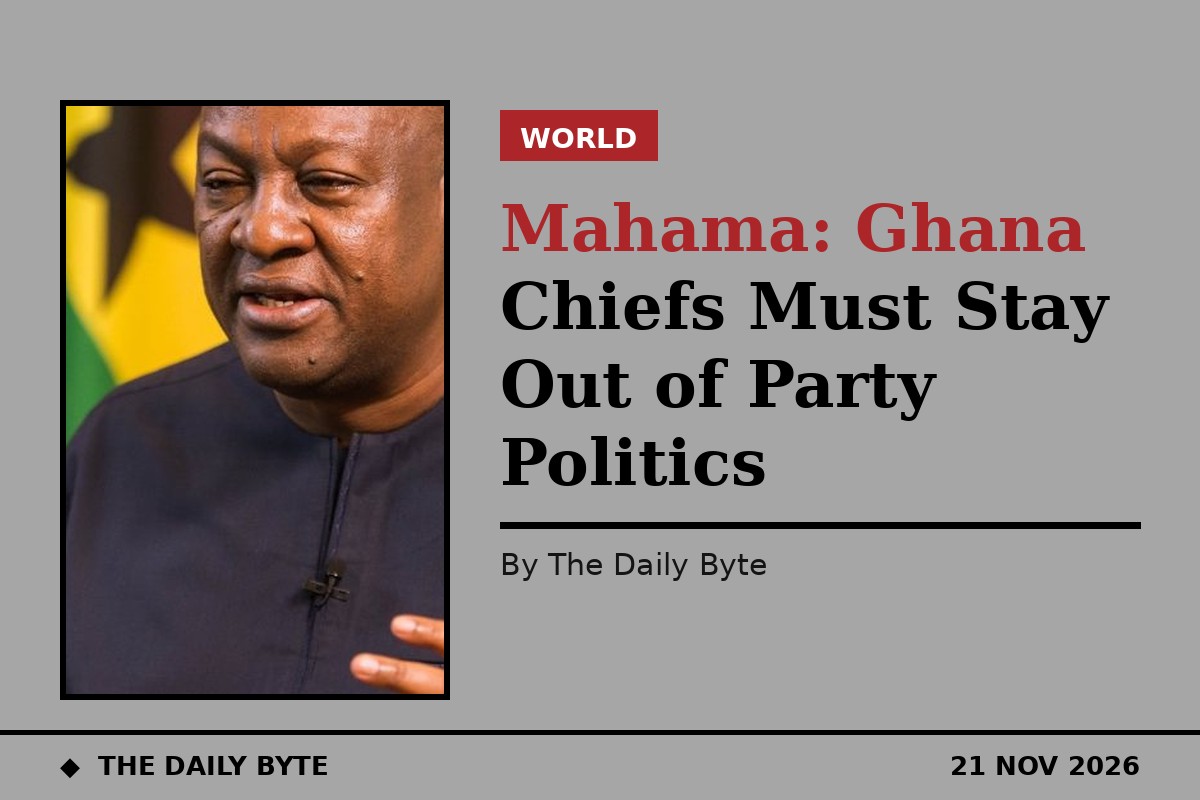
Ghana’s President John Dramani Mahama has defended the constitutional ban on chiefs taking part in active partisan politics, saying the restriction is essential to preserving the dignity and respect of the chieftaincy institution.
Mr Mahama was speaking on Friday, 20 November, during a courtesy call by the Oti Regional House of Chiefs at the Jubilee House in Accra. He said traditional rulers should remain above party-political contests while continuing to support local governance and development in their communities.
“The 1992 Constitution, for very good reason, decided that chiefs should not take part in partisan politics, and it was affirmed by the Supreme Court in its interpretation of what partisan politics is,” he said.
Article 276(1) of Ghana’s 1992 Constitution states that a chief shall not take part in active party politics, and that a chief who wants to stand for Parliament must abdicate the stool or skin. A 2022 Supreme Court interpretation drew a line between chiefs commenting on government policy, which is allowed, and endorsing political parties or candidates, which counts as active party politics.
Why Mahama says the ban must stay
The President questioned whether it would be appropriate for traditional rulers to contest elections against members of the communities they lead. He argued that such contests could undermine the authority and respect traditionally associated with the chieftaincy.
“I believe that to maintain the respect of the institution, I believe that that particular clause is appropriate because can you imagine, let’s say we’re doing district assembly elections and the whole paramount chief is standing against some small student or some butcher or some teacher or something. It doesn’t all go very well,” he said.
Mr Mahama said the restriction should not shut chiefs out of local governance altogether. He pointed to the constitutional arrangement that provides appointed seats on district assemblies for traditional authorities and other groups, an arrangement his government has maintained.
Chiefs keep a role in local government
According to the President, the appointment process should ensure that chiefs, women, young people and persons with disabilities are represented on the assemblies. He called on traditional authorities to nominate representatives who could take part in assembly deliberations on their behalf and report back on the decisions reached.
He also urged chiefs to maintain close working relationships with district chief executives and to oversee how public funds allocated to district assemblies were used. Traditional authorities, he said, are in a strong position to identify the most pressing development needs in their communities, and their involvement should help local authorities choose projects that address those priorities.
Mining in Oti will need consultation first
The meeting also touched on mining in the Oti Region. Mr Mahama told the chiefs there would be consultations with them and with young people before any decision to mine the region’s iron ore and nickel. Exploration has found iron ore with more than 50 per cent iron content in the area, alongside nickel deposits.
“So definitely there will be consultations with the traditional authorities and the youth,” he said, making clear that no mining decision would be taken without talking to the communities first.
The Oti chiefs’ visit was the latest in a series of courtesy calls by regional houses of chiefs on the President since he returned to office, with local development, chieftaincy disputes and the use of natural resources among the issues raised.


