Mahama Defends Chiefs Ban on Party Politics
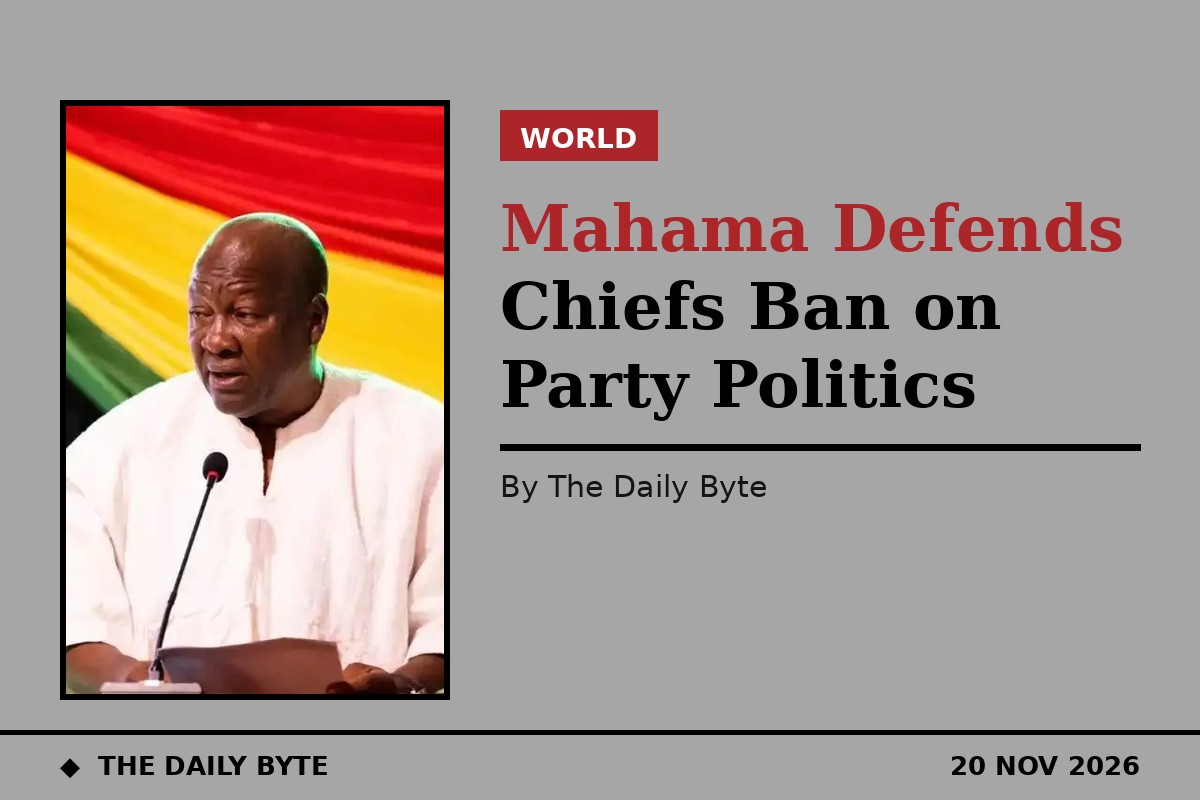
President John Dramani Mahama on Friday defended the constitutional rule that keeps Ghana's chiefs out of active party politics, telling traditional rulers that the restriction protects the standing of the chieftaincy itself.
Mr Mahama spoke during a courtesy call by the Oti Regional House of Chiefs, where he argued that allowing traditional rulers to contest partisan political positions would undermine the institution they lead.
"The 1992 Constitution, for very good reason, decided that chiefs should not take part in partisan politics, and it was affirmed by the Supreme Court in its interpretation of what partisan politics is," he said.
He questioned whether it was fitting for a traditional ruler to compete in a local election against ordinary members of the community. "I believe that to maintain the respect of the institution, I believe that that particular clause is appropriate because can you imagine, let's say we're doing district assembly elections and the whole paramount chief is standing against some small student or some butcher or some teacher or something. It doesn't all go very well," he said.
What Article 276 says
Article 276 of Ghana's 1992 Constitution states that a chief shall not take part in active party politics, and that any chief who wishes to do so and seek election to Parliament must abdicate his stool or skin.
The Supreme Court has affirmed the restriction in its interpretation of the provision. In a 2023 ruling, the court held that it was unconstitutional for chiefs to endorse political parties or presidential candidates, while praising a candidate's policies remained permissible.
Mr Mahama's remarks restate a long-standing constitutional position rather than announcing a new law. The question of how far chiefs may go in public life has returned repeatedly in Ghanaian politics, because traditional rulers command deep respect in their communities while elections remain fiercely contested.
Chiefs still have a role in local government
The President stressed that the restriction should not shut chiefs out of local governance. He pointed to the constitutional arrangement that provides appointed positions on district assemblies for traditional authorities and other groups, an arrangement he said his government has maintained.
He said the appointment criteria were designed to ensure that chiefs, women, young people and persons with disabilities were all represented when the assemblies take decisions affecting their communities.
Mr Mahama urged traditional authorities to nominate representatives who would take part in assembly discussions on their behalf and report back on the decisions taken.
Chiefs asked to watch public funds
He also encouraged chiefs to work closely with district chief executives and to monitor how public funds allocated to the district assemblies are used.
Traditional rulers, he said, were well placed to identify the development needs of their communities and to help guide local authorities in choosing projects that respond to those priorities.
The meeting with the Oti chiefs was a courtesy call, and the President used it to set out how he sees the balance between respecting traditional authority and keeping it above party competition.


