Mariana Trench volcanic eruption found at record depth
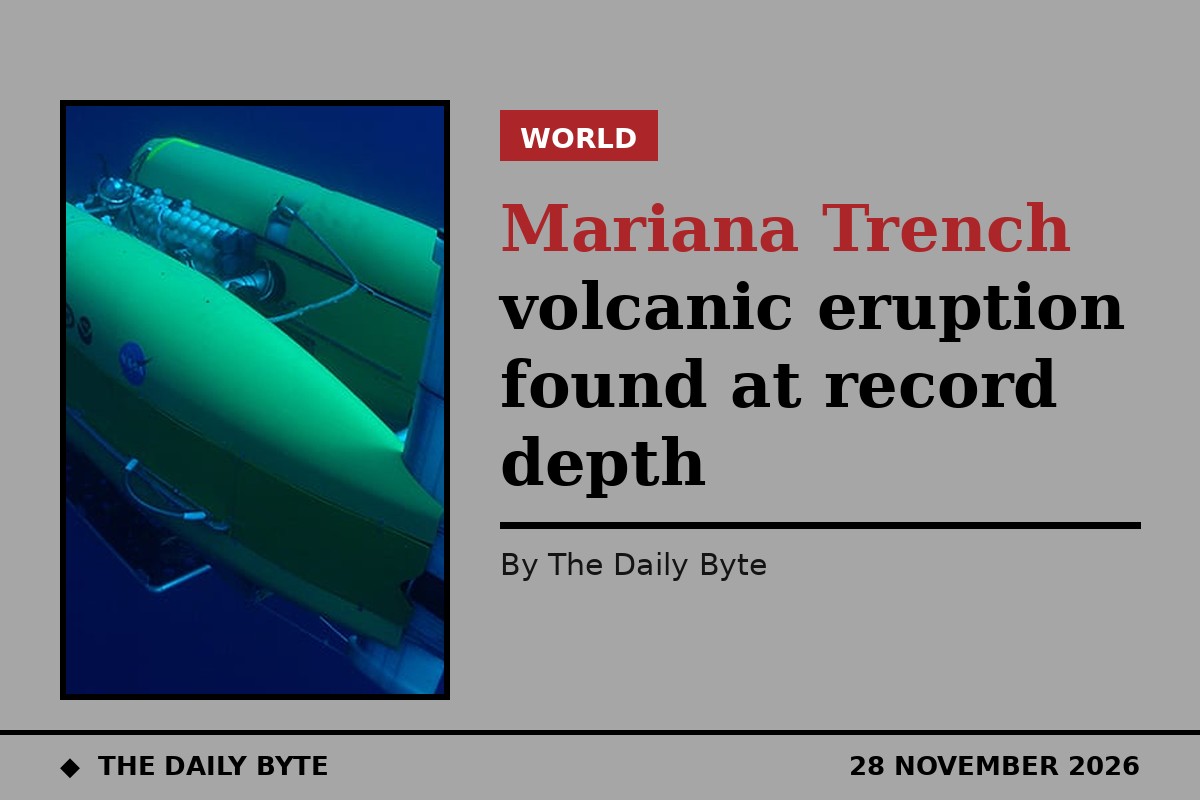
An international team of marine geologists has found evidence of the deepest-known explosive volcanic eruption on Earth, in the Mariana Trench in the western Pacific Ocean. The findings were reported on 27 November in the journal Frontiers in Earth Science, and picked up by news outlets on 28 November.
The researchers sailed to the trench and sent down Jason/Medea, a remotely operated vehicle built by the Woods Hole Oceanographic Institution, to study the trench walls around Challenger Deep, the deepest-known point of seabed on Earth. The vehicle worked down to 6,500 metres, about four miles below the surface. On one dive, at about 20,170 feet down, it found thin, flat layers of pyroclastic rock, made up of broken rock fragments and volcanic glass cemented in finer-grained material. That is the telltale sign of an explosive eruption, in which hot rock, ash and gas are thrown out with force.
Unmistakably volcanic, but no vent found
Robert Stern, a professor emeritus of geosciences at the University of Texas at Dallas and lead author of the study, said the rocks were unmistakably the product of a volcanic eruption. He added: “We did not see any eruption, and we have not yet found the vents from which the pyroclastic rocks erupted.” The age of the rocks is not yet known, but Stern said they appear to be recent in geological terms.
Why the depth makes it surprising
The discovery is surprising because the water pressure at that depth should make explosive eruptions very difficult. Under such pressure, the gas trapped in molten rock tends to stay dissolved instead of bubbling out and tearing the magma apart, which is what drives explosions on land or in shallow water. The previous deepest evidence of explosive volcanism, found in 2008, lay about 13,000 feet below sea level, roughly half the depth of the new find.
The team carried out 10 dives in total, seven of them in the forearc around Challenger Deep and three in shallower water near Guam because of the weather. The remotely operated vehicle explored along about 550 kilometres of the forearc, the part of the upper plate between the trench and a line of volcanoes on the seafloor. Challenger Deep itself reaches a maximum depth of 35,876 feet, where the pressure is about a thousand times that at sea level.
What happens next
Researchers now want to understand how explosive eruptions can happen at such depths, and they hope the find will encourage others to send robotic submersibles into the trenches to look for more clues. Stern said: “The trenches are the last frontier. We've opened a door.”


