Mbeki Questions ANC Top Seven Future After Election Rout
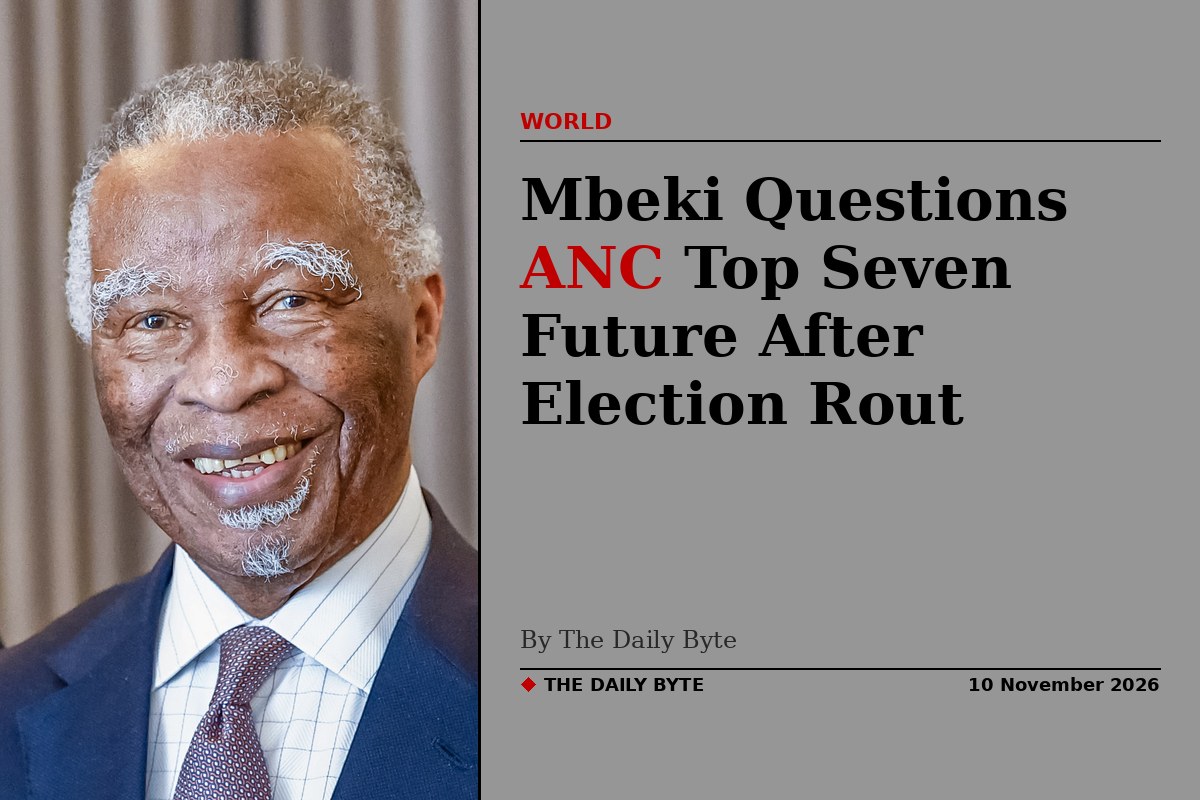
Former South African president Thabo Mbeki has questioned whether the African National Congress (ANC) top seven leaders should remain in office after the party's disastrous performance in the local government elections, saying leaders must take responsibility for major electoral defeats.
Speaking on the African Renaissance Podcast, hosted by former EFF MP Mbuyiseni Ndlozi, on Monday, Mbeki said the leadership should examine its role in the ANC's declining electoral support and consider whether it was still capable of leading the organisation.
Vote fell from 45.59% to 30.76%
The Electoral Commission confirmed on Sunday that the ANC had secured 30.76% of the national vote and 3,246 council seats in the 4 November local elections, down from 45.59% in 2021. The party remains the country's largest, and won outright majorities in 53 municipalities, but it failed to win outright control of any of the eight biggest cities, and numerous councils were left without a single party holding a majority.
Mbeki put the question directly to the party's senior leadership. “That's an important question, and I think, in fact, that question needs to be posed to the Top Seven themselves. What's your view of yourselves?” he said.
He suggested that President Cyril Ramaphosa and other senior ANC officials should consider stepping aside. “Isn't it time for that Top Seven to say, like President Ramaphosa seems to be saying, we can't continue to lead having produced a negative outcome of this kind? Maybe that's what they should say. I'm not saying they must, but maybe they should say that,” Mbeki said.
Ramaphosa resignation reports denied
His remarks followed a Sunday Times report saying Ramaphosa had offered to resign as ANC president following the party's electoral setback. Mbeki acknowledged that he had not personally read the report, but said that if it was accurate, Ramaphosa would be taking the correct position.
“And when I saw that, I said I think he's taking a correct position, because normally, in all of these democratic countries where you have a major disaster like that, the leaders resign. They take responsibility. We are at fault for this, what [ANC secretary-general Fikile] Mbalula called a catastrophe,” he said.
Ramaphosa dismissed the resignation reports on Sunday, while Mbalula denied that the party was considering the president's departure. “The president is not going anywhere, and there are no such considerations in the ANC of the president stepping down,” Mbalula said.
Mbeki criticises Ramaphosa's record
Mbeki's criticism extended to Ramaphosa's leadership since he became ANC president in 2017 and South African president in 2018. He questioned what positive developments could be attributed to Ramaphosa's time in office, citing economic difficulties, unemployment, poverty, crime and declining ANC support.
“We are now in 2026. What has happened between 2018 and 2026 of a positive nature, that you can point to, to say during this period, positive, positive, positive, nothing. There's a lot of negativity,” Mbeki said, according to the African News Agency.
He also questioned whether the party had entrusted its renewal to the right people, and said the ANC should prioritise rebuilding itself rather than seeking governing positions in municipalities where voters had not given it sufficient support.
Who are the top seven?
The ANC's top seven comprises Ramaphosa, deputy president Paul Mashatile, national chairperson Gwede Mantashe, secretary-general Mbalula, first deputy secretary-general Nomvula Mokonyane, second deputy secretary-general Maropene Ramokgopa and treasurer-general Gwen Ramokgopa.
His comments came ahead of ANC National Executive Committee discussions on the election outcome and coalition negotiations. The ANC is expected to announce its position on coalitions on 13 November.
ANC Youth League president Collen Malatji hit back at Mbeki on Tuesday, arguing that the former president was part of the problem and questioning why he had not resigned when the ANC faced similar challenges during his own tenure. Mbeki served as South Africa's second democratic president from June 1999 until his resignation in September 2008.


