McKinsey: 3.7m European Industry Jobs at Risk
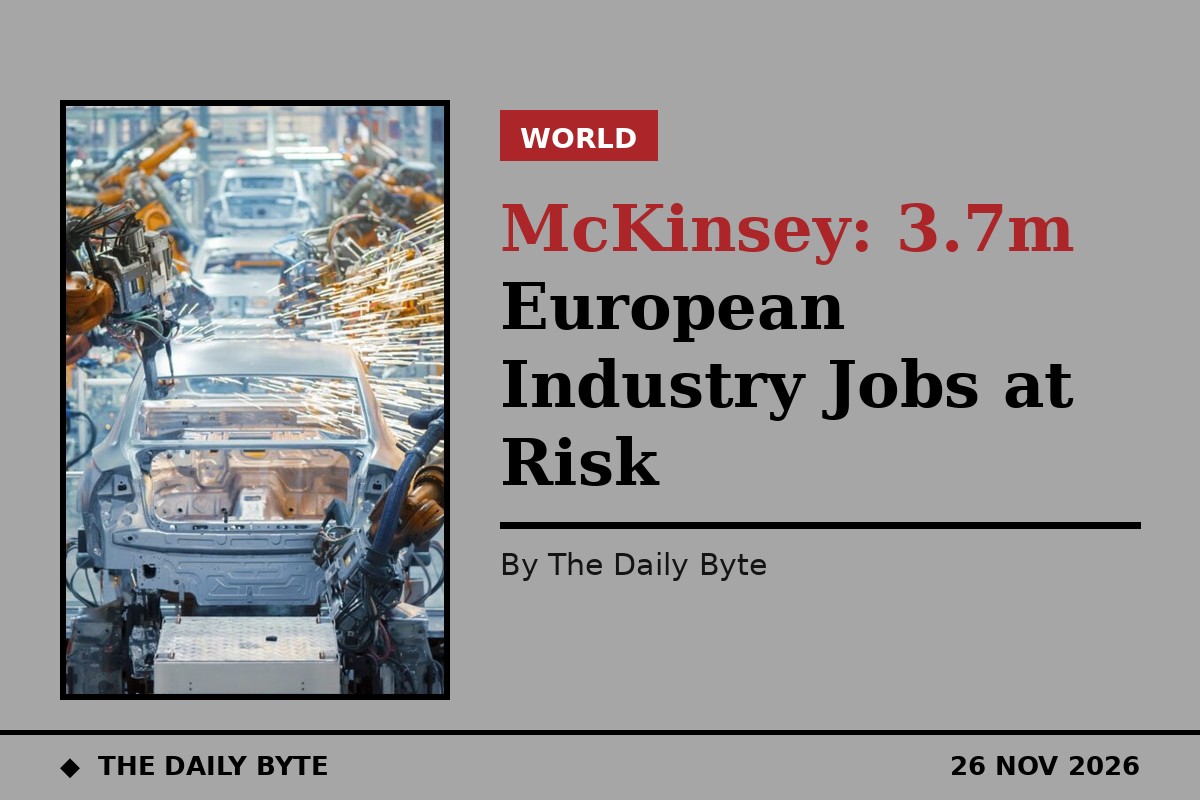
Almost half of Europe's large industrial companies are now in financial stress or distress, putting about 3.7 million jobs and more than 500 billion euros of value added directly at risk, according to a new report from McKinsey & Company published on 25 November.
The consultancy's Industrial Financial Health Index, which covers almost 1,200 listed and privately held manufacturers across Europe, each with more than 100 million euros in annual revenue, found that about 45 per cent of the companies were stressed or distressed in 2025. That was up from 42 per cent in 2024 and 39 per cent in 2023, and preliminary data for 2026 suggest the slide is accelerating, with the share reaching roughly half.
McKinsey describes the problem as structural rather than cyclical, driven by high labour and energy costs and intensifying competition from Chinese rivals. Its message, however, is that the decline is fixable: the report points to European companies that have turned themselves around at scale under the same conditions.
Half of large industrials under strain
The index sorts companies into healthy, stressed or distressed. In 2025, 9 per cent were stressed and 36 per cent distressed, making 45 per cent in difficulty. Early figures for 2026 point to about 50 per cent, with most of the trouble in the distressed category rather than mild stress.
The stakes are high because industry is a backbone of the European economy. McKinsey puts the sector at about 36 per cent of the region's value added, 29 per cent of jobs and more than 45 per cent of research and development spending.
The report warns of a spiral: lower productivity leads to worse unit costs, which cut returns, raise financing costs and depress investment. Gross productive investment in Europe has remained roughly flat at about 3 trillion dollars in 2025, McKinsey says, while China's has soared to about 6 trillion dollars over the past three decades.
Why costs are biting
Labour and energy sit at the heart of the squeeze. McKinsey's analysis finds Chinese output per worker is now about 1.5 times Europe's, while European industrial energy costs average more than 1.5 times those in China and the United States. For the total European industrial value chain, more than half of the combined cost base is adversely affected.
Electricity prices illustrate the gap. McKinsey cites average European industrial power prices of just under 150 euros per megawatt-hour, against just over 75 euros in the United States and under 100 euros in China.
The report follows a series of warnings about European competitiveness, including former European Central Bank president Mario Draghi's 2024 report, and lands as EU leaders meet in Brussels this week to discuss the bloc's next long-term budget.
No country is immune
No country is immune, the report says. Portugal, Luxembourg, the Netherlands and Spain show a very high share of industrial companies in stress or distress, and Germany's share increased by 12 percentage points between 2024 and 2025. Norway also saw a strong increase, while Finland and the United Kingdom saw decreases.
The pressure is spreading across the major manufacturing segments, from machinery and automotive to electrical equipment and materials, according to the study.
Turnarounds are possible
McKinsey argues the problems are structurally fixable and points to five recent European case studies. A chemicals producer swung to more than 1 billion euros in positive free cash flow, an automotive supplier tripled its operating earnings, and a components maker doubled its share price.
There is no single fix, said Tunde Olanrewaju, McKinsey's European managing partner. The successful turnarounds combined commercial measures, cost control, manufacturing improvements and portfolio changes, run through a dedicated task force rather than the usual line organisation.
The report cautions that turnarounds are hard: about 70 per cent of transformations miss their targets, according to earlier McKinsey research, and about 55 per cent of the value is lost in implementation. But it concludes that at-scale performance transformation is achievable in Europe's constrained environment, and that the companies that act decisively can break the narrative of decline.


