Medieval Sudan cathedral floor uncovered at Old Dongola
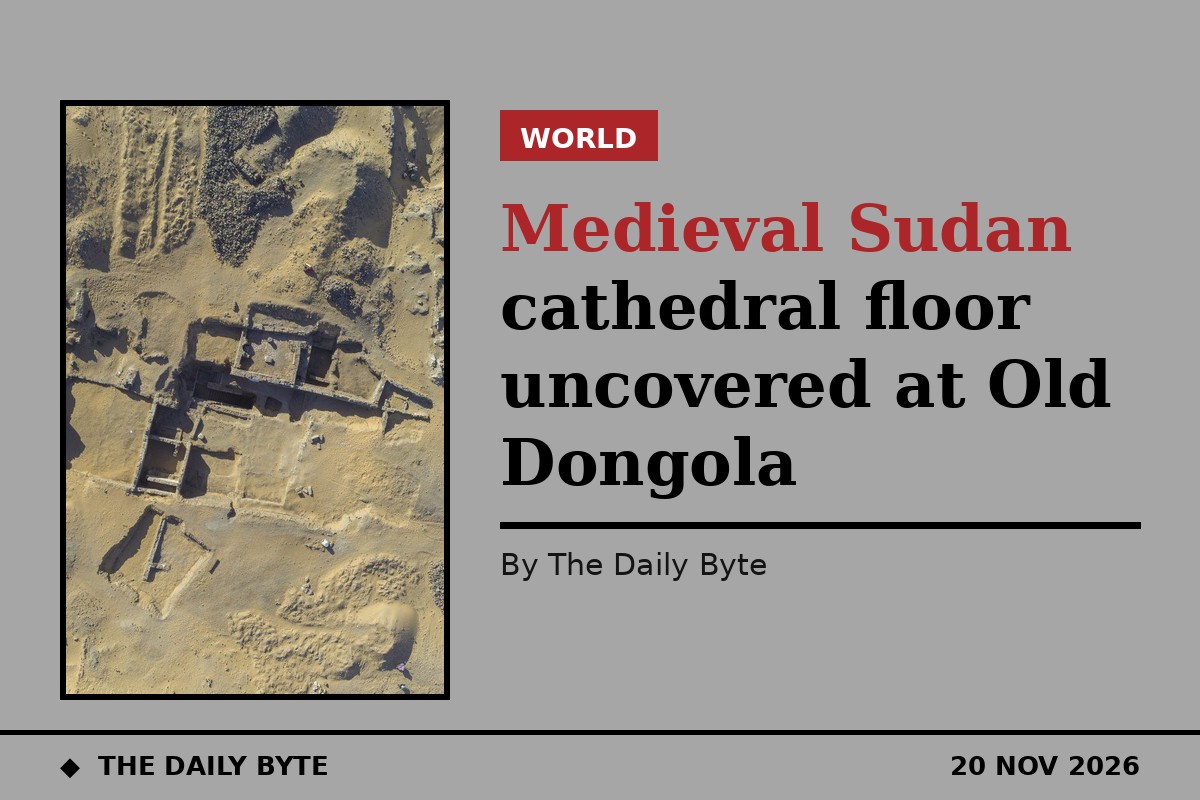
Archaeologists working at Old Dongola in northern Sudan have reached the original floor of a monumental medieval cathedral for the first time, revealing the scale of one of the largest churches of Christian Nubia.
The Sudanese-Polish team uncovered a monumental staircase leading into the Great Church of Jesus, along with buttresses supporting its apse, in work announced by the Polish Centre of Mediterranean Archaeology at the University of Warsaw on 4 November. The staircase is the one place where excavators have so far reached the floor level. Sudan's antiquities authority later clarified that the widely reported findings came from the previous field season, with archaeological work continuing in 2026 under Sudanese authorisation and supervision.
Old Dongola, known in medieval times as Tungul, was the capital of Makuria, a Christian kingdom that flourished along the Nile. The church stands on the east bank of the Nile, about 160 kilometres south-east of the modern town of Dongola. The excavation is run by the Polish centre in cooperation with Sudan's National Corporation for Antiquities and Museums, under Professor Artur Obluski.
A building larger than the White House
Researchers estimate the church measured about 47 metres wide and 57 metres long, with a height of around 21 metres. Walls beside the staircase still stand about 11 metres high, which means the team must dig through exceptionally deep deposits to expose more of the building. Only a small part of the church has been opened so far.
"This was a building larger than the famous White House in Washington, DC, and we are planning to excavate it," Obluski said. He compared the church to Hagia Sophia in Constantinople, suggesting the Great Church of Jesus may have been a trendsetter for church architecture in Nubia and beyond.
The team first identified the structure as the probable Great Church of Jesus in 2021. Its size and position inside the walled city now raise a question over the long-held view that Dongola's cathedral was a church outside the city walls, whose role will need to be reconsidered.
A second church and Greek inscriptions
The excavation also produced an unexpected find: the remains of another church built on the upper floor of a structure added to the cathedral. Its walls survive to only about one metre high, but the interior was once richly painted. Archaeologists have recovered so many fragments of painted plaster that they now fill six large shelving units.
Among the debris were plaster fragments bearing inscriptions in Greek, identified by epigraphist Dr Agata Deptula as fragments of biblical odes, prayer songs attached to the Psalter. One text comes from the Prayer of Hannah, mother of the prophet Samuel, written in a careful book hand with letters only about half a centimetre high. Psalm texts were already known from Old Dongola, but the odes are new to the site's written record.
The team plans further excavation to establish the church's full dimensions and layout, a task that will need deeper digging and more funding. The work forms part of the European Research Council project Afropolis Tungul, which traces the city's growth from the 4th to the 15th century. The Polish centre has worked at Old Dongola since the 1960s, and the site has so far escaped damage in Sudan's civil war, although UNESCO estimates more than 100 cultural sites have been damaged, looted or destroyed since fighting began in April 2023.


