Meloni Scraps Italy School Staff Cuts in Budget
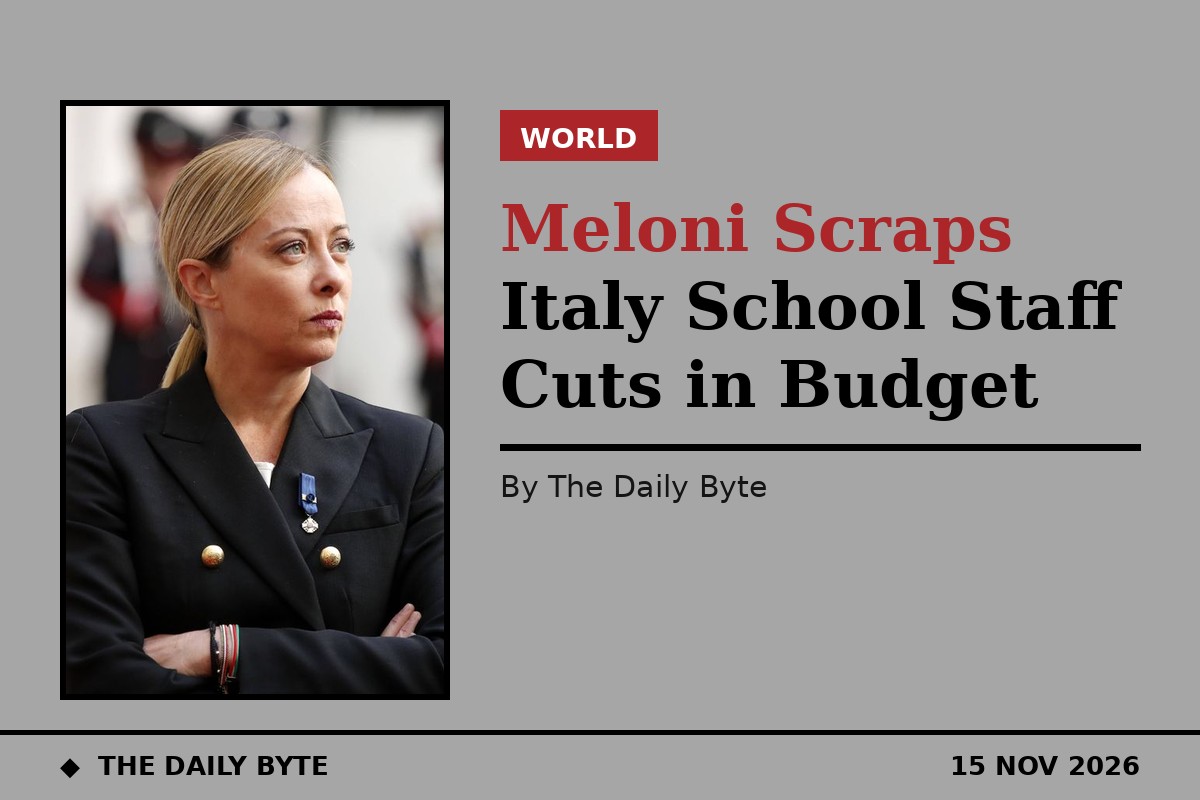
Italian Prime Minister Giorgia Meloni has confirmed that her government will scrap a planned reduction in school staff from the 2027 budget, reversing one of the most contested measures in the spending plan after weeks of protests from unions, teachers and opposition parties.
Meloni made the announcement in a video message on Friday, 13 November, after a meeting with trade unions at Palazzo Chigi in Rome. "During today's meeting with the trade unions, the government officially confirmed that it intends to scrap the measure that had caused particular discontent in the education sector," she said.
At the same time, she pushed back against the description of the measure as a cut. "To be clear, no teacher would have lost their job, no ATA staff member would have been made redundant, and no class would have been closed," Meloni said, using the Italian term for administrative, technical and auxiliary school staff.
What the measure would have done
The draft 2027 budget law, approved by the cabinet in late October, said school staffing levels should fall by 4,925 teaching posts and 2,049 non-teaching posts from the 2027-2028 school year. The government also planned a 75 per cent cap on hiring replacements for retiring public-sector staff, with estimated savings of 336 million euros over 2027-2028.
School-sector reporting put the annual saving from the staffing measure alone at about 252 million euros from 2028. The measure followed earlier reductions in the 2025 budget law, which cut 5,660 teaching posts and 2,174 non-teaching posts.
Meloni defended the original proposal as an adjustment to falling pupil numbers rather than a cut to education. She said Italian schools had lost almost 800,000 pupils over the past ten years because of the falling birth rate. Official data show pupils in primary and secondary schools fell from 8.4 million in 2017-2018 to 7.7 million in 2024-2025.
Not yet law
The reversal is not yet final. The measure can only be removed through a parliamentary amendment, and amendments to the budget are due in the Chamber of Deputies by Tuesday, 17 November. The government must also show how the expected saving will be replaced or absorbed, since Economy Minister Giancarlo Giorgetti has insisted that budget amendments must carry funding and preserve the overall balances.
Opposition parties welcomed the change while questioning whether it would hold. Five Star Movement leader Giuseppe Conte said Meloni was backtracking on the school cuts, "although last year's staff cuts remain in place", and said his party would keep pressing for a review of health spending as well.
Democratic Party leader Elly Schlein, speaking in Milan, attacked the wider budget, accusing the government of raising military spending by 14 billion euros while squeezing public health. Her party has said it will press other opposition parties to block cuts to health and schooling.
Unions keep up the pressure
The unions have not called off their mobilisation. The CGIL trade union confederation still has a general strike scheduled for 20 November, and school assemblies are planned for 16 November. Union leaders have said they want concrete commitments and guaranteed funding before the parliamentary vote, not only assurances in a meeting.
Education Minister Giuseppe Valditara had already signalled a step back before the Palazzo Chigi meeting, telling Corriere della Sera that the government was working to eliminate the staffing reductions.
The episode shows how tightly constrained Meloni's budget is. With EU deficit limits, rising energy costs and a slow-growing economy, the government has little room for extra spending, and every concession in one area has to be paid for in another. The test now is whether the amendment tabled by 17 November actually removes the measure, and what replaces the saving it was meant to deliver.


