MEPs Call for Black Sea Shipping Protection
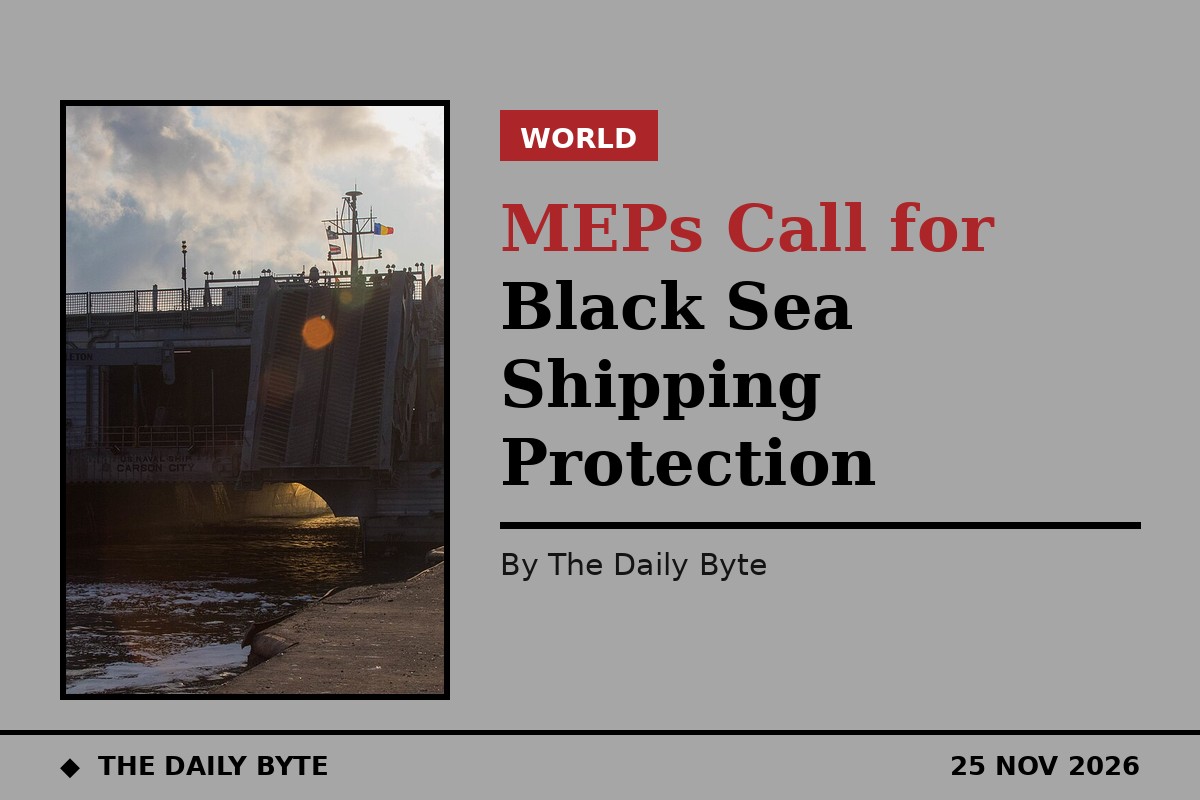
Members of the European Parliament have urged the European Union to do more to protect commercial shipping in the Black Sea and to compensate Romania and Bulgaria for the damage caused by repeated attacks on merchant vessels. The calls came during a plenary debate in Strasbourg on Monday, 24 November, on the security challenges facing member states along the EU's eastern border. No new money was promised, and no resolution was adopted.
What MEPs asked for
Bulgarian MEP Elena Yoncheva, speaking for the European Conservatives and Reformists group, called for a dedicated regional fund and for the Commission to examine compensation for economic losses, pointing to rising insurance costs, reduced activity in shipyards and pressure on fisheries. Her Bulgarian colleague Stanislav Stoyanov, of the Europe of Sovereign Nations group, made a similar case for a European compensation mechanism, warning of risks to shipbuilding jobs, cancelled orders and consequences for fisheries, tourism and the marine environment.
Romanian MEP Dan Barna, speaking for Renew Europe, linked the situation to the negotiations over the EU's next long-term budget. He criticised European Council President António Costa's compromise proposal, arguing that cutting security and defence resources was incompatible with the pressures facing eastern-border states, which he said protect the whole Union's security. His intervention came ahead of EU leaders' 26-27 November meeting on the 2028-2034 budget.
Other Romanian members added demands. Adrian-George Axinia, also of the ECR group, said political commitments on border security must be turned into financial assistance and effective protection capabilities. Dragoș Benea, of the Socialists and Democrats, argued for protecting cohesion policy resources and for financing conditions adapted to eastern-border regions.
Nine ships attacked in October
The debate followed an assessment the EU delivered at the United Nations Security Council on 23 November. Ambassador Stavros Lambrinidis, head of the EU delegation to the UN, said nine vessels were attacked in EU member states' waters in October, four of which sank, and four more were attacked during a single weekend in mid-November. The Black Sea is now the deadliest maritime route in the world, with 40 seafarers dead or missing, the statement said.
The EU attributes the broader escalation to Russia, saying the clear objective is to disrupt maritime traffic and make grain and food exports almost impossible, while noting that responsibility for each incident must be established on its own circumstances. Russia has ruled out even a limited Black Sea ceasefire, the statement added, and it called on Moscow to engage seriously, starting with a full, immediate and unconditional ceasefire.
The impact on trade is already visible. Commission transport figures published on 19 November show about 90 percent of Ukrainian grain, oilseed and related exports travelled through the EU's Solidarity Lanes in October 2026, against about 10 percent through Ukrainian Black Sea ports. As recently as June 2026, the proportions were roughly reversed. Trade through the Lanes since May 2022 is estimated at about 335 billion euros.
Bulgaria's authorities have reported the human side of the recent attacks. On 16 November, the transport ministry confirmed the evacuation of all 12 crew members of the merchant vessel BETUL 8, which had capsized. A day later, Bulgarian authorities announced the rescue of all 19 crew members of the gas tanker GAS HUSKY.
No new money announced
Responding in the debate, Commissioner for Internal Affairs and Migration Magnus Brunner said threats facing eastern-border member states should be treated as threats to the entire Union. He recalled the commitment of up to 50 million euros for a joint Romanian-Bulgarian maritime security hub, announced by Commission President Ursula von der Leyen on visits to Bucharest and Varna on 9 and 10 November, aiming to make it operational in 2027. That is separate from 10 million euros each for the two countries' search-and-rescue capabilities.
Charlie McConalogue, representing the Irish Council presidency, called for faster implementation of European security and defence projects. But neither announced a separate compensation fund for the affected maritime industries. Any such support will depend on identifying suitable financial instruments, assessing the economic losses and the negotiations over the Union's future budget. The debate is registered under reference 2026/2985(RSP); individual speeches in it do not amount to a common position of the Parliament or a new financial instrument.
Parliament had set out its concern in a resolution adopted on 22 October, calling for member states to consider an EU naval operation to protect commercial shipping. It passed by 432 votes to 52, with 88 abstentions. The latest debate shows that, a month on, MEPs from the affected region believe the political backing has not yet been matched by protection on the water or compensation on land. The test now falls to EU leaders at this week's summit. Read the full debate report here and the EU's statement to the UN Security Council here.


