Merck Wins German Appeal in Keytruda Patent Fight
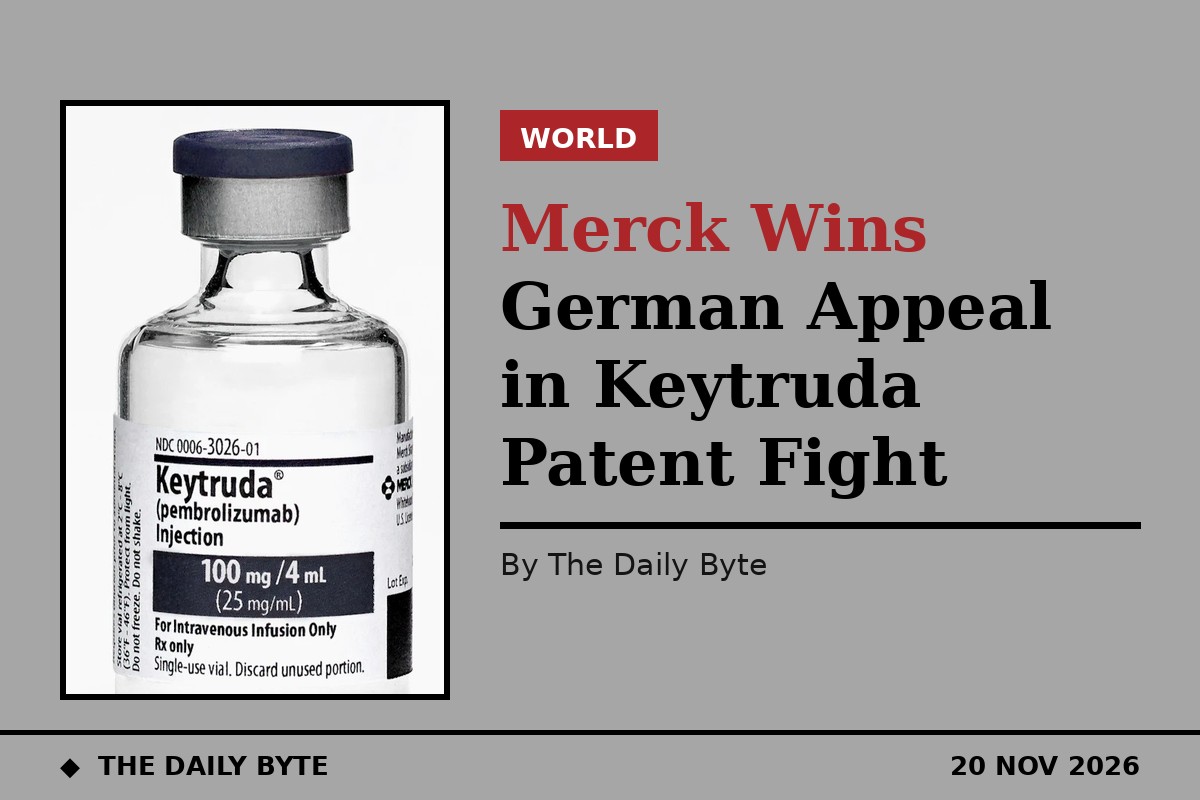
A German appeals court has overturned an order that barred Merck from selling its subcutaneous version of the cancer drug Keytruda in Germany, handing the drugmaker a win in a long-running patent dispute with Halozyme Therapeutics.
The Higher Regional Court lifted a preliminary injunction granted in December 2025, which had prohibited Merck from distributing and offering Keytruda SC, the under-the-skin formulation of the cancer treatment, in Germany. Halozyme said it disagreed with the ruling and planned to file a new patent infringement lawsuit in Germany seeking a permanent remedy.
Halozyme's shares fell 2.9 per cent after the announcement. The stock has still risen 38.3 per cent so far this year, compared with a 5.7 per cent rise for its industry, according to Zacks.
The patent at the centre of the case
The dispute turns on Halozyme's MDASE patent portfolio, which covers technology designed to allow drugs to be given rapidly under the skin using modified human hyaluronidases. Halozyme alleges that Merck's subcutaneous Keytruda infringes its European Patent No. 2,797,622.
Keytruda, known generically as pembrolizumab, is normally given by intravenous infusion. The subcutaneous version offers patients and healthcare providers a faster and less invasive alternative, which makes the ability to market it in major European markets commercially significant.
Halozyme stressed that the MDASE patents are separate from its ENHANZE drug delivery technology, which it licenses to other pharmaceutical companies. It said the outcome of the MDASE enforcement proceedings against Merck was not expected to affect its ENHANZE licensing arrangements or the royalties and fees those agreements generate. Johnson & Johnson uses ENHANZE technology to deliver its multiple myeloma therapy Darzalex, and argenx uses it for the generalised myasthenia gravis therapy Vyvgart.
A split picture across Europe
The German reversal does not settle the dispute, and Merck still faces restrictions elsewhere in Europe. In October 2026, a Dutch patent court ruled in Halozyme's favour in a separate case, prohibiting Merck's European marketing authorisation holder from manufacturing, offering, selling or using Keytruda SC in eight European countries: Belgium, Denmark, France, Ireland, Italy, Sweden, Switzerland and the Netherlands.
The German and Dutch proceedings are separate and independent, so the latest German ruling does not reverse the Dutch court's decision. That means Merck can resume distributing Keytruda SC in Germany, one of Europe's largest pharmaceutical markets, while remaining barred from selling it in the eight countries covered by the Dutch ruling.
Merck has also filed actions in several jurisdictions seeking to revoke the disputed European patent, as part of a broader legal strategy to clear the way for its subcutaneous Keytruda formulation across Europe.
What happens next
Investors will now watch for Halozyme's planned new infringement lawsuit in Germany, and for developments in Merck's patent revocation actions. The status of the Dutch court's restrictions on Keytruda SC sales in eight European countries will also remain relevant, as will any further rulings that widen or narrow Merck's ability to sell the drug across the region.
The case underlines how fiercely contested the market for under-the-skin cancer treatments has become, as drugmakers race to offer versions of established infusions that are quicker to administer and easier for patients to receive.


