Merz Ties EU Budget Deal to Ukraine Funding
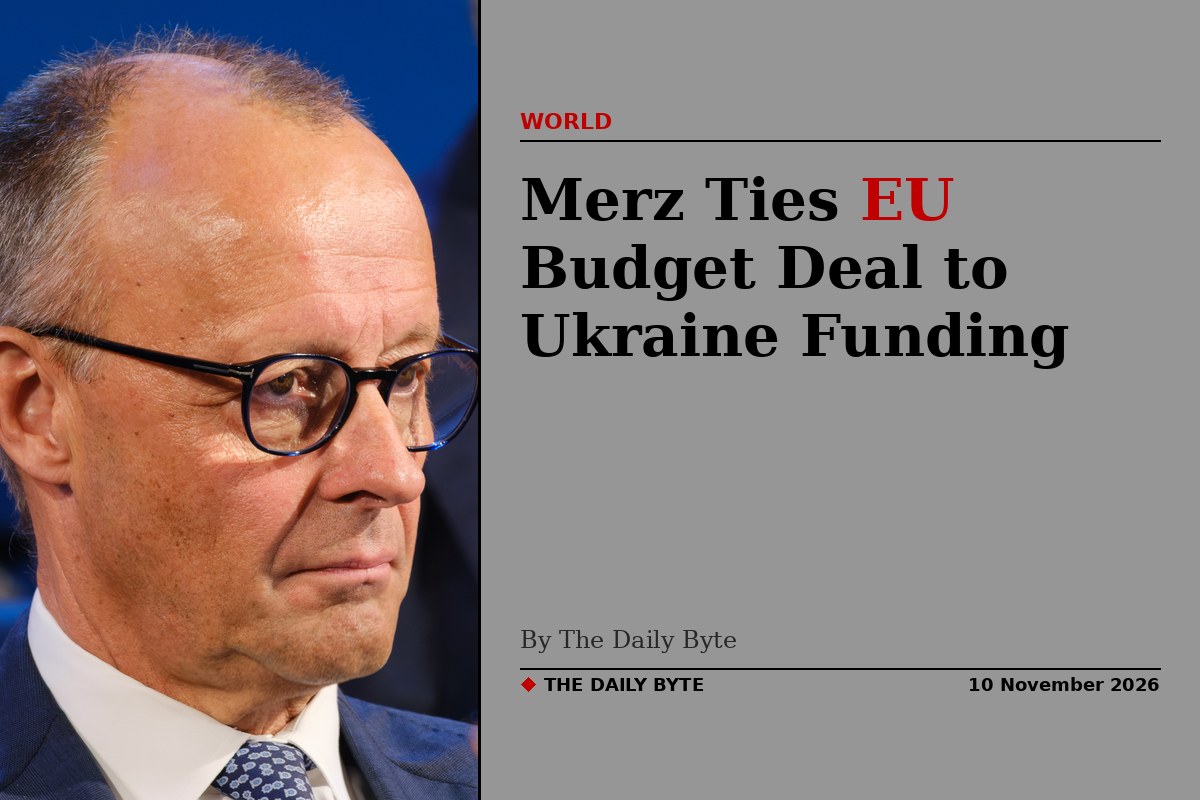
German Chancellor Friedrich Merz has warned he will block the European Union’s next seven-year budget unless every member state commits to financing Ukraine, raising the stakes in the bloc’s most sensitive negotiation of the year.
In a letter dated 6 November to European Council President António Costa, Merz made Germany’s support for the 2028–2034 Multiannual Financial Framework conditional on a collective pledge to close Ukraine’s funding gap. The letter, first reported by the Financial Times, was also sent to European Commission President Ursula von der Leyen.
“A collective commitment that all of us, without exception, will contribute fairly to closing this gap is an essential prerequisite for resolving this issue and for discussing any further matters, particularly those with financial implications,” Merz wrote.
A €70 billion gap for 2027
Ukraine faces an estimated €70 billion financing gap next year, a figure Kyiv’s allies accept as the real shortfall. The EU has pledged to cover roughly two-thirds of that sum, about €45 billion, but four member states — Hungary, Slovakia, Bulgaria and the Czech Republic — have ruled out contributing further.
Merz also wants the next long-term budget to include a solution, backed by all member states, that gives Ukraine a sound, multi-year financing outlook from 2028 onwards, including the interest costs already built up on past loans. Berlin is additionally pressing for future Ukraine funding decisions to be taken by qualified majority rather than unanimity, so that no single government can veto them.
Germany is the EU’s largest net contributor and its biggest funder of Ukraine in cash terms. According to the Kiel Institute, Berlin has provided close to €31 billion in financial support to Kyiv since Russia’s full-scale invasion in February 2022, the most in the EU and the second-highest globally after the United States.
Dublin talks this week
Merz has asked for Ukraine’s financing to be discussed at a lunch of EU leaders in Dublin this week, at an informal European Council meeting. A spokesperson for Costa said the Council president would make time for interventions on Ukraine in Dublin, and that the topic is also on the agenda of the special European Council on 26–27 November.
The ultimatum has already drawn a rebuke from one of the EU’s smallest members. Estonia’s finance minister, Jürgen Ligi, argued that Germany’s demand for deep cuts to the 2028–2034 budget sits awkwardly with its own position, noting that Estonia has given more to Kyiv than Berlin as a share of its economy.
The warning lands as the EU tries to settle two budgets at once: the annual budget for 2027, which the Council and the European Parliament are aiming to agree on Tuesday, and the far larger seven-year framework that must be in place by 1 January 2028. Merz’s move links the two, making agreement on the long-term budget hostage to a deal on Ukraine.
For Kyiv, the timing matters. The US-brokered talks between Russia and Ukraine open in Abu Dhabi on Tuesday, and European governments are anxious to show that their financial support for Ukraine will not run dry whatever the talks produce. Merz’s letter is, in part, an attempt to lock in that support on a rolling basis, even if elections next year bring to power leaders opposed to further aid.
Whether the gamble works depends on the four holdouts. Hungary, Slovakia, Bulgaria and the Czech Republic are all net recipients of EU funds, and three of them already secured an opt-out last year from interest payments on the €90 billion EU loan for Ukraine agreed in spring 2026. Persuading them to pay more, rather than less, will be the test of Merz’s ultimatum when leaders meet in Dublin.


