Merz: Europe to Join Ukraine Talks, UAE a Venue
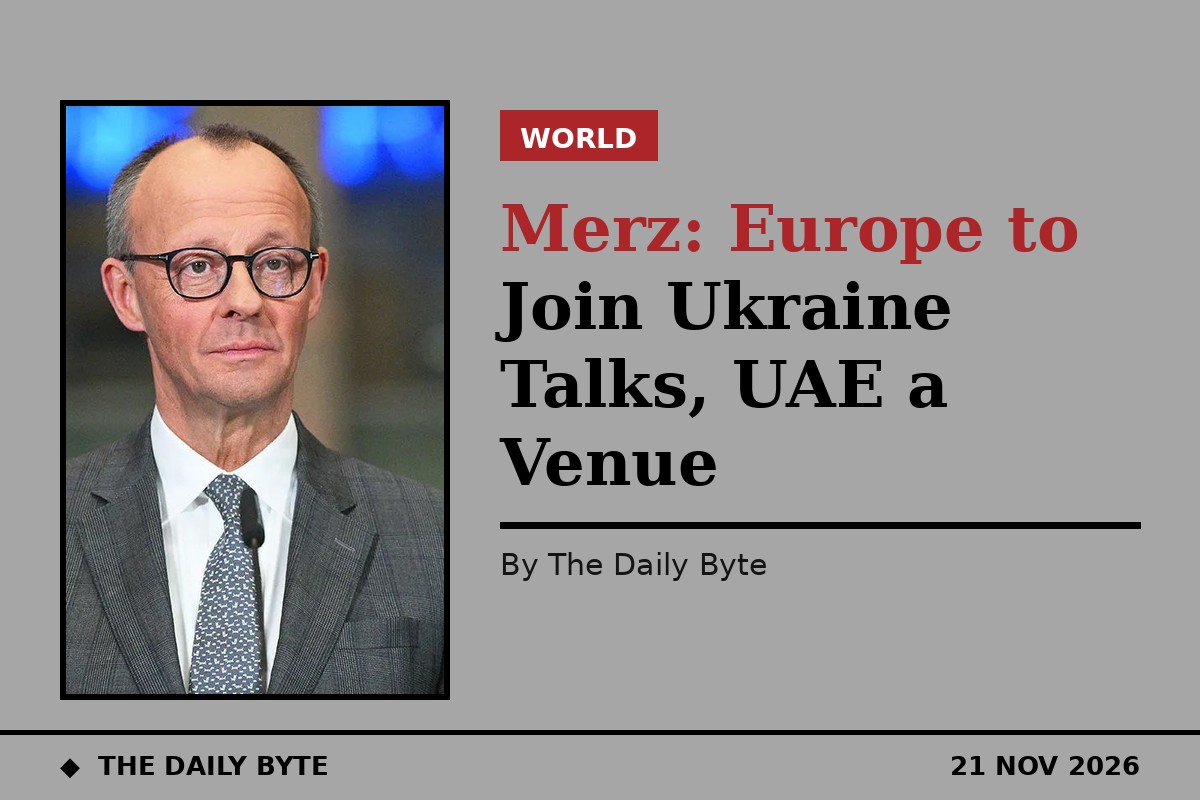
German Chancellor Friedrich Merz has said he expects new Ukraine peace talks to take place soon, with Europe now set to have a seat at the table alongside the United States, Russia and Ukraine. Speaking in Berlin on Thursday, 19 November, after a summit of the Coalition of the Willing, Merz said officials were looking for a venue on neutral ground and named the United Arab Emirates as a possible location. No date has been set and no venue has been chosen.
Merz said the talks should take place in a four-party format of Ukraine, Russia, Europe and the United States. Under an arrangement agreed by European leaders in Dublin, Europe would be represented by Germany, France, the United Kingdom, Poland and Italy, together with the European Union’s institutions. The Berlin summit brought together leaders from more than 25 countries, with 40 allied delegations taking part, and was hosted by Merz with British Prime Minister Andy Burnham and French President Emmanuel Macron.
The chancellor rejected the idea of holding the talks in Moscow, after President Vladimir Putin said through diplomatic channels that he had invited European leaders to the Russian capital to explain why they should take part. Merz said a Yalta format cannot bring peace, a reference to the 1945 summit at which the United States, Britain and the Soviet Union carved up post-war Europe. He gave each participant in Berlin a piece of the Berlin Wall, saying it had brought oppression, insecurity and a lack of peace, and adding: “That is exactly what Yalta stood for.”
The Berlin meeting took place only hours after an unprecedented three-way summit in Shenzhen, China, between US President Donald Trump, President Putin and Chinese leader Xi Jinping, which had raised fears in European capitals that decisions on Ukraine could be made over the heads of Kyiv and Europe. Trump joined the Berlin talks by telephone from Air Force One on his way back from Shenzhen. His envoy Jared Kushner, who led the American participation in Berlin, said Russia had agreed to take part in a multilateral format with Europeans, and that Trump wanted Europe involved in any deal rather than imposing one unilaterally.
What Europe wants from the table
Kushner said Trump was open to extending to Ukraine a security guarantee similar to NATO’s mutual defence clause, while stressing that Washington had to protect its own interests too. “From America’s perspective, giving an Article Five-like security guarantee is a really, really big deal,” he said. Macron called on allies to do the maximum to deliver the air defence systems Ukraine needs and urged them to reopen the question of Ukraine’s NATO membership, while President Volodymyr Zelenskyy said he saw a huge chance for peace if the United States really put pressure on Putin.
European Commission President Ursula von der Leyen told the summit that peace depended on putting Ukraine in a position of strength, pointing to the Commission’s proposal for a new 45 billion euro loan for Ukraine, and said the EU would keep increasing pressure on Russia until Moscow agreed to sit at the negotiating table, with a 22nd sanctions package on its way. European Council President António Costa said the coalition’s support, including future security guarantees, was essential to any peace agreement.
The Abu Dhabi precedent
The United Arab Emirates has already hosted one round of US-mediated talks between Russia and Ukraine, on 10 and 11 November in Abu Dhabi, which ended with an agreement in principle on a major prisoner exchange but no comprehensive ceasefire. That precedent is part of the reason Merz named the Gulf state as a possible venue, though he stressed that the location still had to be found and should be neutral.
There is still no agreement on the format, the venue or a timetable. Putin has questioned the need for a European negotiating team, ruled out defence ties of any kind between Ukraine and Europe, and warned that Russia’s response to Ukrainian attacks on the bridge linking occupied Crimea to Russia would be far more painful. For now, Merz’s announcement is a stated plan rather than an arranged meeting, but it is the clearest sign yet that Europe expects to be in the room when the next round begins.
Sources: The Straits Times via The Sun Report and Pollar and FreeMalta, based on Deutsche Welle.


