Merz: Germany Faces Historic Antisemitism Test
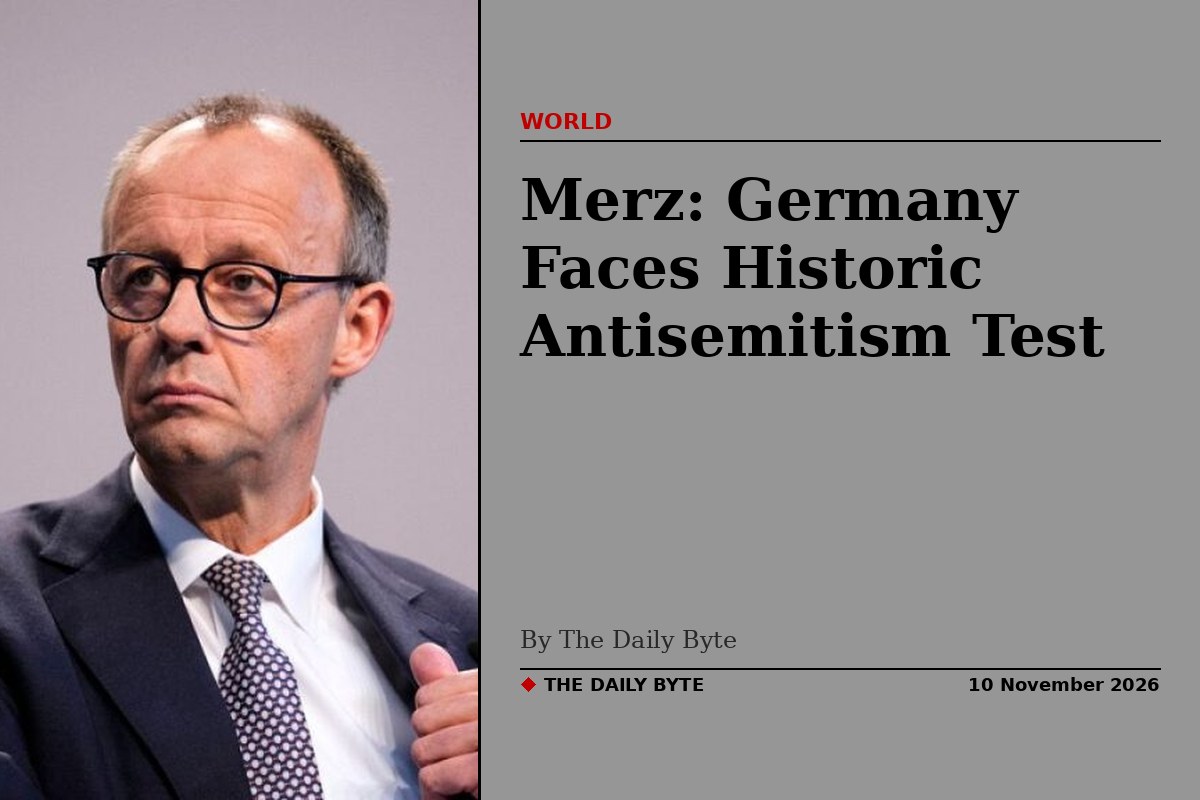
Chancellor Friedrich Merz has said Germany faces a historic test of its commitment to protecting its Jewish community, as he warned that antisemitism in the country has become "omnipresent". He was speaking on Monday 9 November at a synagogue in Munich, on the anniversary of the Kristallnacht pogrom of 1938.
Merz decried what he called the "horrifying sight" of kindergartens and synagogues protected by bulletproof glass and armed police, and said the moment had come to prove that the promise of "never again" still means something in practice.
"And that is why this is now the moment of truth for the 'Never again' that we utter so often," he said, according to Reuters. He said his government would do everything in its power to protect Jewish life in Germany and abroad, and restated Germany's longstanding support for Israel, which he said "is part of our historical responsibility".
A grim anniversary
Kristallnacht, or the Night of Broken Glass, was a wave of killings of Jews and the looting and destruction of their property that began on 9 November 1938. It foreshadowed the Nazi Holocaust, in which more than six million European Jews were murdered. Commemorations are held across Germany every year on the anniversary, but this year's speech carried a sharper warning than most.
Merz's address came as official monitoring shows antisemitic incidents in Germany running at a scale not seen in modern times. According to the most recent annual report from RIAS, a monitoring group, antisemitic incidents have been occurring on a "dramatic scale" since the start of the Gaza war in 2023.
Incidents more than triple 2022 levels
RIAS recorded 8,725 antisemitic incidents last year — more than three times the number in 2022, or around 24 every day. The figures cover incidents ranging from threats and harassment to vandalism and assault, and the group says the true total is likely higher because many incidents go unreported.
The rise has put Jewish schools, synagogues and community centres under visible security. Armed police patrols and reinforced entrances have become a familiar sight, and community leaders have warned that many Jewish families now think twice before wearing visible signs of their faith in public.
What the government promises
Merz used the Munich speech to give a direct assurance that the state would stand behind Jewish life in Germany. He pledged that his government would use all the powers at its disposal to protect Jewish communities, and he linked that duty explicitly to Germany's history and to its responsibility towards Israel.
The chancellor's warning also reflects a wider European concern. Antisemitic incidents have risen across the continent since 2023, and governments in France, Britain and other countries have reported similar patterns, with Jewish institutions stepping up security and police increasing patrols around synagogues and schools.
For Merz, the test he described is not only about policing. He framed it as a question of whether Germany can keep the promise made after the Holocaust — that Jewish life would be safe in the country — at a time when the evidence suggests that promise is under strain. The anniversary speech was his answer: that the commitment must now be proved in deeds, not only in words.


