Merz Floats Gradual Easing of Russia Sanctions
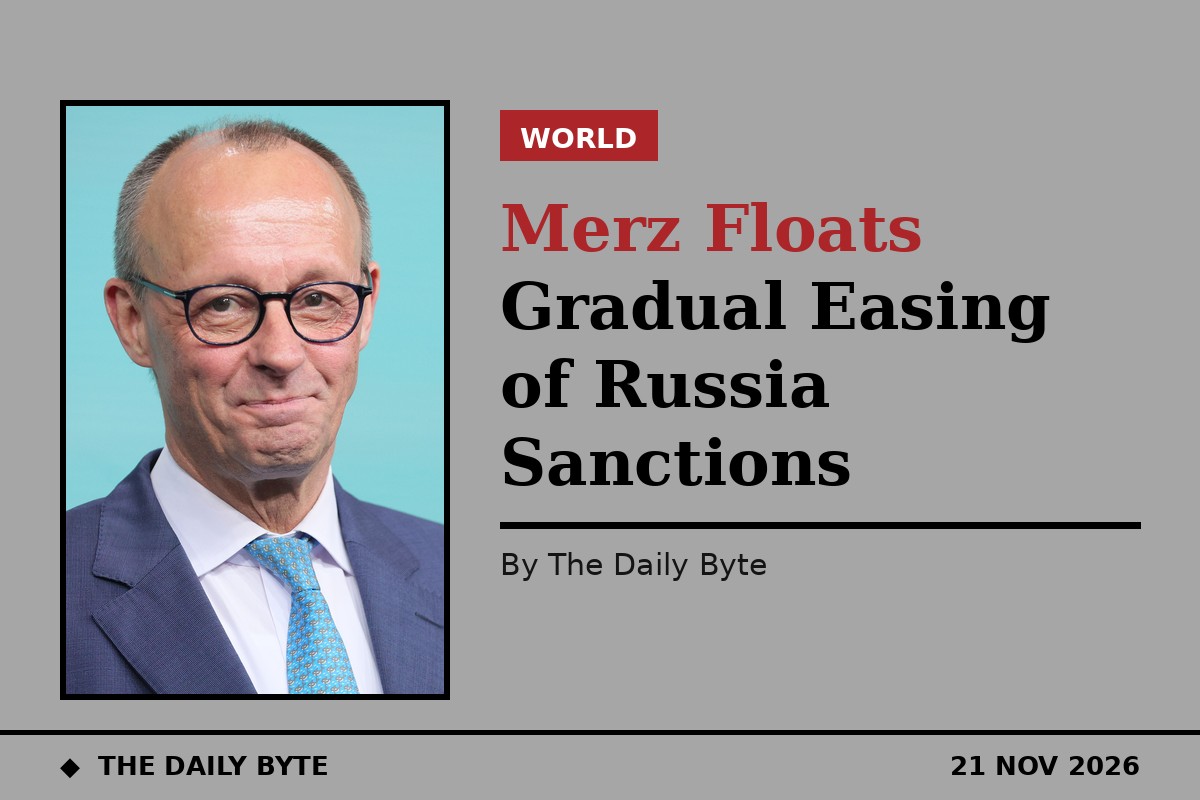
German Chancellor Friedrich Merz has raised the prospect of lifting sanctions against Russia gradually, in return for a ceasefire in Ukraine and concessions from Moscow.
Merz spoke at a press conference in Berlin on Thursday 19 November, after hosting a meeting of the Coalition of the Willing, the group of countries giving political and military support to Ukraine. More than 30 countries took part, the largest meeting of the group so far, according to the German newspaper Handelsblatt.
“A Yalta format will not bring peace,” Merz said, referring to the 1945 conference at which the victorious Allied powers divided Europe. He said there could be no peace in Ukraine without the Europeans, and appealed directly to the Russian president: “End the war in Ukraine and let us work together to find diplomatic solutions.”
He added that the coalition would stand by Ukraine for as long as necessary, saying: “The goal, and it remains the goal, is a sovereign Ukraine in a secure Europe.”
The conditions Merz set out
Merz said the current line of contact between Russian and Ukrainian forces should be the starting point for any understanding on territory. Ukraine, he said, must be allowed to continue on its European path and to rely on international help to rebuild the country.
In return, he said, “the gradual lifting of some sanctions against Russia” could be considered, provided certain conditions are met. He stressed that any easing would be conditional and step by step, not a single sweeping removal of the restrictions.
He also set out the order in which he sees a settlement working: first peace in Ukraine, and only then agreements on wider European security. Moscow, he said, was aware that its sweeping security demands of December 2021 were not realistic, but talks with Russia would eventually need to cover military communication channels, risk reduction and transparency.
Merz said the timing of the Berlin meeting was deliberate, coming as the leaders of the United States, China and Russia met in Shenzhen. European leaders have been working to make sure they are not left out of any peace process shaped by Washington, Beijing and Moscow.
Europe’s seat at the table
Merz said Europe would be represented in any peace negotiations by the “European Five”, the United Kingdom, Germany, Italy, Poland and France, together with representatives of EU institutions.
In a joint statement after the meeting, Merz, British Prime Minister Andy Burnham, French President Emmanuel Macron and Ukrainian President Volodymyr Zelensky said they shared broad positions on Europe’s role in talks between Ukraine and Russia. They backed direct dialogue between Kyiv and Moscow, with the United States and European countries taking part, and said a search was under way for a neutral location to host the talks.
As a first step towards ending the fighting, the leaders called on Russia to agree to a ceasefire covering energy infrastructure for the winter. They also reaffirmed the pledge by NATO allies to provide €70 billion in military equipment, assistance and training in 2026, and at least the same amount in 2027.
Merz said the European Commission’s proposal for a new €45 billion loan to Ukraine for 2027 had received broad European support at the meeting. At the same time, the leaders pledged to increase economic pressure on Russia’s war effort through sanctions and action against attempts to get round them, with the Commission expected to present its 22nd package of sanctions to member states on Monday 23 November.
Advisers from European countries, the United States and Ukraine were due to meet in Berlin on the evening of Friday 20 November to continue the discussions.