Merz Rejects Yalta-Style Deal on Ukraine in Berlin
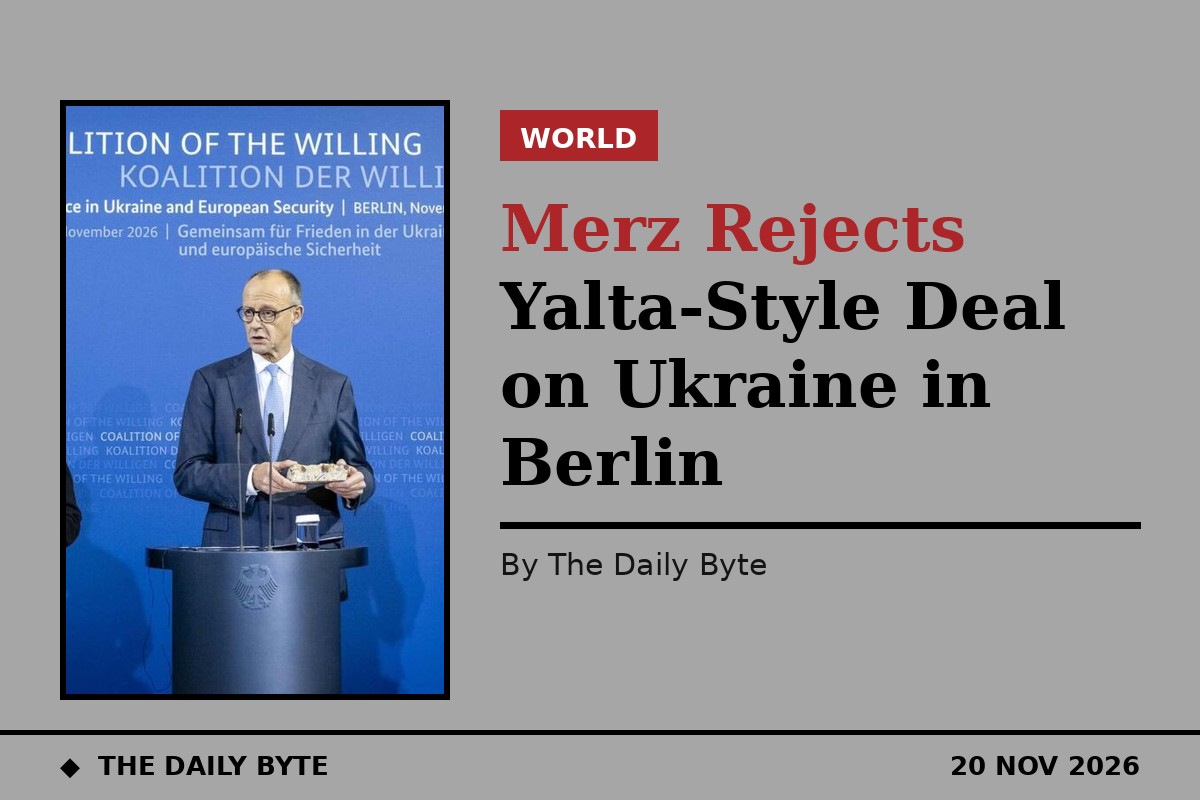
German Chancellor Friedrich Merz has rejected any attempt to settle the war in Ukraine through a great-power bargain struck over Europe's head, warning that a "Yalta-style" format will not bring peace. Speaking in Berlin on 19 November 2026 after hosting a summit of Ukraine's allies, Merz said Europe would not allow the continent to be divided into spheres of influence again.
"At Yalta, Europe was divided up. It was parcelled up. And we won't allow anything like that to happen again," Merz said, according to the Kyiv Post. To underline the point, he presented visiting leaders with fragments of the Berlin Wall.
Why Yalta matters in 2026
The warning was aimed at the trilateral meeting held the same day in Shenzhen, China, where US President Donald Trump, Russian President Vladimir Putin and Chinese leader Xi Jinping held talks billed as historic. The three leaders issued a joint "Declaration toward Peace" covering United Nations reform, petroleum supplies, the International Criminal Court and nuclear risk reduction — but it made no mention of Russia's war against Ukraine, despite the conflict having been discussed.
For European leaders, the image of three major powers discussing European security without Ukraine or its European partners at the table revived memories of the 1945 Yalta Conference, where the United States, Britain and the Soviet Union agreed the post-war order and Europe was divided. Merz dismissed the Shenzhen gathering as "above all a photo opportunity", and insisted that no settlement could be reached without Kyiv and Europe involved.
The Berlin meeting of the Coalition of the Willing, a group of Ukraine's key allies, was Europe's answer. It brought together the leaders of Germany, France, Britain, Poland and Italy, NATO, and Ukrainian President Volodymyr Zelenskyy, along with more than 40 delegations in total.
What Berlin agreed
The summit's joint declaration, issued by Germany, France, Britain and Ukraine, reaffirmed existing commitments by NATO allies to provide €70 billion in military assistance in 2026 and at least the equivalent in 2027, EU Today reported. The EU's €90 billion Ukraine Support Loan will provide further military and financial resources through 2027.
Britain confirmed a £10 billion support package and announced more than 1,000 long-range strike drones for Ukraine, while Britain and Norway announced a joint investment of more than £100 million in two advanced fast attack boats. The coalition also agreed to intensify pressure on Russian energy revenues, illicit financial networks and the shadow fleet of tankers used to evade sanctions.
The message, European leaders said, was that Moscow should not expect Western financial exhaustion to leave Kyiv without the means to keep fighting. Ukraine must enter negotiations with enough military and financial resources to resist unacceptable demands, rather than being forced to accept terms dictated by others.
The road to talks
Merz said new peace talks could take place soon, with European representatives joining Ukraine, Russia and the United States, and named the United Arab Emirates as a possible neutral venue. Europe has agreed on how it will be represented: by the EU, alongside representatives from France, Germany, Italy, Poland and the United Kingdom, with NATO also involved — a joint team of seven for the next round of talks.
US envoy Jared Kushner suggested that Russia was comfortable with security guarantees for Ukraine resembling NATO's Article 5 collective defence provisions, which treat an attack on one ally as an attack on all. But Putin subsequently reiterated his opposition to foreign military deployments in Ukraine, raising questions about what Moscow would actually accept.
Merz also set out his terms for a settlement: the current line of contact between Russian and Ukrainian forces should serve as the starting point for any territorial understanding, Ukraine must remain free to pursue its European path, and Kyiv must receive strong security guarantees once a ceasefire is in place. In return, he signalled that a gradual, conditional lifting of sanctions against Russia could be considered. Wider questions of European security, he said, should be addressed only after peace in Ukraine — "first peace in Ukraine, then agreements on Euro-Atlantic security."
Divisions remain
The summit also exposed disagreements with Washington. Trump telephoned participants from Air Force One during the Berlin meeting and, according to reports citing European officials, questioned the rationale for continuing to spend billions on Ukraine's military needs, arguing that Putin was genuinely interested in negotiating peace. Polish Prime Minister Donald Tusk expressed scepticism about that assessment.
Sources: EU Today and Kyiv Post via EuropeSays.


