Meta launches Muse Ember, its cheapest AI model yet
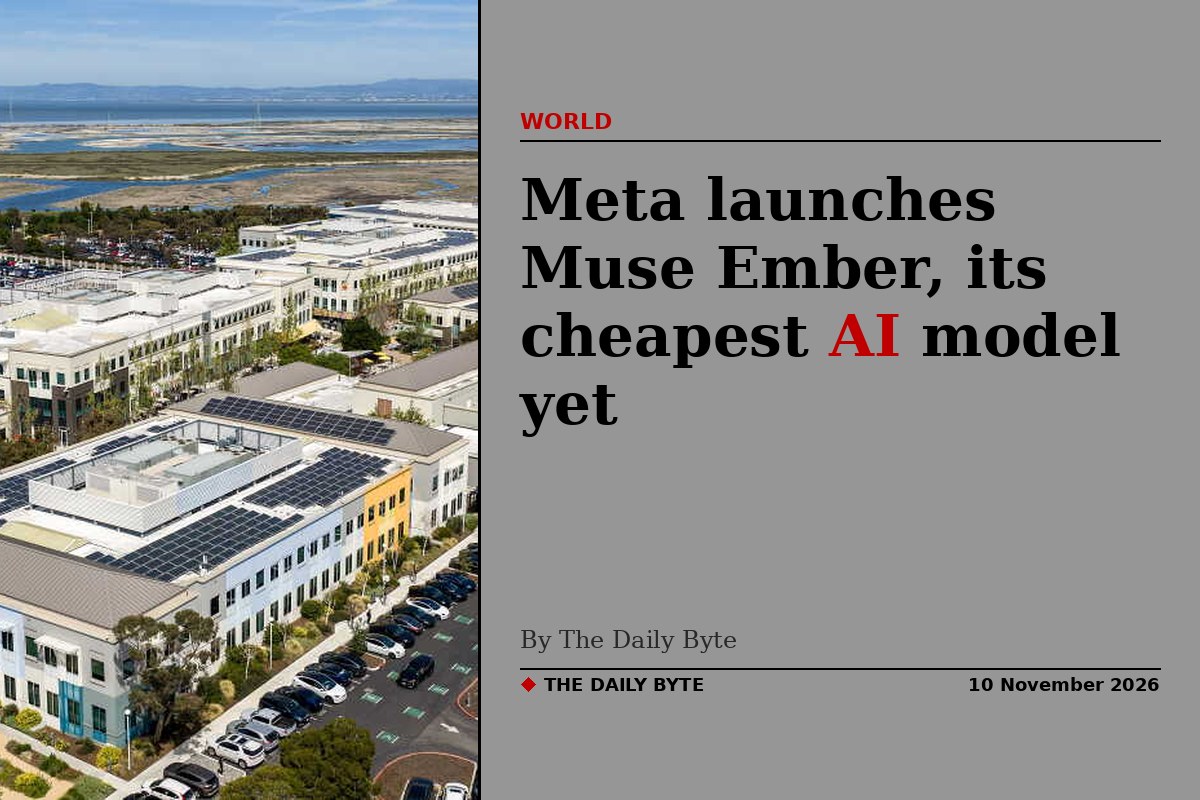
Meta has launched Muse Ember, the smallest and cheapest model in its Muse family of AI systems, built for the repetitive work that AI agents carry out all day. The company introduced the model on Monday, 9 November 2026, and said it is available immediately.
Ember is aimed at the high-volume steps inside agent systems: tool calls, coding subtasks, routing requests, extracting information and parsing long documents. Meta says it delivers more intelligence per dollar than rival small models, matching the best score of Anthropic's Claude Haiku 5.5 on an independent benchmark at about a third of the cost per task. Meta announced Muse Ember on its research blog, and SiliconANGLE reported the launch on the same day.
What Muse Ember costs and can handle
Muse Ember costs 0.10 dollars per million input tokens and 0.50 dollars per million output tokens, with cached input at 0.004 dollars per million tokens. Requests above 200,000 input tokens move to a higher pricing tier. The model is available as muse-ember-1.0 on the Meta Model API and in Muse Code, Meta's coding agent, and is also offered through Google Cloud and Oracle Cloud.
It has a one-million-token context window, so it can take in a whole codebase or a large set of documents in a single call, and it can produce up to 512,000 tokens of output. Ember is multimodal, accepting text, images, audio and video as input, and it supports the Responses API.
How it compares with rival small models
Meta's headline comparison uses the Artificial Analysis Intelligence Index, which combines nine benchmarks. Ember scores 36 on the index, effectively tied with Claude Haiku 5.5 at its highest reasoning setting, and well ahead of OpenAI's GPT-6 Luna, which scores 28. The cost per index task is put at about 0.14 dollars for Ember, against about 0.41 dollars for Haiku 5.5.
Meta says Ember sits on the efficiency frontier of the full Artificial Analysis leaderboard, meaning no model scores higher for less per task. These figures come from Meta and Artificial Analysis, and the benchmark index itself was reset in a new version published on the same day, so comparisons with older scores should be treated with care.
Built by a bigger model
Ember is the first model Meta says it trained using Muse Wonder Full, its largest model. The company presents the Muse family as a team: Wonder plans and reasons through the hardest problems, Spark handles coding and agentic workflows, and Ember carries out the repeatable execution work at scale.
Before release, Meta evaluated Ember under its Superintelligence Scaling Framework, covering chemical and biological, cybersecurity and loss-of-control risks. The model was not released with open weights, and Meta has not disclosed a parameter count.
The launch matters because most of the tokens an AI agent consumes go on small, repeated steps rather than on a single moment of reasoning. A cheaper model that can handle those steps reliably lets developers run agents far more often without the bill rising at the same rate. For Meta, Ember also rounds out a three-tier Muse lineup that competes directly with Anthropic's Claude family and OpenAI's GPT models at every price point.