MI5 must prove its claims in court, Leveson warns after BBC probe
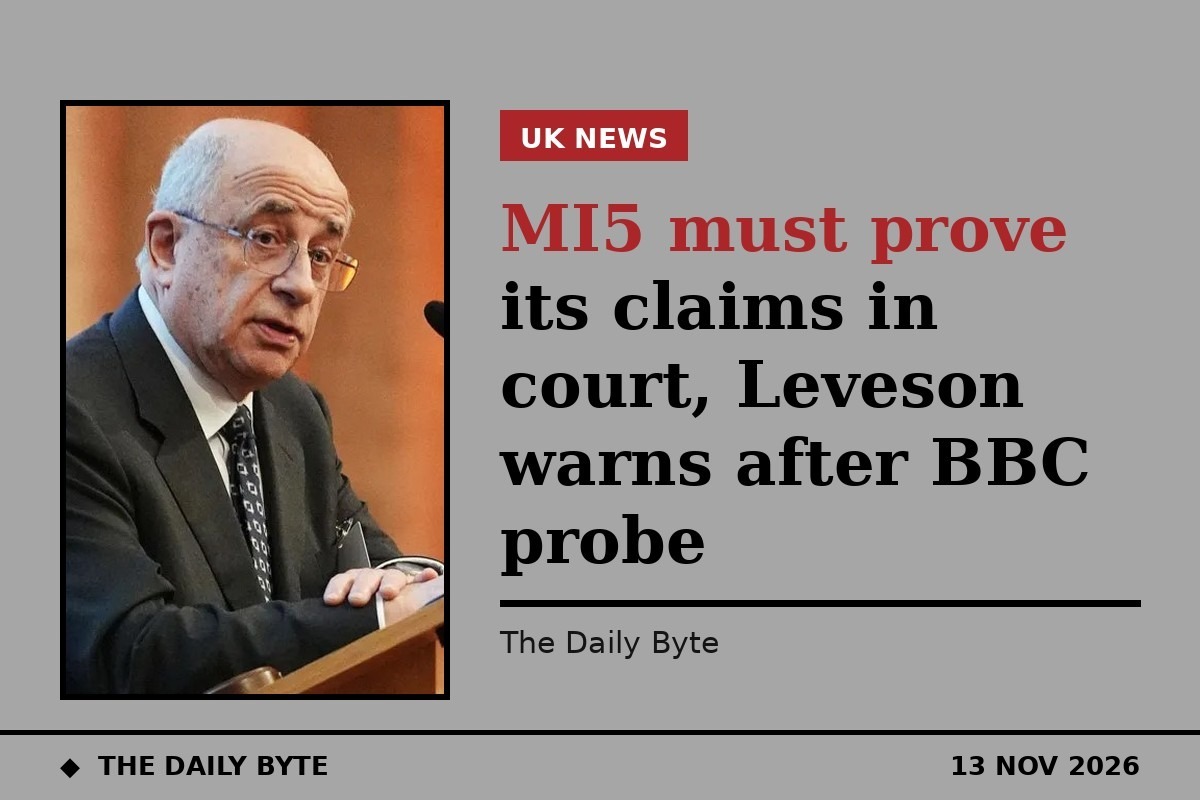
The man who oversees MI5 has warned that the security service will now have to prove what it tells judges, after a BBC investigation exposed how it gave false evidence to three courts. Lord Leveson, the Investigatory Powers Commissioner and a former Court of Appeal judge, said the damage to MI5's standing in court was severe and would take time to repair.
Speaking to the BBC during the first annual conference of the Investigatory Powers Commissioner's Office (Ipco), Lord Leveson said the BBC's investigation had "hit the intelligence community hard", including security services around the world. He said intelligence chiefs from other countries had contacted him to ask whether something similar could happen in their own organisations.
What Lord Leveson said
Lord Leveson said that as a judge, "if the security service said something to me, then I would accept it". That, he said, has now changed. Courts would in future be "far more reluctant to accept, without evidential proof, things that are said in the future".
He added that "MI5 have a great distance to go" with the courts, and said he stood ready to help the police if they asked for his assistance. The High Court declined earlier this month to bring contempt of court proceedings against MI5, saying the police might be better placed to take the matter on.
The Agent X case
The BBC investigation centred on a neo-Nazi informant known as Agent X, who used his role as a paid MI5 source as a tool of abuse. He coercively controlled his partner, known by the alias Beth, and attacked her with a machete. He had previously abused another woman and threatened to kill her child.
Despite what was known about him, MI5 protected the agent and helped him go abroad to continue intelligence work while he was under police investigation, even removing his possessions from a police station.
The false evidence concerned MI5's core secrecy policy of neither confirming nor denying whether someone was an agent. MI5 told three courts it had stuck to that policy, when in fact it had disclosed the man's agent status in telephone calls with BBC journalist Daniel De Simone in 2020, as it tried to persuade him not to investigate the agent. A senior MI5 officer had also tried to cover up for the man, falsely saying he was not an abusive misogynist nor a real extremist, and even suggested the journalist meet the agent.
What the inquiries found
After the BBC's reporting, a secret inquiry by Ipco concluded that MI5 knew the agent was a misogynist who was "obsessed" with violence. At the request of the then Prime Minister, Sir Keir Starmer, Ipco also investigated how the false evidence came to be given to the three courts.
Its report, released earlier this year, found that one senior MI5 officer had lied repeatedly, while another had misled his own colleagues and lied about what he had been told. It also criticised other senior officers and found "serious and systemic failures in MI5's conduct" throughout the case. The officer found to have lied repeatedly has since resigned from MI5.
MI5 has apologised and said it accepted the report's findings "without reservation". On 3 November, the High Court decided not to launch contempt proceedings, while noting that the findings would affect the confidence courts could have in MI5 evidence. The judges suggested that offences such as misconduct in public office or perverting the course of justice might be more straightforward for police to pursue.
Changes since the case
Lord Leveson said the case had led to real changes in how informants, known as covert human intelligence sources, are managed. There is now a new policy covering agents and domestic violence and coercive control.
"There is no doubt that concern is now being focused not merely on the activity of the CHIS, but the impact of the CHIS on other aspects of his or her life," he said. "I think that everybody learns from disasters, and this for MI5 has been a very serious matter."
Ipco's chief executive, Richard Thompson, now attends meetings of an internal MI5 board created to oversee changes arising from the case, including changes to the culture of the service. MI5 must also change the way it prepares and gives evidence, after the High Court case.
Lord Leveson said the Agent X case had "done a great service to everybody", and that the BBC investigation's reach "has been far greater than if this had never happened". The government took the BBC to court in 2022 in a failed attempt to block the investigation into Agent X, although it won him legal anonymity. Beth later sued MI5, and in 2024 sought a review of a ruling at the High Court.
Sources: BBC News; Computer Weekly.