Micron Shares Plunge 10% as Memory-Chip Rout Deepens
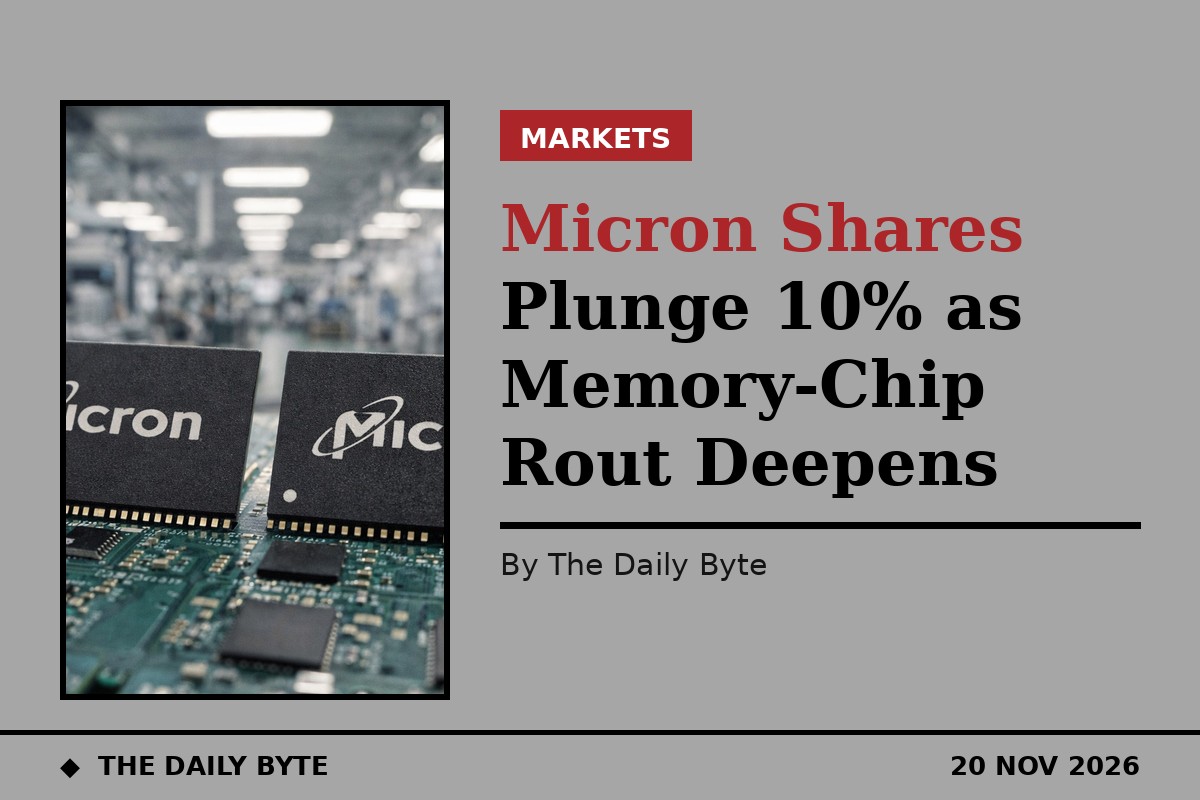
Memory-chip shares plunged on Friday as investors questioned whether the artificial intelligence spending boom can sustain record profits, with SanDisk, Micron Technology and Western Digital all falling by double-digit percentages in afternoon trading in New York.
SanDisk was the biggest decliner, down 14.06% at $81.12, while Micron Technology fell 10.45% to $618.30 and Western Digital dropped 10.12% to $266.76, according to market data compiled by InvestingLive. The falls came on top of sharp premarket losses, when Micron had already dropped more than 5% and SanDisk more than 6% before the opening bell.
The selling was not confined to memory makers. Fourteen AI-linked stocks on the InvestingLive watchlist were down more than 9% on the day, with nine posting double-digit losses. Optical networking groups Coherent and Lumentum fell 11.43% and 10.03% respectively, data-centre power supplier Bloom Energy dropped 12.36%, and Anthropic, the AI developer that made its stock market debut only on Thursday, fell 11.7% to $85.80, barely above its $83 flotation price.
NAND glut warning rattles memory makers
The immediate trigger for the memory sell-off was a warning that the NAND flash market could swing from shortage to surplus next year. GF Securities lowered its flash-memory price forecasts this week, predicting that NAND prices will remain flat during the first quarter of 2027 before declining over the following three quarters. The brokerage projects annual supply growth of 28% in 2027 and 30% in 2028, according to Invezz.
SanDisk is the most exposed of the three memory makers because its business is concentrated in NAND storage chips, and GF Securities said it remains conservative on pure NAND names such as SanDisk. Weaker smartphone and personal computer demand, combined with slower orders from Chinese cloud providers, could leave manufacturers competing more aggressively on price.
Micron has some protection through its broader product mix. The company makes high-bandwidth memory used alongside powerful AI processors, as well as conventional DRAM and NAND, linking its prospects to both data-centre investment and the wider electronics cycle. Management has argued that limited production capacity and demand for advanced products could keep supply tight beyond 2027, but investors are now reconsidering how much they should pay for profits that may be near a cyclical peak.
Still up sharply for the year
Despite Friday's rout, the memory makers remain among the year's biggest winners. SanDisk is still up 173.38% this year after adjusting for its eight-for-one stock split, which took effect at Friday's open, while Micron is up 116.64%. The scale of those gains is part of the problem: with valuations stretched, any doubt about the durability of memory prices gives investors a reason to take profits.
The distance from the year's highs shows how far sentiment has turned. SanDisk was trading 72.44% below its 2026 peak, and Micron 50.73% below its high of $1,255, according to InvestingLive. Friday also marked SanDisk's first session of trading on a split-adjusted basis, which mechanically cut its quoted share price to roughly one-eighth of Thursday's level without changing the company's value.
The broader market mood has shifted, too. "The broader market mood has shifted from buying the dip towards questioning whether the correction has further to run," Daniela Hathorn, senior market analyst at Capital.com, told The Guardian on Friday. The selling followed Thursday's Wall Street rout, when Nvidia fell 3.3% and Advanced Micro Devices dropped 7.7%, and even Anthropic's record initial public offering failed to revive confidence in technology stocks.
The sell-off has created an unusual valuation debate. Companies reporting extraordinary revenue growth are trading at low multiples of projected earnings, suggesting investors doubt how long those earnings can last. Louis Navellier described the depressed prices as an "incredible buying opportunity" in comments reported by MarketWatch, citing forward earnings multiples of roughly 3.69 for Micron and 3.04 for SanDisk. Such measures look inexpensive when memory prices and margins are near their highs, but they become less reassuring if new capacity pushes selling prices down and forecasts are revised lower.
For now, the question hanging over the sector is whether the memory supercycle has peaked. Demand for the chips that power AI systems is still strong, and supply remains tight, but Friday's trading showed that investors are no longer willing to pay any price for that story. The next evidence will come from the memory makers themselves, in their orders, their pricing and their guidance for 2027.
Sources: Invezz | InvestingLive