Microsoft Foundry Managed Compute now generally available
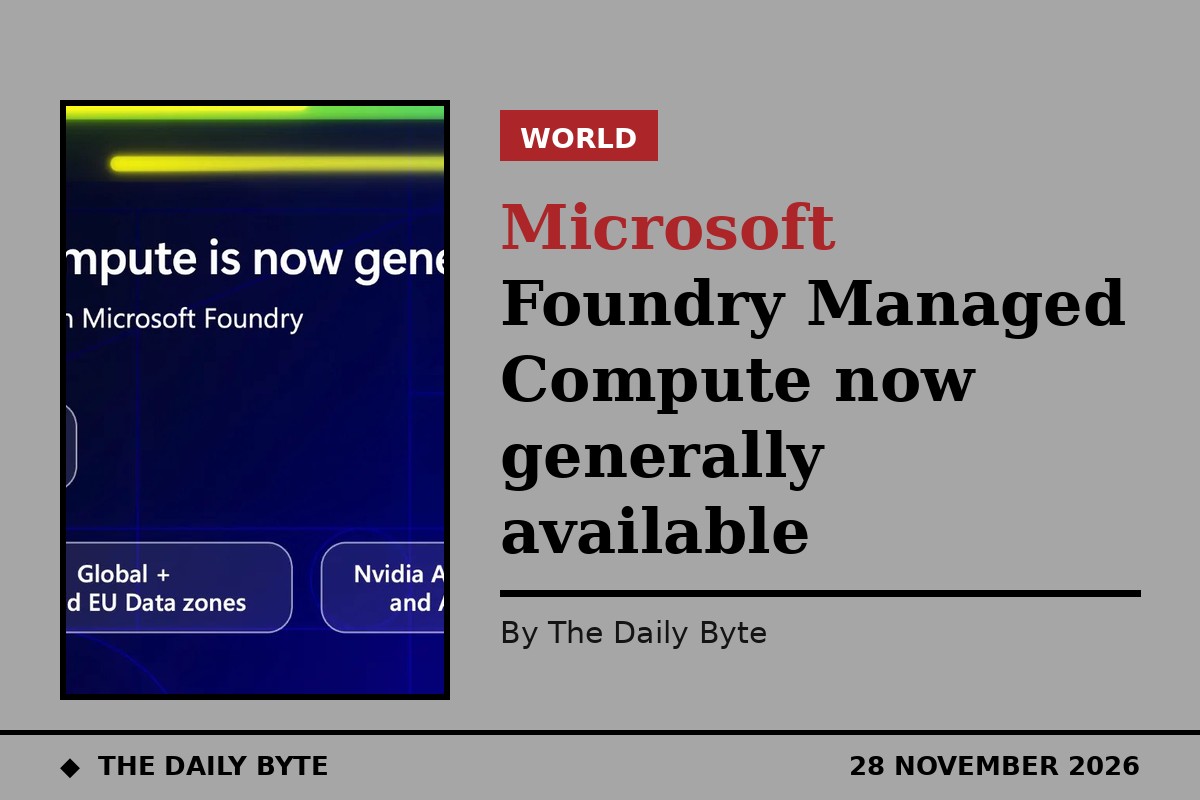
Microsoft has moved Foundry Managed Compute to general availability, giving teams a managed way to run open-weight AI models on dedicated graphics processors without operating the serving infrastructure themselves.
The service entered public preview at Microsoft Build in June 2026. Microsoft announced general availability on 20 November 2026, and confirmed the move again in its Foundry roundup at Ignite 2026 on 24 November. The change matters most in practice because the preview carried no production service-level agreement, while the generally available service can now be considered for production planning.
What Managed Compute does
Teams pick an open model from the Foundry catalog, and Microsoft provisions the GPUs, maintains the containers and operates the serving runtime. The catalog has grown since the preview opened to more than 150 models in the Hugging Face Collection, including DeepSeek V4.1 Flash, Reflection Beam and Meta's Muse Spark Open, alongside NVIDIA's Nemotron 3.5 family for search, document parsing and speech.
Depending on the model, teams can choose NVIDIA A100, H100 or H200 graphics processors, or AMD Instinct MI300X accelerators. Deployments can sit in a global zone or in a US or EU Data Zone, and billing is hourly for each accelerator in use.
To start, a team signs into the Foundry portal, filters the model catalog by Managed Compute under deployment options, picks a model and a deployment template, and tests prompts in the Playground once the deployment is ready. Templates define the context length, serving runtime and GPU configuration, so a team does not have to tune the serving stack itself.
Built for production traffic
As traffic grows, teams add model instances behind the endpoint they already use, with each instance using the number of GPUs in its template. Microsoft says that in its own load test, a DeepSeek V4.1 Flash deployment with five instances processed about five times as many tokens as one with a single instance, and returned fewer HTTP 429 rate-limit responses.
Prompt caching can cut repeated work where the model and runtime support it, and prompt-aware routing sends requests with matching prefixes to the same instance. For leading open models with a high-performing draft model, Microsoft enables speculative decoding to improve inference speed and reduce the effective cost per token.
Microsoft also tightened the supply chain behind the service. Before a model joins the collection, Microsoft reviews its licence, screens for untrusted code and validates its SafeTensors weights, then stages the weights in Azure so deployments load them without connecting to Hugging Face Hub. The serving images are built, scanned and signed, with runtime updates rolled out to existing deployments.
Early users and benchmarks
AT&T is among the early users. The telecoms company added Managed Compute alongside the model-serving platform it built on Azure Kubernetes Service, and used Phi-4, GPT-OSS-120B and Gemma 4 to process about a trillion tokens of telecom data while developing OTel 2.0, its next-generation operations system.
Microsoft partnered with Signal65 to benchmark popular open models on AMD Instinct MI300X graphics processors. In that study, one instance of DeepSeek V4.1 Flash supported 128 concurrent agents on four MI300X GPUs and matched the performance of Signal65's tuned self-hosted serving environment.
Hugging Face's vice president of product, Jeff Boudier, said: 'Open models unlock incredible opportunities for enterprises to build their own AI with the flexibility and control they need.' He added that the partnership with Microsoft makes secure, high-performance deployment of open models 'a one-click experience.'
Two related features remain in preview. Serving of LoRA adapters from Foundry post-training is in preview, and bringing your own weights is in limited public preview. Managed Compute itself, however, is now generally available, and Microsoft lists it alongside voice agents, the Foundry Dev Pack and the Foundry CLI among the Ignite 2026 releases teams can adopt now.


