MiniMax AI breaks cryptography schemes
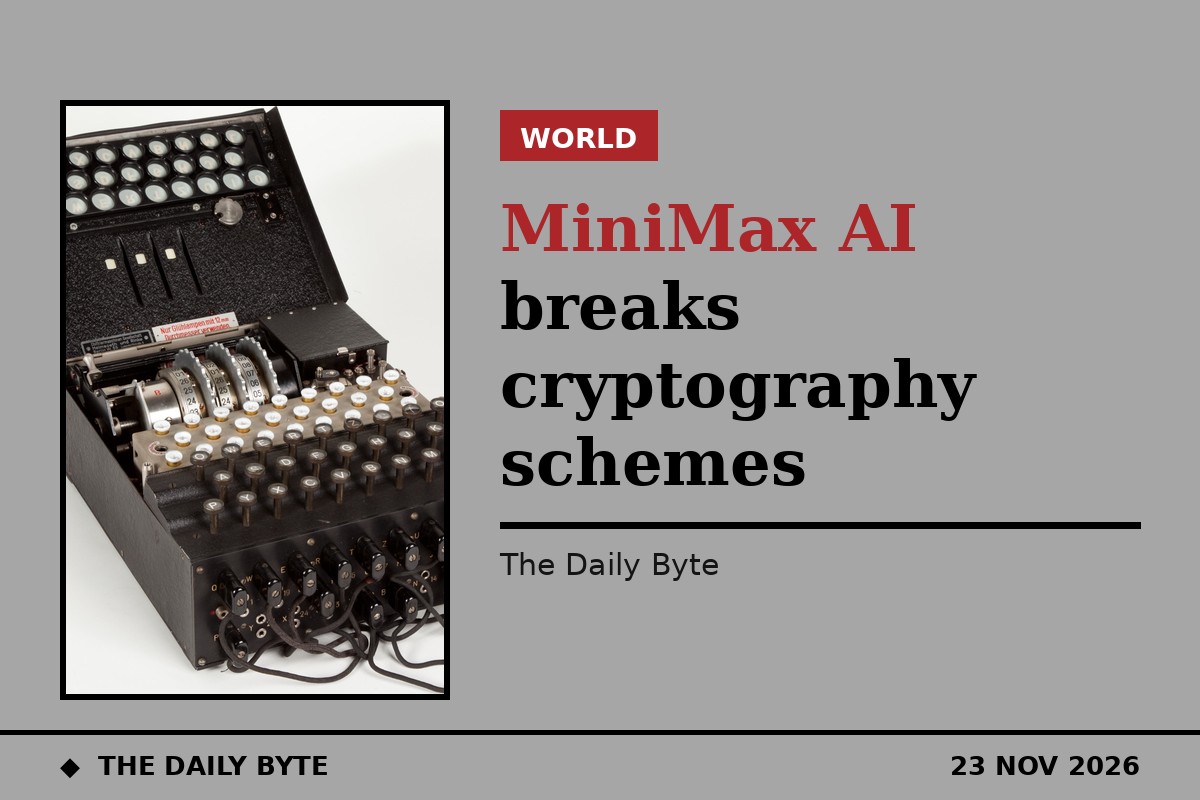
Chinese AI company MiniMax says its internal AI model has produced the first practical attacks against several experimental cryptographic schemes, solving dozens of public challenge problems that had no known solution. The company published technical papers and supporting code on 20 November 2026 and announced the work on 22 November.
The model, which MiniMax calls its Internal Model (MIM), was used to automate cryptanalysis — the study of how to break codes — across encryption, digital-signature and hash-function designs. MiniMax says the findings came mainly from the model itself and were organised and checked by its research team. TechNode reported the announcement on 23 November 2026.
What the MiniMax model actually broke
The headline results come from public challenge problems rather than from systems in everyday use. In the TII McEliece challenge, a set of public-key cryptography problems, MiniMax says the model recovered 94 private keys, including 55 instances with no previously published solution, with speedups of up to 43,400 times over existing implementations.
The work also covers past candidates from NIST cryptography standardisation competitions, where MiniMax reports the first practical attacks on several algorithms that previously had no known practical break. Other findings include practical attacks on selected signature schemes and on reduced-round versions of the ARADI block cipher. VectorWire's account of the disclosure notes that MiniMax also reports recovering a shared secret in its LOCKER post-quantum test case in two seconds.
What this does not mean for your passwords
MiniMax is explicit that the work does not affect the cryptographic standards people actually rely on. The published results concern specific research designs, historical competition candidates and challenge parameters — not AES, RSA or SHA-256, the standards behind banking, messaging and web encryption.
That distinction matters. Breaking a retired competition candidate or a deliberately weakened, reduced-round cipher is a research result, not a sign that everyday encryption is failing. MiniMax says it shared the findings with the affected scheme designers in advance, and that it has published the reasoning traces, technical reports and proof-of-concept code so other researchers can examine the work. The model itself is not public; MiniMax says researchers can apply for test access.
Why AI cryptanalysis matters
Cryptanalysis is a demanding test for AI reasoning because an attack either works or it does not — there is no room for a plausible-sounding but wrong answer. MiniMax's team used a benchmark setup known as CryptanalysisBench, which covers 135 publicly reviewed schemes with no known practical attacks plus seven production-strength challenge schemes.
The results arrive in a week when AI safety is already under scrutiny: OpenRouter dropped three inference providers after a canary test exposed prompt theft, and Together AI disclosed that a coding agent had leaked stored prompts. MiniMax's disclosure is a different kind of warning — that AI systems are getting good enough to do expert-level mathematical attack work, which raises the bar for how new cryptographic designs are tested before they are trusted.
Frequently asked questions
Does MiniMax's work break AES or RSA encryption? No. MiniMax says the work targets academic designs, past competition candidates and public challenge parameters, and does not establish attacks on mainstream standards such as AES, RSA or SHA-256.
What is MiniMax's Internal Model (MIM)? It is an internal-only research model used by MiniMax's research team for automated cryptanalysis. It is not a public product, and MiniMax has not disclosed its architecture or size.
Where can researchers read the findings? MiniMax has published technical reports and proof-of-concept code in its public research repository, and the announcement was covered by TechNode on 23 November 2026.


