Modi Opens First SCO Civilisational Dialogue in Delhi
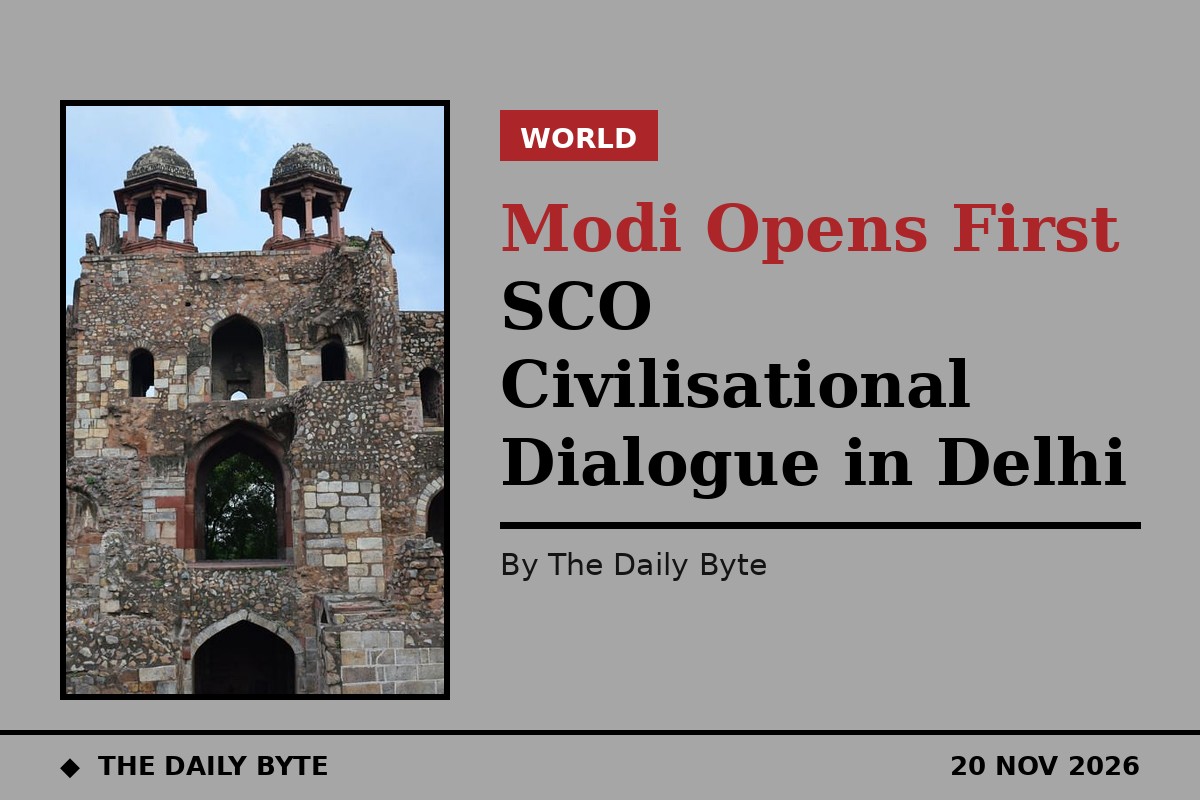
Prime Minister Narendra Modi on Friday inaugurated the first Shanghai Cooperation Organisation (SCO) Civilisational Dialogue Forum at Purana Qila in New Delhi, opening a three-day gathering aimed at celebrating the shared heritage of the SCO's member states and strengthening cultural ties between them.
The forum, which runs from 20 to 22 November, is jointly organised by the Ministry of Culture and the Ministry of External Affairs. It brings together ministers, ambassadors, scholars, artists and cultural representatives from the SCO's ten member states – Belarus, China, India, Iran, Kazakhstan, Kyrgyzstan, Pakistan, Russia, Tajikistan and Uzbekistan – along with observers and dialogue partners. Pakistan's Federal Minister for Climate Change, Musadik Masood Malik, is among the delegates attending.
Modi inaugurated the forum at around 5.30pm and addressed the gathering, telling delegates that cultural connections serve as the strongest guarantee for world peace at a time when global discussions are dominated by war and unrest.
A forum at a historic fort
The choice of venue was deliberate. Purana Qila, the Old Fort in Delhi, is a cultural heritage site whose history scholars trace back thousands of years to the era of the Mahabharata, Modi noted in his address, and its ancient setting framed an opening programme of Vedic recitations, Buddhist philosophy presentations and depictions of Hanuman's journey.
The inaugural ceremony featured a cultural presentation titled “Civilisations in Conversation – Cultural Show”, combining music, dance, narration and visual storytelling. The forum also features exhibitions showcasing India's archaeological, artistic and literary heritage under the title “ASTITVA – The Essence of Our Existence”.
Four thematic sessions will be held on 21 and 22 November, bringing together scholars and experts to discuss the region's shared civilisational heritage and ways to deepen cultural cooperation.
What Modi told the gathering
In his address, Modi argued that civilisational dialogue has shaped the world more durably than conquest. “Empires may have redrawn the maps of the world, but civilisational dialogues have transformed and enriched global thought,” he said, adding that the forum should not be merely a ceremonial platform but one that can give direction to the world.
He traced centuries of exchange across the region, from trade links between the Indus Valley Civilisation and Mesopotamia around five thousand years ago to the Silk Route networks that carried merchants, scholars, travellers and Buddhist monks such as Faxian, Xuanzang and Kumarajiva between India, China and Central Asia. He cited the Panchatantra travelling into Persian and Arabic as Kalila wa Dimna, the Ramayana living on in Southeast Asia as Reamker in Cambodia, and the mathematics of Brahmagupta reaching Baghdad, where scholars such as Al-Khwarizmi carried it forward.
Modi also pointed to shared traditions in architecture and music, including links between Central Asian Maqam and Indian Raga, Sufi influences on Qawwali, and Central Asian garden traditions shaping the Charbagh style. “Our shared civilizational experiences will play an important role in uniting the world,” he said.
Technology, youth and the days ahead
A central theme of the address was the role of technology in carrying heritage forward. Modi said 21st-century technology has created new possibilities for cultural connectivity, allowing people in countries once months apart by travel to connect in seconds, and proposed cooperation on digitising and translating ancient texts, joint research into shared history, joint museum exhibitions, scholar exchanges, heritage circuits and cultural tourism.
He called on young artists, writers and filmmakers to use digital media and other creative platforms to present the shared heritage of SCO countries to future generations, and stressed the need to involve local artists and artisans in the effort. “Our young artists, writers, and filmmakers, through digital media and other creative platforms, can convey our shared heritage to the new generation,” he said.
Closing with the Vedic call to walk together, converse together and achieve harmony of thoughts, Modi invoked the principle of Vasudhaiva Kutumbakam – the whole world is one family – saying that mutual goodwill is the basis of global wellbeing. The forum coincides with the SCO's 25th anniversary, and India proposed the dialogue at the SCO summit in Tianjin in 2025.
Sources: Press Information Bureau – PM inaugurates first SCO Civilisational Dialogue Forum at Purana Qila | Fact News – Shared heritage can strengthen ties among nations: PM Modi at SCO forum in Delhi


