Modi pledges women's reservation will be delivered
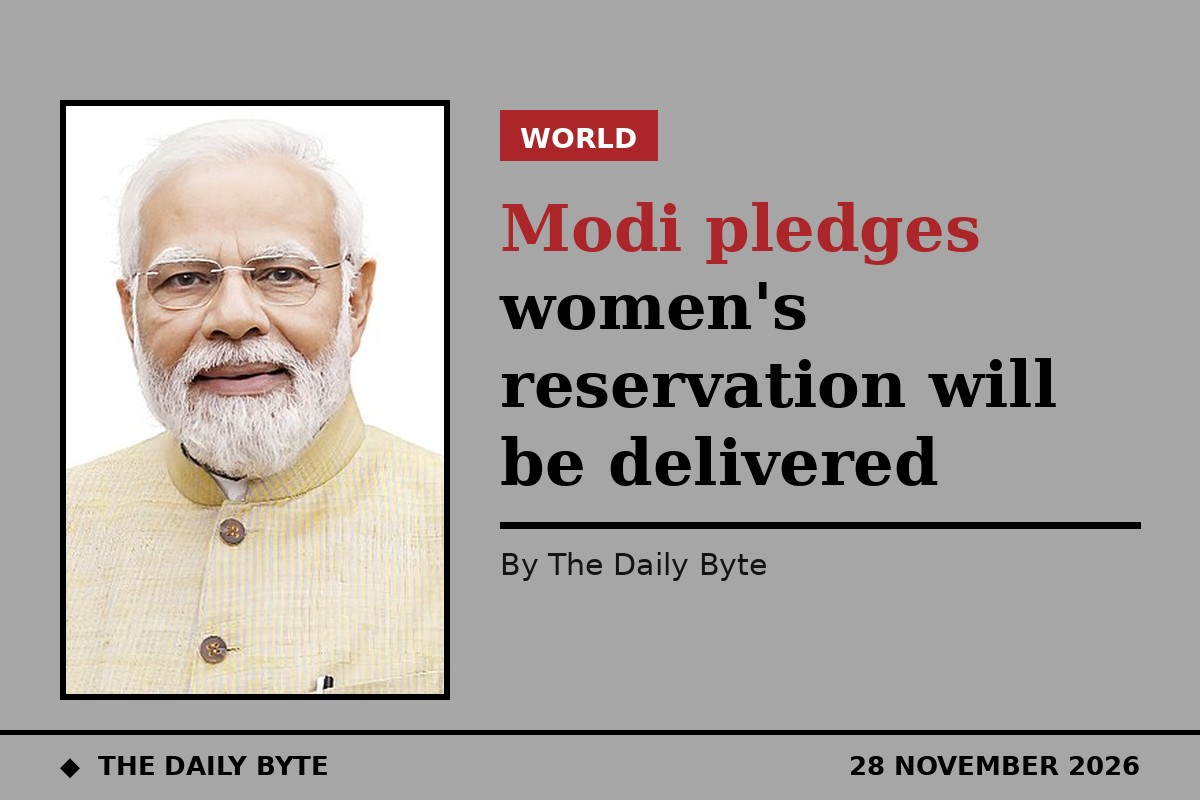
Indian Prime Minister Narendra Modi has reaffirmed that his government will deliver one-third reservation for women in Parliament and state assemblies, saying opponents will not be able to stop it. In a video message posted on Saturday, 28 November, ahead of a special session of Parliament, Modi said: "We had made a promise to our Nari Shakti and we remain committed to fulfilling it."
The Prime Minister's Office said the aspiration for greater political representation for women has spanned decades and has been raised by countless women through letters and personal interactions. Modi said his government's resolve "remains unshaken" and is backed by the support of women across the country.
What the government plans to bring to Parliament
The government has called a special sitting of Parliament from 30 November to 3 December. The Lok Sabha is scheduled to meet from 30 November, while the Rajya Sabha will reconvene on 2 December.
The government is expected to introduce a revised constitutional amendment linked to delimitation, the redrawing of constituency boundaries. Under the proposals, the one-third reservation for women would be implemented alongside an increase in the number of seats: the maximum strength of the Lok Sabha would rise to 850 seats, including up to 815 representatives from states and 35 from union territories. The maximum permitted strength of state legislative assemblies would rise from 500 to 650.
The Union Cabinet has cleared the revised draft legislation. The proposals would also freeze the revised seat allocations and boundaries until 2051.
Opposition announces joint resistance
Opposition parties have announced they will jointly oppose the proposed Bill. Representatives of 11 parties met at the residence of Congress president Mallikarjun Kharge on Saturday and agreed on a joint strategy ahead of the special session.
Addressing reporters after the two-hour meeting, Kharge said the Bill was neither in the interest of democracy nor in the interest of the country. The opposition leaders argued that representation of Scheduled Castes and Scheduled Tribes would be affected if the Bill were passed, and demanded that the current strength of the Lok Sabha be maintained for the next 25 years, with women's reservation provided on the basis of the current strength.
The opposition alliance, known as the INDIA bloc, also alleged that the delimitation exercise was designed to entrench the ruling party's hold on power. The government has rejected that characterisation and says the changes are needed to implement women's reservation.
A long-running demand
The demand for women's reservation in legislatures has been debated in India for decades. Modi noted in his message that he has been among those attempting to advance it for years, saying: "The struggle to provide equal participation to women have been ongoing for decades."
The special session will test whether the government can carry the constitutional changes through Parliament. Constitutional amendments require a special majority, so the government will need support beyond its own benches.
What happens next
The Lok Sabha meets on Monday, 30 November, when the government is expected to introduce the fresh constitutional amendment Bill. The debate will show whether the opposition's joint stand holds, and whether the women's reservation measure can be separated from the wider argument over delimitation and seat numbers.


