Moldova Gagauzia election: voters pick governor
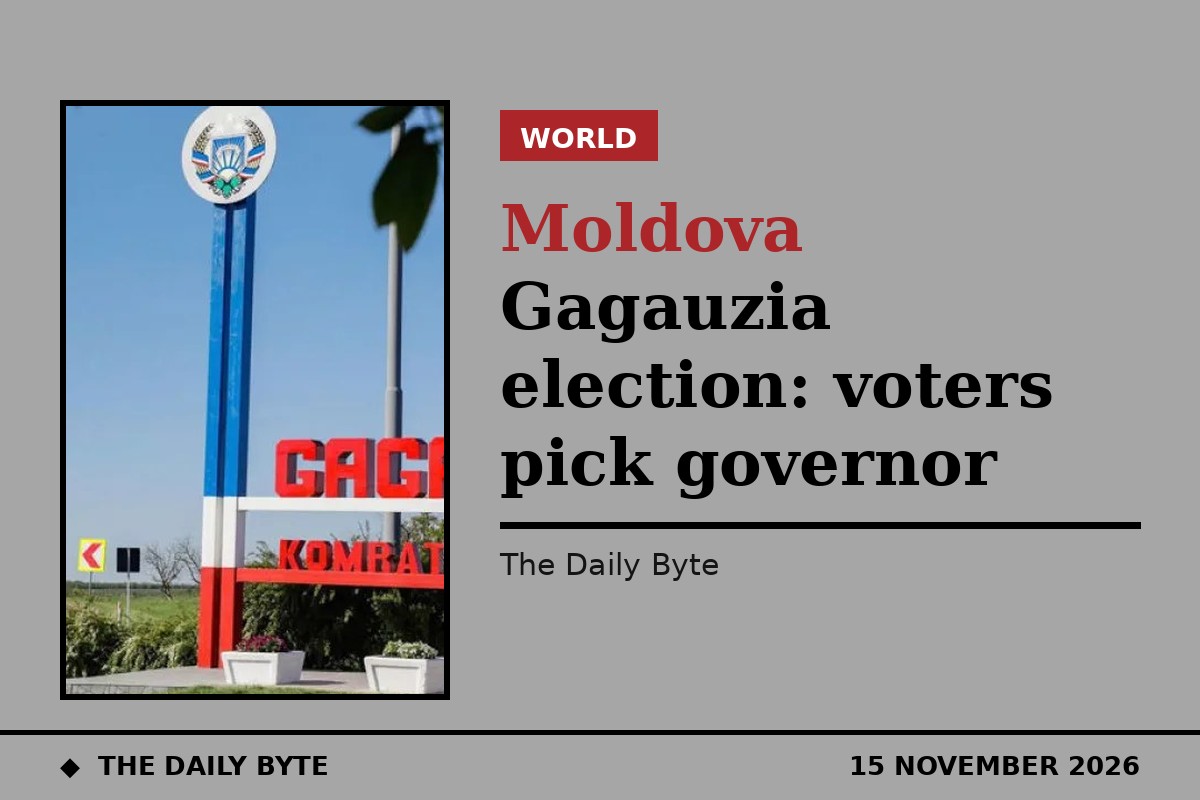
Voters in Gagauzia, Moldova's autonomous region, are electing a new governor and a new regional assembly today, Sunday 15 November, in a vote that will test Russian influence in the region and the strained relationship between its capital, Comrat, and the pro-European government in Chisinau.
About 129,000 residents are eligible to vote at 67 polling stations, choosing a governor, known locally as the bashkan, and all 35 members of the People's Assembly, the regional legislature. It is the first time in more than a year that voters have had the chance to choose both, and the first regional vote organised with the direct involvement of Moldova's Central Electoral Commission.
A region without a governor for over a year
The two posts have been vacant without an election for months. The People's Assembly's mandate expired in November 2025, and votes first planned for November 2025 and then for March 2026 never took place because of court disputes over how to form the regional electoral body.
There has been no bashkan since Evghenia Gutul, elected in 2023 with the backing of the now-banned party of fugitive oligarch Ilan Shor, was sentenced to seven years in prison for receiving illicit financing from a criminal organisation. The People's Assembly formally declared the post vacant on 17 August, and after deputies failed three times to set a date, the Central Electoral Commission fixed the vote for 15 November, Infotag reported.
A Constitutional Court ruling in July 2026, followed by changes to the Electoral Code, narrowed the region's autonomy and put the elections under national oversight, after years of confrontation between the regional leadership in Comrat and President Maia Sandu's pro-European government.
Who is standing
Eight candidates are competing for the bashkan's post, five of them independents. The ruling pro-European Party of Action and Solidarity has not fielded a candidate.
The most prominent candidate is Alexandr Stoianoglo, Moldova's former prosecutor general and a former presidential contender. A survey by IMAS published on 12 November put him in the lead with 26.5 percent of respondents, down from 32.4 percent in September. His main rival is Fiodor Gagauz, backed by the pro-Russian Party of Socialists, whose support rose from 3.2 percent in September to 17.5 percent in November.
If no candidate for bashkan wins outright, a runoff will be held on 29 November. About 135 candidates registered for the 35 assembly seats, and ballot papers have been printed in Russian, Romanian and Gagauz.
Observers and warnings
A 15-member delegation from the Council of Europe's Congress of Local and Regional Authorities is observing the vote, with seven teams deployed at polling stations across the region on election day. The delegation, led by Mélanie Lepoultier of France, will publish its preliminary conclusions on the afternoon of Monday 16 November, the Council of Europe said.
Monitoring group Promo-LEX has already flagged problems in the campaign, reporting more than 240,000 lei in unreported expenses, suspected voter bribery and misuse of administrative resources. Its report also documented Russian-financed online advertising and coordinated TikTok accounts promoting particular candidates.
Why the vote matters
The election will determine more than the leadership of a small autonomous region. Gagauzia is Moldova's most pro-Russian area, and the result will show whether Chisinau's legal changes have produced a regional leadership it can work with, or a new confrontation as Moldova moves closer to the European Union.
For the government in Chisinau, a governable Gagauzia would remove a long-running obstacle to its European course. For Moscow, the vote is a chance to show it still holds sway in a region it has long cultivated. The count, and the observers' verdict on Monday, will show which of those outcomes the voters of Gagauzia have chosen.
Sources: Council of Europe; Infotag; Jamestown Foundation.


