Mongolia President Quits as Parliament Approves Exit
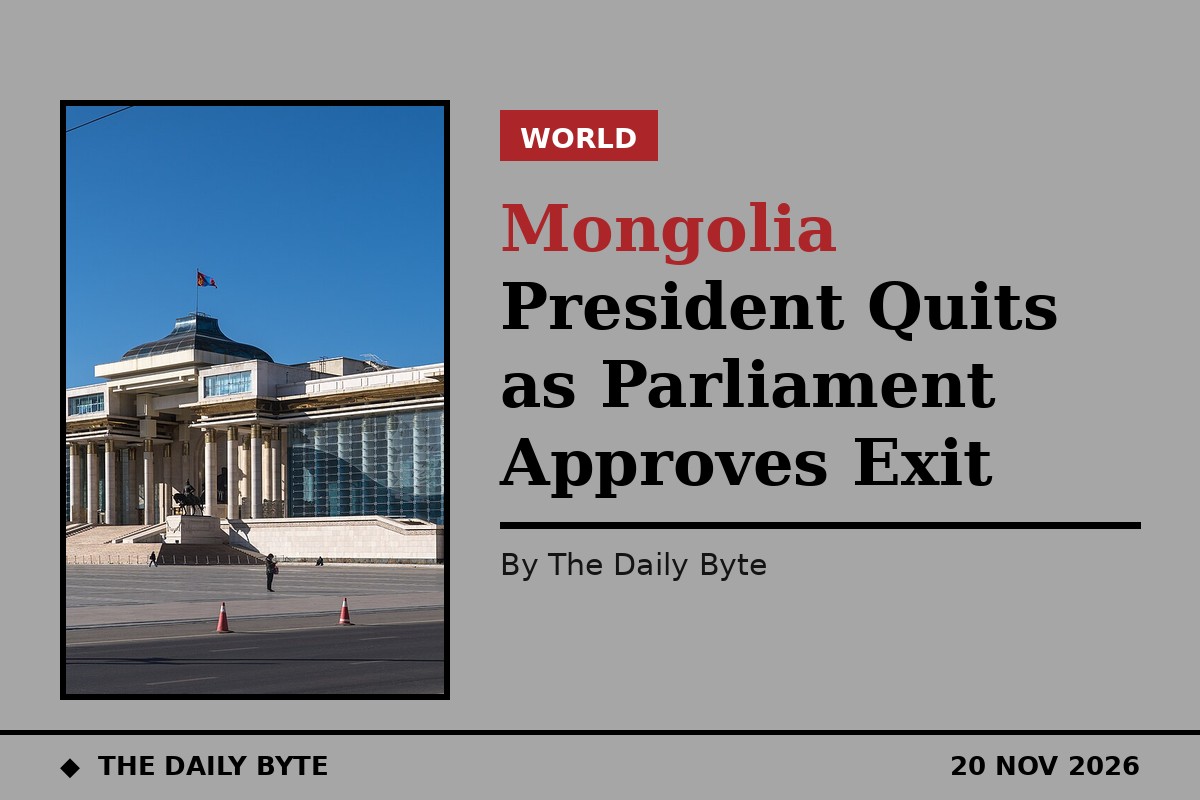
Mongolia's parliament has approved the resignation of President Khurelsukh Ukhnaa, two days after he asked to step down amid accusations of corruption from political rivals, setting the stage for an early presidential election.
The State Great Khural, Mongolia's parliament, backed the resignation on Thursday, 19 November, with 96 of the 104 members present voting in favour, according to the state news agency Montsame. The resignation took effect at once, and parliament speaker Sandagiin Byambatsogt will exercise presidential powers until a successor is elected and sworn in.
Khurelsukh announced on Tuesday, 17 November, that he would resign after a former mayor of the capital, Ulaanbaatar, accused him of benefiting from corruption linked to a railway project. Khishgeegiin Nyambaatar, the former mayor, claimed that 110 million dollars connected to the Tavan Tolgoi to Gashuunsukhait railway was paid out as kickbacks, with 25 million dollars allegedly going to the president. Khurelsukh has denied the claim, calling it defamation, and said he would cooperate with any investigation so his honour could be restored.
"I have never lied, stole or deceived anyone," Khurelsukh said when he announced his decision, adding that he would bring those defaming him before the relevant authorities. Nyambaatar is a former justice minister and a member of a rival faction within the ruling Mongolian People's Party, the party with which Khurelsukh has long been affiliated.
A first in Mongolian politics
Khurelsukh's departure is the first time a sitting Mongolian president has left office before the end of a term. He took office in 2021 and had about 221 days of his term still to run, with the next regular presidential election not due until the summer of 2027. Under the constitution, parliament must now call and hold an election within four months.
The road to the vote was short. The opposition Democratic Party demanded the resignation of every official named in the railway claims and gathered the signatures of its 42 lawmakers for a temporary investigative commission. Parliament's Standing Committee on State Structure backed the resignation request by 14 votes to 4 on Wednesday, sending the question to the full chamber.
A pattern of turmoil at the top
The resignation has exposed deep divisions in Mongolian politics. "Not only is there intense hostility between the ruling Mongolian People's Party and the opposition Democratic Party, but there are also factional struggles within the Mongolian People's Party itself," said Xu Tianchen, a senior analyst at the Economist Intelligence Unit.
Anger over corruption accusations has repeatedly shaken the country's leadership. Then prime minister L. Oyun-Erdene stepped down in June 2025 after losing parliamentary support following corruption allegations he denied, and his successor, Zandanshatar Gombojav, resigned in March 2026 amid a parliamentary boycott by the opposition and mounting infighting within the ruling party. Khurelsukh himself resigned as prime minister in 2021 after protests over the government's handling of the Covid-19 pandemic, and was elected president later that year.
Bodi International, the company that built the railway under a contract awarded without a tender, has denied paying any bribes, and the anti-corruption agency said on 9 November that no cash payout had been established. The head of the Cabinet Secretariat, Battumuriin Enkhbayar, has also stepped down this week over the railway affair, leaving the defence portfolio vacant ahead of an expected reshuffle.
What happens next
The change at the top leaves the rest of the executive untouched. Prime Minister Nyam-Osoryn Uchral and his cabinet remain in place, and the 2027 budget, passed last week, is unaffected by the departure. The parties must now settle on candidates for the election that will choose Khurelsukh's successor, in a contest that will test whether Mongolia's political system can steady itself after two years of resignations at the top.


