Montenegro Euro Puzzle Tests EU Accession Rules
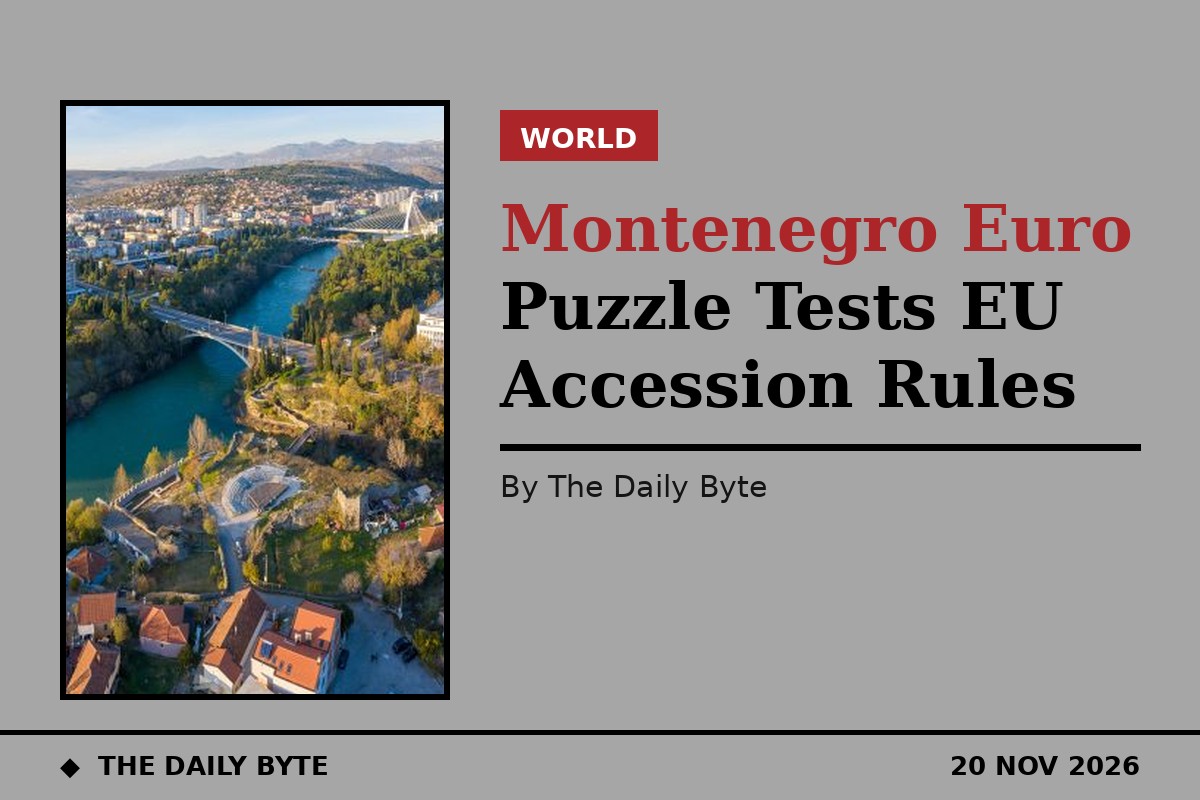
Montenegro has used the euro for almost a quarter of a century without ever being allowed to join the single currency, and Brussels has now devised an exceptional fix so that the anomaly does not block the country from becoming the European Union's 28th member.
The solution is contained in the EU's common negotiating position on economic and monetary policy, the chapter of accession talks that was provisionally closed on 12 October. It would allow Montenegro to keep the euro as its national legal tender after joining the EU, while remaining formally outside the eurozone until a separate decision admits it.
A currency adopted without permission
Montenegro's unusual monetary arrangements date back to the break-up of Yugoslavia. Hyperinflation and political instability in the 1990s destroyed confidence in the Yugoslav dinar, and Montenegro turned progressively to the German Deutschmark to protect savings and restore monetary stability. The Deutschmark became legal tender alongside the dinar in 1999 and then replaced it entirely.
When euro banknotes and coins entered circulation in 2002, Montenegro followed Germany in adopting the new currency. Neither decision was based on a formal monetary agreement with the European authorities. Montenegro declared independence in 2006 and applied for EU membership in 2008, leaving Brussels with a problem it had never faced before.
Under the EU treaties, adopting the single currency is supposed to follow a structured assessment of a member state's economic readiness, not precede EU membership itself. The EU has consistently maintained that unilateral adoption of the euro cannot substitute for meeting the conditions for entering monetary union.
Using the euro without joining the eurozone
Montenegro's experience illustrates the difference between using a currency and taking part in the institutions that govern it. Although Montenegrin citizens conduct everyday transactions in euros, the country has no say in European Central Bank monetary policy decisions, and its central bank cannot create euros to finance the economy or respond to financial emergencies in the way a central bank inside the Eurosystem can.
The formal requirements for joining the euro, set out in Protocol No 13 to the European treaties, include price stability, sustainable public finances, exchange rate stability and convergence in long-term interest rates. The exchange rate requirement presents a particular difficulty for Montenegro, which no longer has a separate national currency whose value can be assessed against the euro.
Brussels' exceptional solution
The EU's answer, agreed when the 29th Accession Conference with Montenegro provisionally closed negotiations on chapters 17, 18 and 19 on 12 October, is that Montenegro would enter the Union under a derogation from full monetary union membership. An exceptional provision in the accession treaty would permit the country to retain the euro as its national legal tender, but that would not automatically grant it the institutional privileges or responsibilities of eurozone membership.
Brussels has also proposed adapting the economic assessments that would precede a formal decision on eurozone entry. Rather than attempting to measure the stability of a non-existent exchange rate, European authorities would examine Montenegro's external economic position, competitiveness, financial vulnerabilities and other indicators capable of revealing underlying monetary pressures.
Montenegro would nevertheless be required to take part in the European Exchange Rate Mechanism for at least two years before receiving a positive convergence assessment, preserving the substance of the test applied to other prospective eurozone members.
The frontrunner, with conditions
Montenegro has emerged as the candidate closest to completing the accession process. On 6 November, negotiations were provisionally concluded in two further policy areas, free movement of goods and food safety, bringing the number of closed chapters to 23 out of 33. The European Commission believes the remaining negotiations could be completed by the end of December, and the Montenegrin government has identified 2027 as its objective for signing an accession treaty, with membership targeted for 2028.
Commission President Ursula von der Leyen backed that ambition during a visit to Podgorica on 1 October, saying: "We believe in Montenegro '28 by 28'." Ratification by all existing EU member states would still be required, and the Commission's 2026 country report continues to demand more effective prosecutions in organised crime and money laundering cases.
If the timetable holds, Montenegro would become the first country to join the European Union already using the euro as its national currency without immediately becoming a formal member of the eurozone, a precedent Brussels hopes will show that enlargement can still produce results after more than a decade without a new member.


