Mozambique FDI Falls 55.6% in Q2 as Gas Dominates
Foreign direct investment (FDI) in Mozambique fell 55.6% in the second quarter of 2026, dropping from $1.3 billion in January to March to $590 million in April to June, according to data published by the Bank of Mozambique. Despite the sharp quarterly decline, the country still received approximately $1.9 billion in the first six months of the year.
The fall amounts to about $738.5 million less than the first quarter, when foreign investment reached $1,328.4 million. Over the first half as a whole, FDI totalled $1,918.4 million, equivalent to 33.7% of the $5.69 billion attracted during the whole of 2025, which was the highest volume in the recent data series.
Extractive industries still dominate
The sectoral breakdown shows that extractive industries, principally activities linked to coal, oil, gas and other minerals, continued to dominate FDI inflows, although their share contracted considerably between the two quarters.
In January to March, extractive industries received $1,251.4 million, equivalent to approximately 94.2% of all FDI captured by the country. In the second quarter, investment in the sector retreated to $368.7 million, reducing its share to roughly 62.5% of the quarterly total.
Investment in all remaining sectors rose from approximately $77 million in the first quarter to $221.2 million in the second. That shift indicates that, despite the overall decline in FDI, non-extractive activities managed to attract a greater volume of foreign capital.
Manufacturing leads the non-extractive sectors
Among non-extractive sectors, manufacturing emerged as the second-largest destination for foreign investment in April to June, recording inflows of $151 million. Wholesale and retail trade and repairs followed with $18.3 million, transport, storage and communications with $14.4 million, and construction with $13.1 million over the same period.
Real estate, rental and business services attracted $12.2 million, while electricity, gas and water production and distribution received $11.2 million. Financial activities, by contrast, recorded a negative flow of approximately $20.6 million.
Government target depends on gas projects
For 2026, the government projects FDI inflows of $5.88 billion, a target underpinned primarily by the development of large-scale liquefied natural gas projects in the Rovuma Basin in Cabo Delgado province. With approximately $1.92 billion received between January and June, Mozambique has achieved roughly 32.6% of the annual target, and would need a further $3.96 billion during the second half of the year to meet the projection.
As 360 Mozambique reports, the performance of FDI during the second half will be decisive in assessing whether the government target can be met, and much will depend on the trajectory of planned investments in the natural gas sector.
Among the largest schemes under development is Rovuma LNG, led by ExxonMobil in Area 4 of the Rovuma Basin. In August 2026, the project's partners awarded approximately $1.1 billion in pre-investment contracts covering equipment and activities required for the preparation of the first development phase, ahead of a final investment decision. The project envisages an onshore liquefaction facility at the Afungi peninsula, with a planned capacity of 18.6 million tonnes per year.
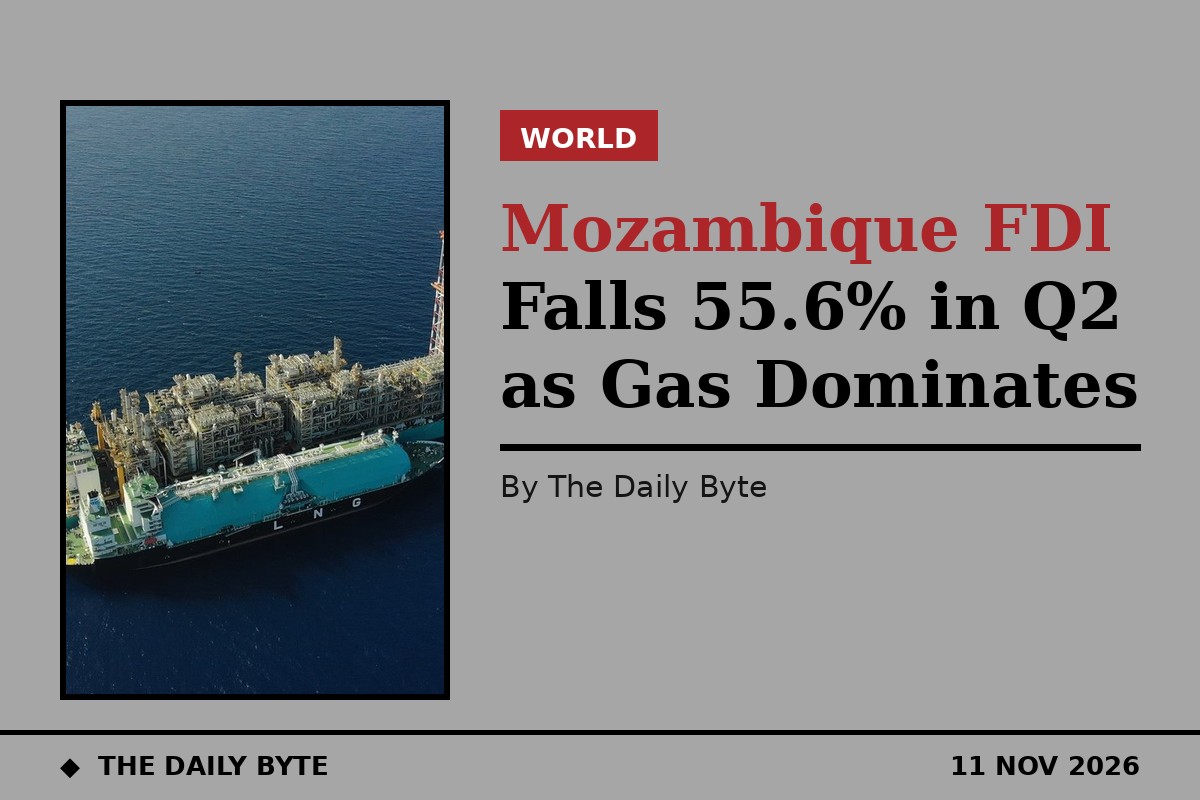
Mozambique LNG, led by TotalEnergies, fully resumed construction activities in January 2026 following the lifting of the force majeure declaration that had been in place since 2021. Italy's Eni, meanwhile, continues to produce liquefied natural gas through the Coral Sul floating platform, which has been operational since 2022, and is developing the Coral Norte project, valued at approximately $7.2 billion, with production start-up scheduled for 2028.
The first-half data confirms Mozambique's strong dependence on extractive industries for foreign investment, although the growth recorded in other sectors during the second quarter suggests a broader base is slowly emerging.
Frequently asked questions
How much FDI did Mozambique receive in the first half of 2026? A total of $1,918.4 million, according to Bank of Mozambique data, with $1,328.4 million in the first quarter and $590 million in the second.
Why did FDI fall so sharply in the second quarter? Investment in extractive industries dropped from $1,251.4 million to $368.7 million between the quarters, while non-extractive sectors grew. The figures reflect the timing of large gas project spending rather than a collapse in investor interest.
What is Mozambique's FDI target for 2026? The government projects inflows of $5.88 billion, driven mainly by liquefied natural gas projects in the Rovuma Basin. A further $3.96 billion would be needed in the second half to reach it.
Sources: 360 Mozambique and Diario Economico.


