MPs urge 15,000-pound tax allowance in Finance Bill row
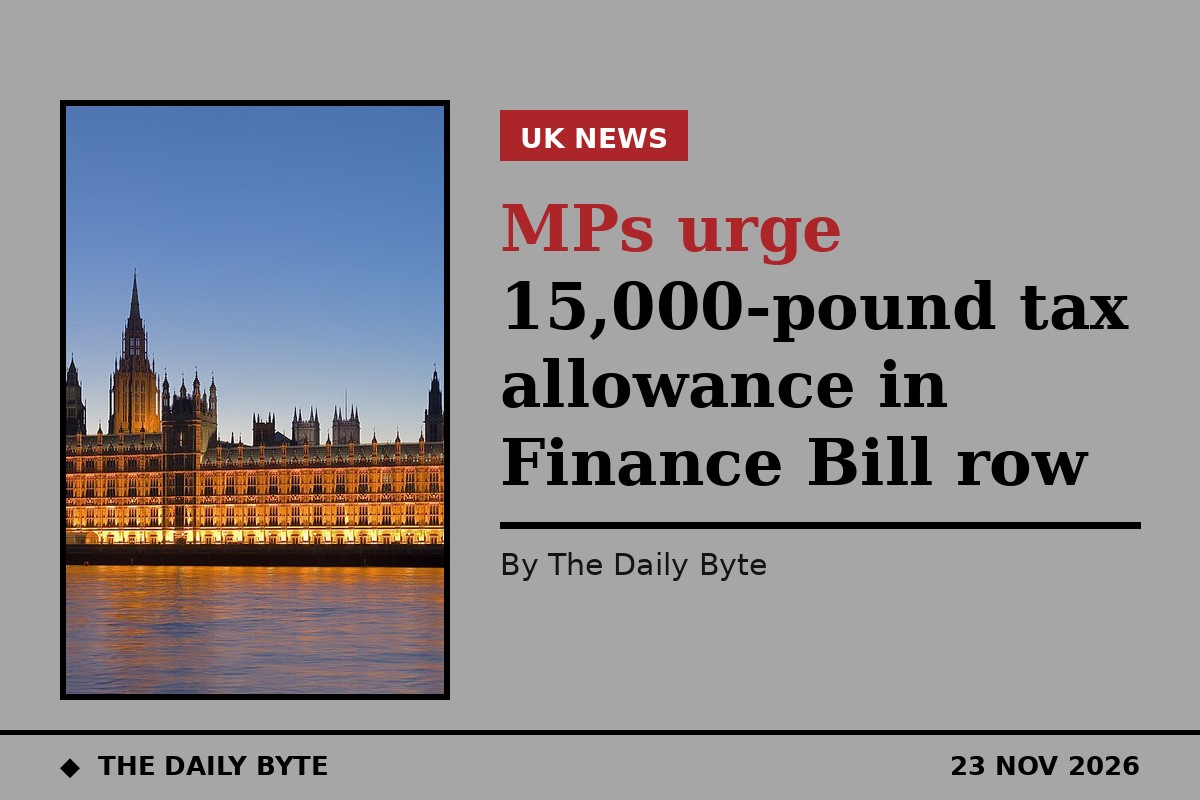
MPs debated the Finance Bill in the House of Commons on Monday 23 November, as the Government's tax measures from the 28 October Budget faced their first full test in Parliament, with the long freeze on income tax thresholds at the centre of the argument.
The Bill writes the tax measures announced by Chancellor John Healey in the Budget into law. It was formally introduced with a first reading on 3 November, and the second reading was the Commons' first chance to debate the Bill as a whole. Three reasoned amendments were tabled, each setting out different grounds for declining to give the Bill a second reading.
The 12,570-pound freeze
The personal allowance, the amount people can earn before paying income tax, has remained unchanged at 12,570 pounds since 2021 and is frozen until 2031. The higher-rate threshold, at which the 40 per cent rate begins, stays at 50,270 pounds, and the additional 45 per cent rate applies from 125,140 pounds.
Because wages have risen while the thresholds have stayed still, the freeze has steadily drawn more earners into paying income tax or pushed them into higher brackets. According to the most recent HMRC figures, there are 31.4 million basic-rate taxpayers across the country, a 15 per cent rise in the number of people paying income tax at 20 per cent since the bands were frozen at 2021 levels.
Research by AJ Bell said the threshold would stand at roughly 16,072 pounds next year had it kept pace with inflation.
The 15,000-pound proposal
An amendment signed by Liberal Democrat MPs Daisy Cooper, Ed Davey and Wendy Chamberlain called on the Government to raise the personal allowance to 15,000 pounds and the 40p threshold to 56,000 pounds over five years, putting 680 pounds back in people's pockets and taking 2.5 million low earners out of income tax.
The amendment criticised the 2026 Budget for failing to tackle the cost-of-living crisis, and pointed to household energy bills projected to rise by 26 per cent in January 2027 and fuel duty by 14 per cent in July 2027. It said the threshold freeze dragged millions of low-paid workers into tax.
A Conservative amendment took a different line, arguing that taxes were at a record high, borrowing and debt were increasing, and the Office for Budget Responsibility had confirmed that household net incomes were set to fall and growth next year would be lower than this year. It called instead for cutting taxes, reducing the rate of employers' National Insurance contributions for young people, and abolishing Stamp Duty and Inheritance Tax on the family home.
A third challenge from independent MPs
Four independent MPs, led by Shockat Adam and including Jeremy Corbyn, tabled a further amendment opposing the freeze. It said the personal allowance would be around 16,000 pounds had it kept pace with inflation, and that the Office for Budget Responsibility said the freeze was equivalent to adding 4p to the basic rate of income tax, taking 29.3 billion pounds a year from workers and pensioners by 2027-28.
That amendment also said disposable incomes were set to fall by 1,050 pounds over three years, and called for a 2 per cent wealth tax on assets over 10 million pounds, which it said would raise around 24 billion pounds.
What the Chancellor said
Mr Healey had been pressed on the freeze at the Treasury Committee on 11 November. Liberal Democrat MP Bobby Dean told him the Office for Budget Responsibility had described the freeze as having the biggest impact on people's disposable income, and asked whether it was fair for the public to face a tax rise without it being explained in the Budget speech.
The Chancellor replied that the decision on thresholds had already been taken and was not a fresh decision for this Budget. He said he had wanted to reject arguments for an across-the-board increase in taxes, and to respect the commitments voters had been given at the election not to raise the levels of income tax, national insurance or VAT.
What happens next
A reasoned amendment, if passed, would rewrite the motion for second reading to set out the grounds on which the House declines to let the Bill proceed. The Speaker may select one of the reasoned amendments, or choose none at all. The debate was timetabled to run until any hour on Monday, with votes on the amendments to follow.
If the Bill passes its second reading, a programme motion sets out the remaining stages. Key clauses on income tax, the banking surcharge, VAT on electric vehicle charging, alcohol duty and environmental taxes would go to a Committee of the whole House over two days, with the rest of the Bill going to a Public Bill Committee whose proceedings must conclude by Thursday 28 January 2027.