MTN Seeks Banking Licences in Nigeria, Ghana, Rwanda
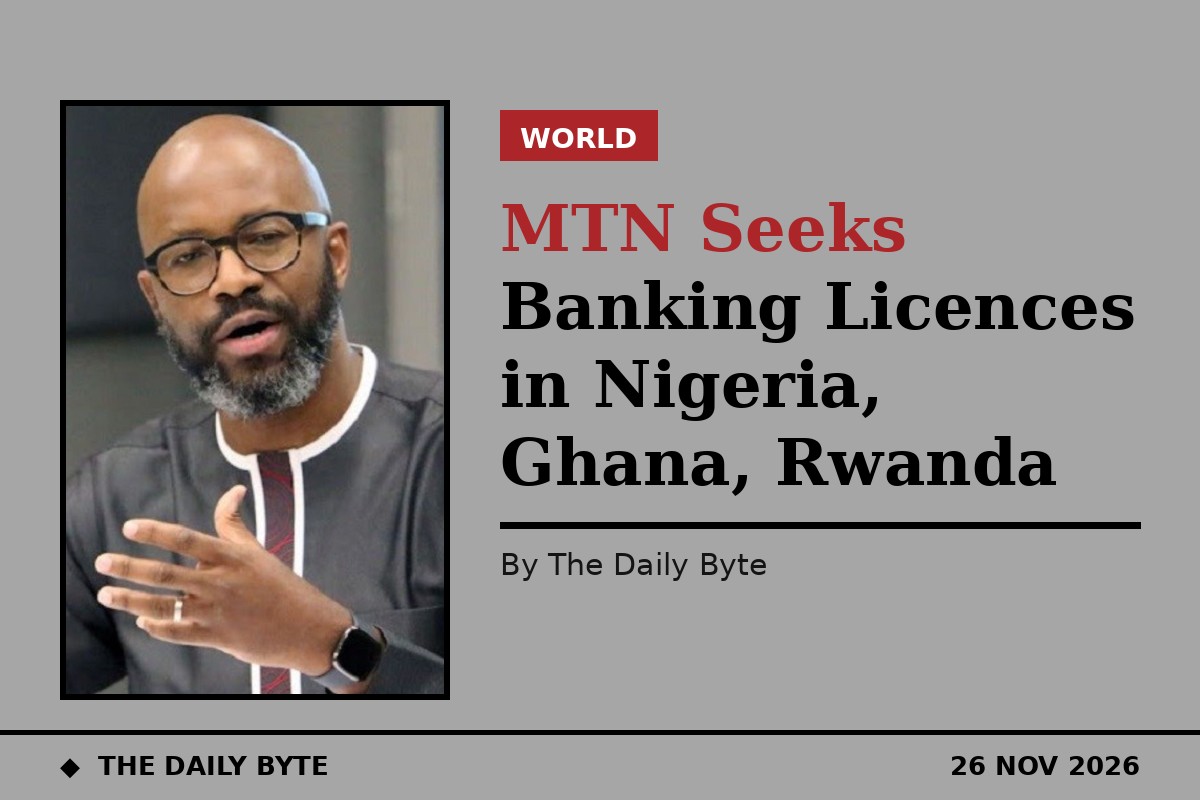
MTN Group is seeking a regional banking licence in Nigeria and financial services licences in Ghana and Rwanda, chief executive Ralph Mupita said on Thursday, in the clearest statement yet of the telecoms giant's plan to become a lender in its biggest markets.
Mupita disclosed the plan in an interview with Semafor at the news outlet's Next Three Billion summit in Johannesburg on Thursday, 26 November. He said basic mobile money functions such as peer-to-peer transfers and cash in and cash out were becoming commonplace, pushing MTN towards higher-value financial services instead.
He expects the new licences within a year or two, and said the expansion would be mostly organic. In his words, MTN is "not looking at the conventional kind of M&A" for the business.
A $500 billion network looking for the next step
MTN processed more than $500 billion through its fintech network in the nine months to the end of September, and its Mobile Money platform has more than 70 million monthly active users across 16 markets. Lending is already growing fast on the platform: the value of loans facilitated through its BankTech operations reached $3.5 billion in 2025, up more than 80 percent on the previous year.
The pitch rests partly on how underserved Nigerian businesses are. Around 80 percent of the country's small and medium enterprises lack formal credit, and Nigeria's funding gap for that segment runs to $236 billion, according to figures MTN cited at a capital markets event in June.
Mupita first told Semafor in August that MTN would explore a licence allowing it to take deposits, with a longer-term goal of funding loans from its own balance sheet rather than through partner banks. He did not name countries at the time. Thursday's interview is the first time Nigeria, Ghana and Rwanda have been attached to that ambition by name.
Eighteen months of circling, now named
MTN told a capital markets event in June that it was pursuing additional licences in Nigeria, but Mupita declined to disclose which ones. The only specifics on record at that point were the payment gateway and point-of-sale terminal licences MTN Nigeria had applied for through MoMo Payment Service Bank back in November 2024, a process Mupita said was still ongoing, plus shareholder approval for structurally separating the Nigerian fintech business, pending review by the Central Bank of Nigeria.
The group has already run the same structural split twice. MTN's Ghanaian unit completed its separation in March, folding its mobile money business into a new standalone entity, MobileMoney Fintech Ltd, jointly owned by MTN and a trust representing local shareholders. Its Ugandan subsidiary went through the same kind of separation in July last year. Nigeria, Ghana and Rwanda are the next three markets in a pattern the group has already established.
In Nigeria, MTN already operates MoMo Payment Service Bank under Central Bank of Nigeria licensing, which allows deposits and certain payment services but constrains lending without further regulatory approvals. A regional banking licence would take it beyond those permissions.
What is still unconfirmed
The single biggest gap is whether a regional banking licence application for Nigeria actually exists anywhere inside the Central Bank of Nigeria right now, as a filed document, or whether Mupita's phrase to Semafor is still an ambition MTN has not yet submitted. Neither MTN nor the central bank has said so publicly. MTN has also not said whether it has filed formal licence applications in Ghana and Rwanda, or only in Nigeria. The one-to-two-year timeline Mupita gave is MTN's own estimate, not a regulatory commitment from any of the three countries.
The move also lands next to a telecoms consolidation push. MTN revived talks this month to acquire Telkom, the former South African fixed-line monopoly, reopening a bid that collapsed in 2022. Mupita used the same Semafor interview to argue that South Africa's mobile market needs to consolidate around two or three operators, pointing to Europe as a precedent.
The valuation MTN is chasing has a public marker. Airtel Money, the mobile money arm of rival operator Airtel Africa, listed in London in October at a valuation of about $7 billion. That listing is the clearest indication yet of what investors think an African mobile money business carrying real lending and remittance volume is worth.
The first thing to watch is simply whether the Central Bank of Nigeria confirms an application exists. The second is how MTN's balance-sheet lending plans would compete with Nigeria's existing digital lenders, a market that already has more than 400 licensed players including OPay and Moniepoint, long before MTN gets a banking licence of its own.


