Mulberry Shares Slide as Reported Loss Widens to £33.4m
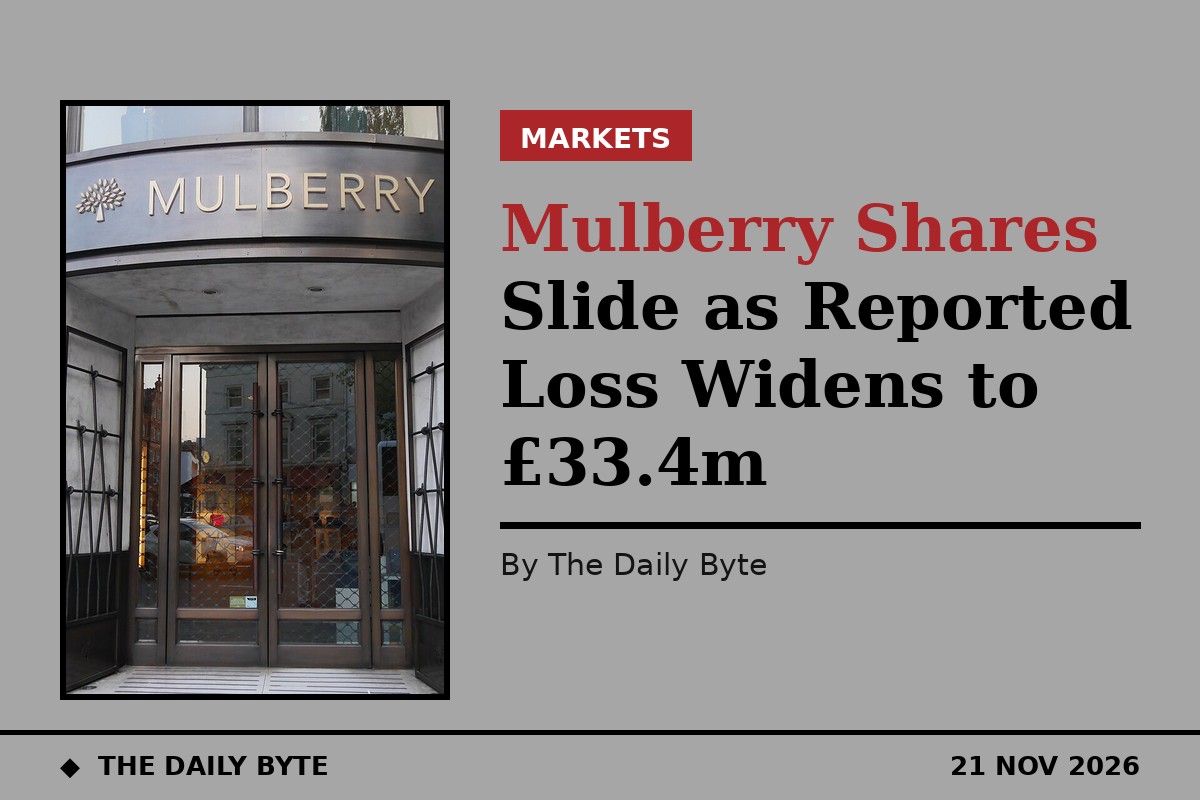
Mulberry Group shares fell sharply on Thursday 19 November after the luxury handbag maker reported a half year in which its trading improved but its headline loss widened sharply on a non-cash accounting charge. Revenue rose 18% to £63.7 million in the 26 weeks to 26 September 2026, while the reported pre-tax loss widened to £33.4 million from £7.1 million a year earlier. The shares fell 22.6% in early trading, quoted at about 217p at 08:57, down from 280p at the previous close, AskTraders reported on a delayed quote.
The fall came after a strong run for the stock. AskTraders noted that the shares had roughly tripled over the past year, from about 90p in early November 2025, so the results arrived on a much higher base. By early afternoon the fall had narrowed to about 14%, with the shares at 240p at 13:15 GMT, Sharecast reported. The company is listed on AIM and is best known for its leather handbags, including the Bayswater and Lily designs.
A £27.6m charge that cost no cash
The gap between the headline loss and the trading result is a single accounting item. Mulberry booked a £27.6 million non-cash fair value charge on the conversion feature of convertible loan notes issued in July 2025. The feature is measured as a derivative financial liability, and its value rises as the company's share price rises, so the charge grew because the shares had risen sharply. The company says it does not anticipate any subsequent cash impact from the charge, including at conversion.
Strip that charge out and the picture is different. Mulberry's underlying loss before tax, a company-defined measure, narrowed by 24% to £5.8 million from £7.6 million a year earlier. The operating loss fell 41% to £2.9 million from a restated £5.0 million, and the adjusted EBITDA loss narrowed to £0.5 million from £4.6 million. In other words, the business lost less money from trading, while the reported loss grew because of the way the loan notes are revalued.
Trading underneath improved
Sales grew across the business. Retail and digital revenue rose 13% to £52.6 million, or 15% on a like-for-like basis, with growth in every region. In the UK, the largest market, retail sales rose 10% to £31.1 million. Europe grew 23% to £7.4 million, the United States rose 28% to £6.0 million, with digital sales there up 35% after the launch on Bloomingdale's Marketplace, and Asia Pacific grew 5% to £8.1 million. Franchise and wholesale revenue jumped 52% to £11.1 million, taking that channel to 17% of group sales, with particularly strong wholesale growth in the Nordics.
Growth did slow through the half, from 24% in the first quarter to 13% in the second, which the company said reflected better stock availability a year earlier in the first quarter. Gross margin widened by 100 basis points to 70.2%, which the company attributed to more full-price sales and fewer promotions, while operating expenses rose 12% to £48.0 million, below the rate of revenue growth. Gross profit rose £7.3 million to £44.7 million.
Cash, debt and the festive test
The balance sheet remains stretched. Net debt stood at £11.1 million, up from £8.2 million a year earlier, and net liabilities were £54.1 million. Operations generated a £3.5 million cash inflow, against a £4.6 million outflow in the same period last year. The revolving credit facility was raised to £19.5 million from £17.5 million, keeping total facilities at £27.5 million, and the lender has agreed not to test certain performance covenants until 31 March 2028, with the facilities committed until 31 July 2028.
Chief executive Andrea Baldo said: "While these results demonstrate the progress we are making, there remains much more to achieve, and the trading environment remains challenging." The company said its focus in the important festive trading period is full-price sales rather than volume through more promotions. Its medium-term targets are unchanged: revenue above £200 million and a 15% adjusted EBIT margin. Whether the second half can hold the first half's sales momentum, at full price, is now the test for the turnaround.