Myanmar mining poisons rivers into Thailand
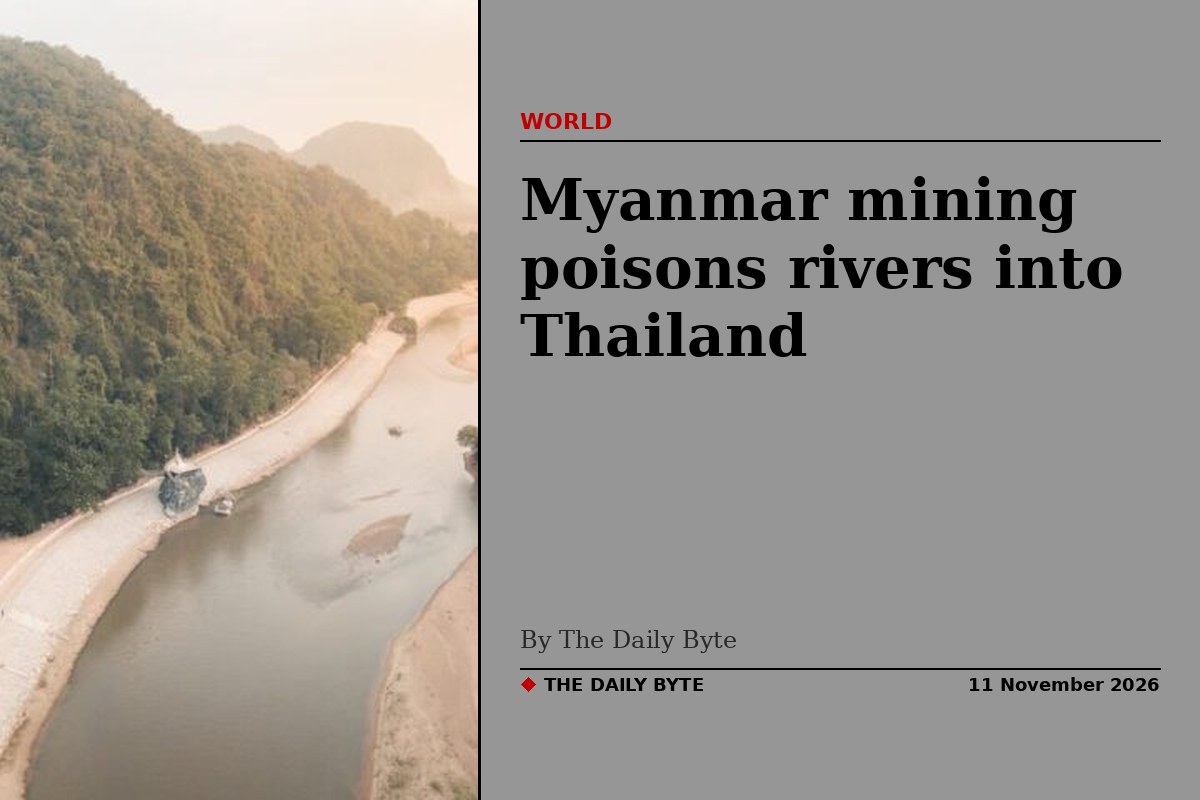
Mining in Myanmar’s conflict-hit borderlands is poisoning rivers that flow into Thailand, spreading arsenic and heavy metals through shared waterways and endangering the health and livelihoods of communities on both sides of the border, according to a new study of the trade.
A recent policy paper from the Stimson Center, reported by OneWorld SouthAsia, traces how demand for critical minerals has combined with Myanmar’s protracted civil war to produce a severe environmental and public health crisis. Since the military coup of 2021, extraction of rare earth elements, gold, tin, antimony and other minerals has intensified in conflict-affected areas, often with almost no regulatory oversight.
In Kachin State, one of Myanmar’s richest mineral zones, a junta-aligned militia colluded with Chinese interests to extract rare earths with little oversight between 2010 and 2024, the paper says. In Karenni State, long-standing tin and antimony mines around Mawchi have moved towards more chemical-intensive processing, sending toxic runoff into Molo Creek and the Salween River, with contamination recorded at up to 55 times above safety standards.
Pollution that crosses borders
Mining waste and chemical effluents are routinely discharged untreated into headwater streams, according to the study. The contaminants include arsenic, mercury, cadmium, lead, radioactive elements and industrial reagents. The pollution does not stop at the border: it travels downstream through the Kok, Sai, Salween and Mekong river systems into northern Thailand.
A regional dataset cited in the research identified more than 2,400 unregulated mining sites across Myanmar, Laos and Cambodia. Many of the mines sit along rivers, and satellite imagery has shown the scale of deforestation and waste ponds at the sites.
Thailand’s own testing confirms the scale of the problem. The country’s Pollution Control Department found arsenic above the national surface water standard at every site it tested along the Sai River during its 23rd monitoring round in late September 2026. The survey covered 23 locations across the Kok, Ruak, Mekong and Sai rivers. Results from the other three rivers were within the standard during that round, although arsenic concentrations in the Mekong were rising.
Fresh sampling on the Mae Sai
On 6 November, field teams from the Pollution Control Department launched urgent inspections along the Mae Sai River in Chiang Rai province, collecting fresh water and sediment samples to track toxic runoff. Provincial authorities urged border communities to stop using untreated river water until testing confirms it is safe.
The pressure is growing rather than easing. Myanmar has approved 20 new mining operations in Tachileik, on the Thai border, including 12 gold mines, six manganese sites and two lead mines. Thai customs data shows the scale of the trade: in August 2026 alone, the Mae Sai checkpoint processed 2,500 tons of manganese and 920 tons of lead.
An agreement reached in August 2025 between Thailand’s foreign ministry and Myanmar’s military government on mining pollution has proved largely unenforceable, the Stimson paper notes, because most mines on transboundary rivers operate in territory held by ethnic armed organisations rather than the central authorities.
Talks planned as Bangkok seeks answers
Thailand is now seeking a diplomatic route. A Thai–Myanmar working group meeting is planned for late November 2026, alongside proposed joint monitoring with Laos, and Thai media have reported that Deputy Prime Minister Sihasak is due to raise the contamination with Myanmar’s leader Min Aung Hlaing on 12 November. Investigations in northern Thailand have so far found no domestic source for the pollution, according to the Pollution Control Department.
For riverside communities in Chiang Rai, the issue is immediate: drinking water, farming and fishing all depend on rivers that now carry the waste of mines they did not approve and cannot control. Until the governments and armed groups that control the mining areas agree on enforcement, the rivers will keep carrying the problem downstream.


