NASA clears UVEX telescope for launch by January 2031
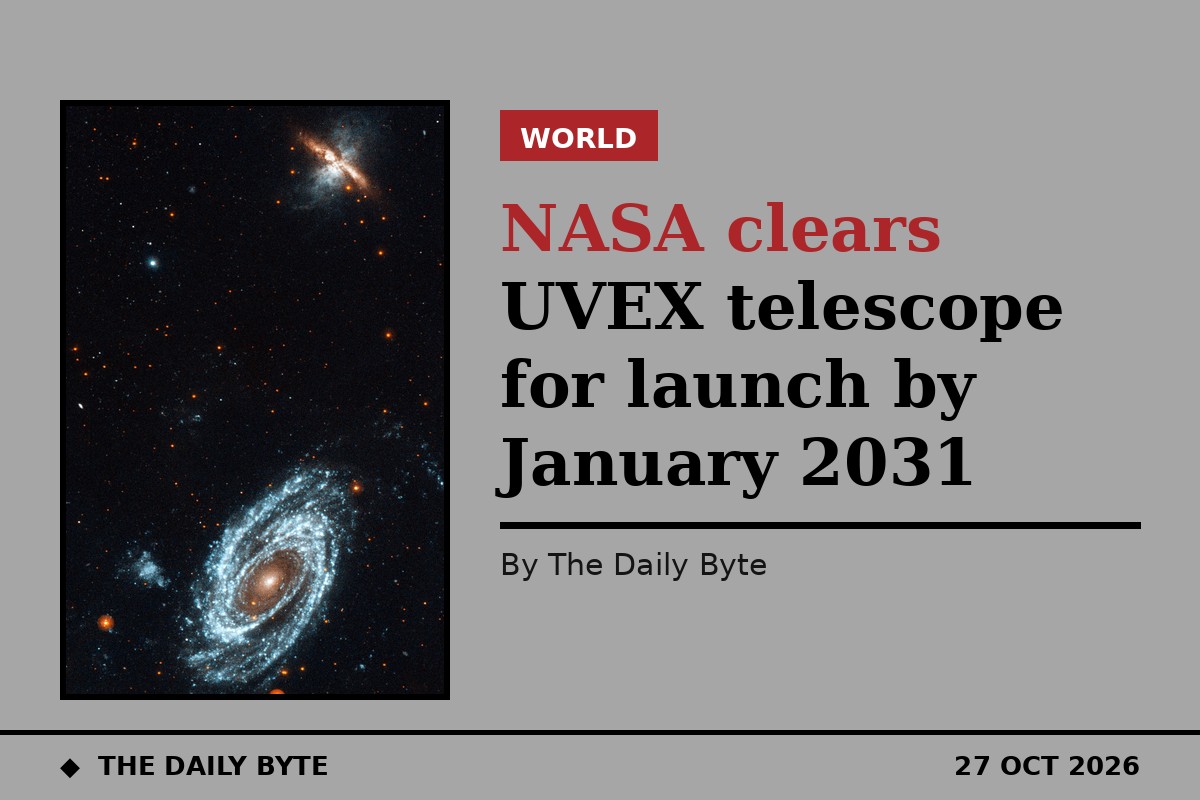
NASA has confirmed its UVEX space telescope after it passed a technical and programmatic review known as Key Decision Point C, NASA Science reported on 27 October 2026. Passing that milestone allows the mission to move into its next phase of development, with the agency committing to a launch by January 2031 and a total lifecycle cost of $590 million.
UVEX stands for UltraViolet EXplorer. Originally selected for development in 2024 as a Medium-Class Explorer mission, it will conduct a sensitive survey of ultraviolet light across the entire sky. The aim is to provide new insights into how galaxies and stars evolve, adding an ultraviolet view to the wider map of the universe being built by other survey missions, including NASA's Nancy Grace Roman Space Telescope.
Why ultraviolet light matters
Ultraviolet observations can reveal energetic processes that are harder to study in visible light alone. UVEX will also be able to point quickly towards sources of ultraviolet light, capturing the explosions that follow bursts of gravitational waves caused by merging neutron stars. That rapid response is an important part of the mission: some of the most informative events in the sky fade quickly, and a telescope that can react fast can catch details a slower survey would miss.
The mission's principal investigator is Fiona Harrison at Caltech in Pasadena, California. Other institutions involved include the University of California, Berkeley, NASA's Jet Propulsion Laboratory, Northrop Grumman and the Space Dynamics Laboratory. With its review passed, UVEX now moves from planning towards construction and testing, ahead of a launch window that ends in January 2031.
Sources: NASA Science and Undercode News.