NASA to fly first space crop system to station on NG-25
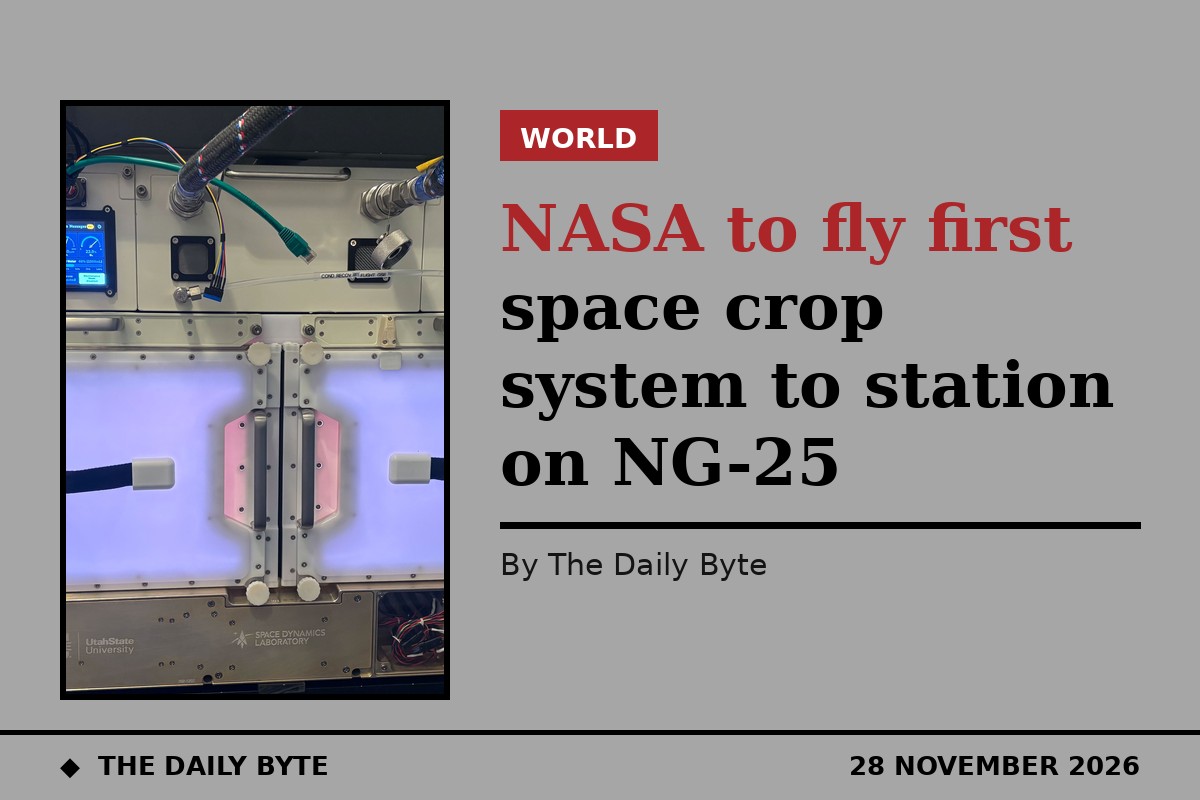
NASA is sending a first-of-its-kind system for growing crops in space to the International Space Station, in an experiment that could shape how future crews on the Moon and Mars feed themselves.
The agency announced on 27 November 2026 that the prototype growth chamber, called Ohalo III, will travel to the station aboard Northrop Grumman's 25th Commercial Resupply Services mission, known as NG-25. The flight is targeted to launch no earlier than 10:47 a.m. Eastern time on Sunday 29 November, lifting off from Space Launch Complex 40 at Cape Canaveral Space Force Station in Florida.
A SpaceX Falcon 9 rocket will carry the Cygnus XL cargo spacecraft, loaded with about 11,000 pounds of science investigations, supplies and equipment. NASA astronauts Jessica Watkins and Luke Delaney, who are living and working aboard the station, are scheduled to capture Cygnus XL with the Canadarm2 robotic arm on Tuesday 1 December.
Ohalo III is a prototype space crop production system that has been in development since 2019 at NASA's Kennedy Space Center. NASA describes it as the first system of its kind, designed to move beyond the small plant experiments flown so far and test how food crops can be produced reliably in microgravity.
The chamber will test two practical problems. The first is water delivery: getting the right amount of water to plant roots when there is no gravity to pull it down through soil. The second is volume: making efficient use of the limited space inside a spacecraft or a future Moon base habitat. The system can grow different plants together in one rig, a capability known as multi-cropping, which could let crews produce a varied diet from a single unit.
"To help understand how crop production works in microgravity, NASA is launching a novel space crops growth chamber called Ohalo III," the agency said in its announcement. "The new prototype growth chamber will provide critical insights for developing safe, nutritious, and reliable crop production strategies for future Moon Base habitats and Mars missions."
The knowledge gained could also be useful on Earth. NASA says the findings may inform vertical farming and indoor growing systems, where growers face similar questions about water use and making the most of limited space.
A second experiment is flying on the same mission. It is a miniature fluid-handling system designed to mix, deliver and maintain the nutrient-rich liquid needed to keep small laboratory-grown models of human brain tissue alive. The work builds on an earlier investigation that sent such models, known as miBrains, to the station, and it is a step towards longer studies of human brain tissue in space. Researchers hope the findings will help identify neurological risks linked to spaceflight and develop ways to protect astronaut health, while also advancing human tissue research and the modelling of neurological disease on Earth.
The NG-25 Cygnus spacecraft is named the S.S. James "Jim" A. Lovell, in honour of the astronaut who flew Gemini and Apollo missions, including commanding Apollo 13. It is scheduled to remain at the station until May 2027, before departing with disposal items and burning up during re-entry. Northrop Grumman says it has delivered more than 169,000 pounds of supplies, experiments and equipment to the station since 2013.


