NATO Sends AWACS to Poland After Russian Missiles
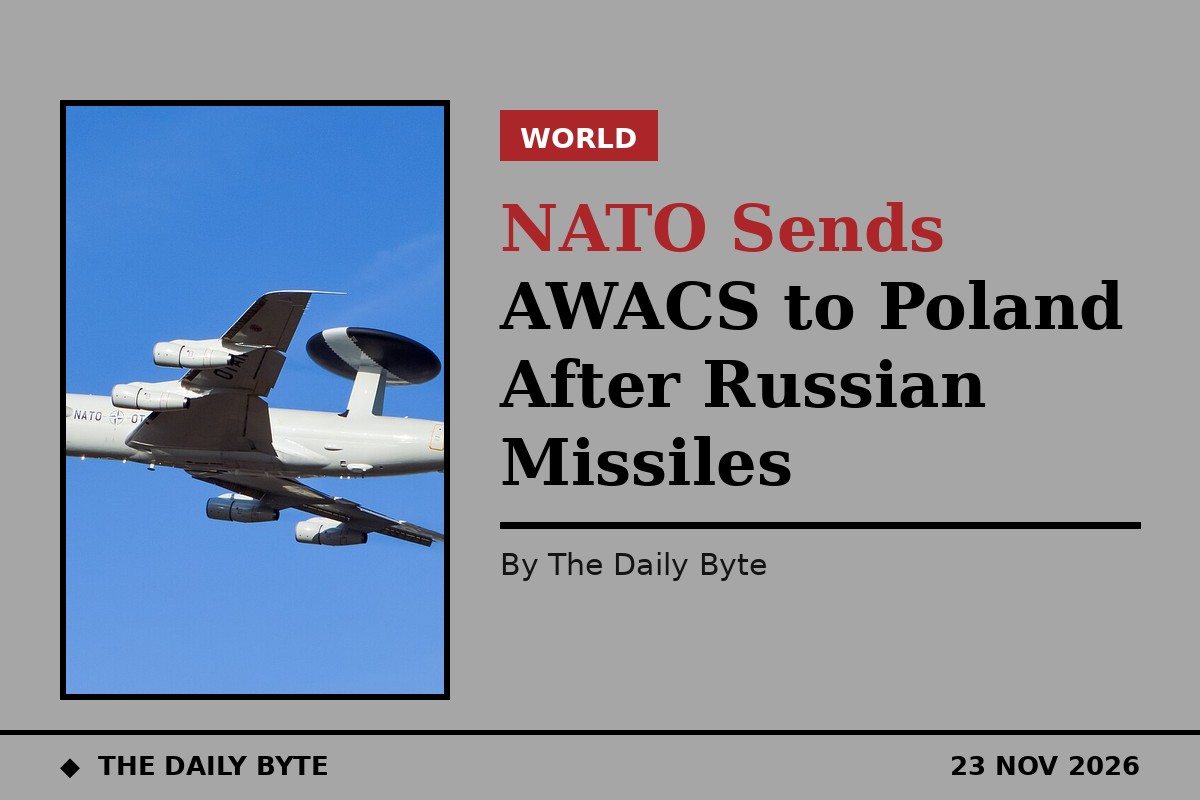
NATO will send an AWACS early-warning aircraft to Poland after three Russian cruise missiles landed in Polish territory last week, Polish Deputy Defence Minister Paweł Zalewski said on Monday after an extraordinary meeting of the alliance's North Atlantic Council in Brussels.
The aircraft will strengthen surveillance along NATO's eastern flank, Zalewski told reporters after the meeting, describing it as a system that gives Poland deeper operational awareness and a better ability to respond to this kind of threat.
The three missiles came down on Friday 20 November during a large-scale Russian air attack on Ukraine. They fell in three places in south-eastern Poland: Nowy Lipowiec in the Lublin region, and Rudnik nad Sanem and Mołodycz in the Podkarpackie region. Polish authorities said there were no injuries and no damage on the ground.
Polish prosecutors in Lublin said analysis of the debris showed that all three objects were Russian Kh-101 cruise missiles. They said the missile recovered near Nowy Lipowiec had been manufactured in the fourth quarter of 2026 at a weapons plant in Dubna, about 140 kilometres south of Moscow.
Polish officials had at first believed that two cruise missiles and a jet-powered drone had entered Polish airspace. The later forensic examination concluded that all three were Kh-101 missiles, launched during the Russian barrage against targets in western Ukraine.
What Poland asked NATO for
Poland called the meeting to press its allies for stronger protection of its eastern border. Zalewski said Poland would present concrete proposals and identify new possibilities for action, including more surveillance capability and more air-defence cover.
Polish officials have also raised the possibility of more F-35 fighter jets being stationed in Poland or nearby so that incoming missiles and drones can be intercepted. NATO Secretary General Mark Rutte visited Warsaw over the weekend and told reporters that NATO would defend every inch of Polish territory.
Rutte said the alliance's Supreme Allied Commander Europe, General Alexus Grynkewich, would examine the circumstances of the incursion and whether NATO's deterrence and defence arrangements needed to be adjusted.
Why the incident caused alarm
Polish authorities said the detection system worked and that anti-missile systems and NATO flights were activated, but the weather was too bad for the precision needed to shoot the missiles down. The missiles crossed into Poland during an attack that also damaged energy infrastructure and bridges in Ukraine.
The crashes happened near Nowa Dęba, where allies were holding the first military training for the coalition of the willing, the group of countries prepared to help keep the peace in Ukraine after any settlement. Poland has described the incursion as a deliberate provocation. Russia has not commented on the missile incursions.
The incident follows the large drone swarm from Russia that crossed into Poland in September 2025, after which NATO set up its Eastern Sentry mission to put more air defence in place along the eastern flank.
What happens next
NATO's AWACS fleet has 14 aircraft, based at Geilenkirchen air base in Germany. With their distinctive nine-metre-wide radar domes, they have served as the alliance's eyes in the sky since 1982, providing a common radar picture for allied fighters, ships and control centres and directing combat jets to their targets.
The fleet has played an important role in surveillance missions along NATO's eastern flank since Russia launched its full-scale invasion of Ukraine in 2022. The aircraft made available to Poland will add to that coverage while allies continue to review what further air-defence measures the eastern flank needs.
The Brussels meeting did not settle every question about how NATO should respond to future incursions, and discussions among allies are expected to continue. For Poland, the immediate outcome was a visible reinforcement: an extra early-warning aircraft watching the skies over its eastern border.


