Nepal and Bhutan push mountain agenda at COP31
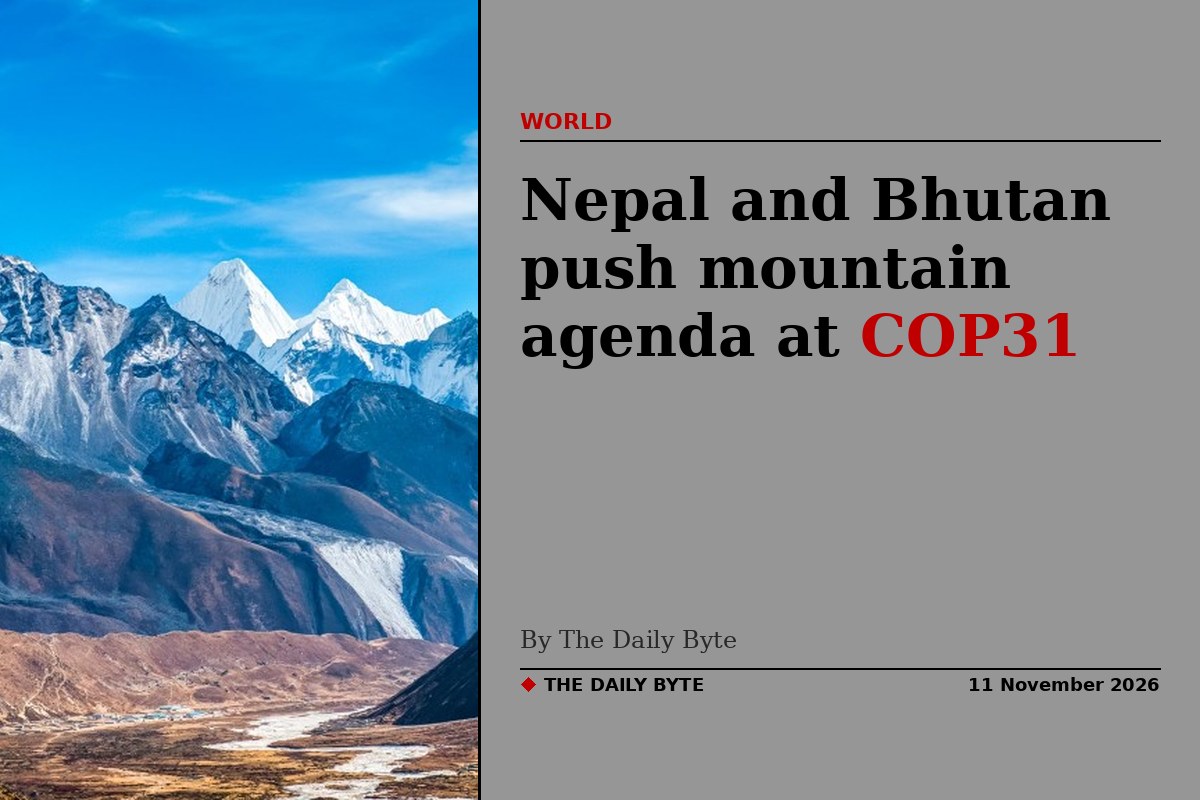
Nepal and Bhutan have jointly asked the COP31 climate summit to give mountains a permanent place on the formal agenda of the United Nations climate talks, warning that Himalayan communities are already paying the price of a warming world.
The two Himalayan nations submitted a joint proposal for a new agenda item entitled “1.5°C Warming in Mountains” to the COP31 presidency and the head of the UN climate secretariat, the UNFCCC. The submission, dated 28 October 2026, was made by Nepal on behalf of both governments under Rule 12 of the conference’s draft rules of procedure, which allows parties to propose additional items for the provisional agenda.
COP31 opened on 9 November in Antalya, Türkiye, and runs until 20 November. Nepal’s delegation to the summit is led by Foreign Minister Shisir Khanal and includes Agriculture, Forests and Environment Minister Gita Chaudhary, who submitted the joint proposal.
What Nepal and Bhutan are asking for
The proposal calls for four steps. First, a dedicated scientific assessment of the risks that 1.5°C of warming, and overshooting that threshold, pose to mountain regions, including irreversible changes to glaciers, ecosystems and water systems. Second, an annual high-level dialogue on mountains and climate change. Third, a formal UNFCCC work programme on mountain ecosystems. And fourth, stronger recognition of mountain-specific needs in climate adaptation, finance and loss and damage arrangements.
The submission draws on provisions of the UN climate convention that recognise the specific needs of countries with fragile ecosystems, including mountain regions. It also points to Nepal’s Sagarmatha Sambaad global dialogue on mountains, held in May 2025, and to a mandated dialogue on mountains and climate change convened in June 2026.
The proposal has not yet been adopted. Its inclusion in the conference agenda remains subject to the formal procedures of COP31, and it is not yet clear whether the opening session will take it up.
Deadly floods sharpen the case
The push follows a season of climate-related disasters across the Himalayas. On 26 August 2026, floods swept through Nepal’s Bhotekoshi and Trishuli river systems after an avalanche temporarily dammed a river, causing widespread damage to transport links, infrastructure and cross-border trade. A rapid disaster needs assessment prepared by the Nepali government estimated the damage at about $2.7 billion, with recovery and reconstruction expected to require about $4.7 billion.
Bhutan has faced similar threats. A flash flood linked to the reported failure of the Shintaphu glacial lake damaged infrastructure at the Gasa Tshachu natural hot springs. No casualties had been reported in that incident at the time it was reported.
Nepal is also pressing for loss and damage support, accessible climate finance and climate justice at the summit. The country has argued that adaptation finance should be tripled by 2035 and has sought a faster mechanism to deliver relief and reconstruction funds after sudden disasters. Nepal, Tajikistan, Kyrgyzstan, Bhutan and Pakistan are jointly hosting a high-level COP31 event on glaciers, the cryosphere and sustainable financing.
Why mountains matter beyond the Himalayas
The two countries argue that changes to snow, glaciers and mountain ecosystems affect water security, food production, energy and livelihoods far beyond the high valleys themselves, with rivers rising in the Himalayas sustaining communities across South Asia. Their submission warns that continued warming could cause irreversible damage to fragile mountain ecosystems and to the communities that depend on them.
Whether the conference agrees to put mountains on its formal agenda will be one of the early tests of COP31. For Nepal and Bhutan, the answer will show whether the world’s climate talks are ready to treat mountain regions as a priority in their own right, rather than as a footnote to wider negotiations.


